Israel has initiated ground raids in southern Lebanon, targeting Hezbollah-linked areas near the border amid escalating violence across the region. These actions, supported by airstrikes and artillery fire, have intensified fears of a broader conflict.
According to a statement on X (former Twitter) early on Tuesday by the Israel Defense Forces (IDF), the operation, dubbed ‘Northern Arrows’, is aimed at targeting Hezbollah’s infrastructure in response to what Israel claims are threats to its northern communities.
Airstrikes and artillery fire have been supporting these raids, with some of the most heavily shelled areas located near the Lebanese towns of Marjayoun, Khiam, and Wazzani. Residents in Marjayoun reported that they were ordered to evacuate but were unable to flee due to ongoing airstrikes that blocked roads, leaving them trapped. An airstrike rendered the main road out of the town inoperable, according to Lebanon’s National News Agency.
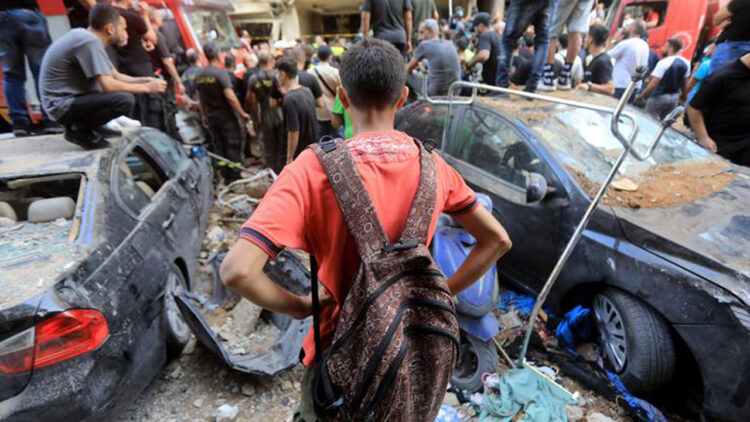
In the past 24 hours, Lebanon’s health ministry reported that Israeli airstrikes have killed at least 95 people and injured 172 in southern Lebanon, the Bekaa Valley, and Beirut. Among those affected were civilians living in heavily bombarded areas such as Ain al-Hilweh refugee camp near Sidon. The camp, Lebanon’s largest for Palestinians, had never previously been targeted since the outbreak of hostilities nearly a year ago. Initial reports suggest that Mounir Maqdah, a prominent commander of the al-Aqsa Martyrs Brigade, was injured in the camp, though Israel has not commented on the attack.
The conflict between Israel and Hezbollah has escalated significantly in recent weeks, with Lebanon suffering from repeated airstrikes and shelling that have devastated its infrastructure and left many dead or injured. Hezbollah’s deputy leader, Naim Qassem, responded to the raids by stating that resistance forces were prepared for a prolonged ground war, echoing sentiments of resilience from the 2006 conflict. Qassem said, “We know that the battle may be long. We will win as we won in the liberation of 2006.”
Meanwhile, Hezbollah confirmed that it had targeted Israeli soldiers near the Lebanese towns of Odaisseh and Kafr Kila, which border the recently declared closed military zone in northern Israel. Heavy shelling continued across this region, with Israeli forces advancing in areas that were fiercely contested during the 2006 war.
The Israeli government, led by Prime Minister Benjamin Netanyahu, approved the expansion of its military operations during a high-level cabinet meeting, indicating a continued focus on both Lebanon and Gaza. Despite calls for restraint, US Defence Secretary Lloyd Austin expressed support for Israel’s military actions, reaffirming Israel’s right to defend itself. Austin stated that Israel was justified in dismantling Hezbollah’s attack infrastructure to prevent further attacks on northern Israeli communities. “Secretary Austin reaffirmed US support for Israel’s right to defend itself against Iran, Lebanese Hezbollah, Hamas, the Houthis, and other Iran-backed terrorist organisations,” according to a Pentagon readout.
However, Austin also called for caution, urging Israel to consider diplomatic solutions in the long term. He added, “A diplomatic resolution is required to ensure that civilians can return safely to their homes on both sides of the border.” Nonetheless, he warned that the US was prepared to defend its personnel and allies in the region should Iran escalate its involvement in the conflict, stating that there would be “serious consequences for Iran” if it chose to launch a direct attack on Israel.
The United States has expressed concern that Israel’s current ground operation could result in a protracted and damaging engagement. US officials have drawn parallels to Israel’s 1982 invasion of Lebanon, which began as a limited operation but ultimately led to an 18-year occupation. Alon Pinkas, a former Israeli diplomat, warned of the dangers of the ground incursion, drawing parallels with previous military engagements that became far more protracted than initially intended.
Lebanon is also facing a rapidly worsening humanitarian crisis. The Lebanese health ministry said that more than 1,000 people have been killed and 6,000 injured in the last two weeks. Over a million people have fled their homes, including more than 300,000 children, according to UNICEF. The organisation has warned that thousands are living in desperate conditions on the streets or in shelters without basic supplies. “Humanitarian conditions are growing worse by the hour,” said UNICEF Executive Director Catherine Russell, calling for an urgent cessation of hostilities to protect civilians.
UNICEF and other humanitarian agencies have been working to provide emergency relief, including water, medical supplies, and essential provisions such as blankets and hygiene kits. However, the escalating violence continues to obstruct aid efforts, leaving many without access to critical resources.
Despite calls for de-escalation from international figures, including US President Joe Biden, Israel has declared northern towns such as Metula and Misgav Am as closed military zones, signalling further military actions in the coming days. Biden has expressed reservations about Israel’s ground operations, stating that a ceasefire should be prioritised to prevent further harm to civilians. “We should have a ceasefire now,” he urged, reinforcing the need for diplomatic efforts to end the violence.
As the situation worsens, the international community continues to voice concern over the potential for the conflict to spill over into other parts of the Middle East. Israel’s simultaneous strikes on Yemen and Syria have added to fears that the region may be on the brink of a broader war. Syria’s official news agency reported that Israel’s airstrikes on Damascus killed at least three civilians, while the country’s air defence systems attempted to intercept further attacks.
The violence and military confrontations are pushing Lebanon into deeper instability, with its economy already in a state of collapse and its infrastructure in ruins from the long-standing conflict. Humanitarian organisations are calling for immediate ceasefire to prevent further escalation and to provide critical support for the millions displaced and affected by the ongoing hostilities.