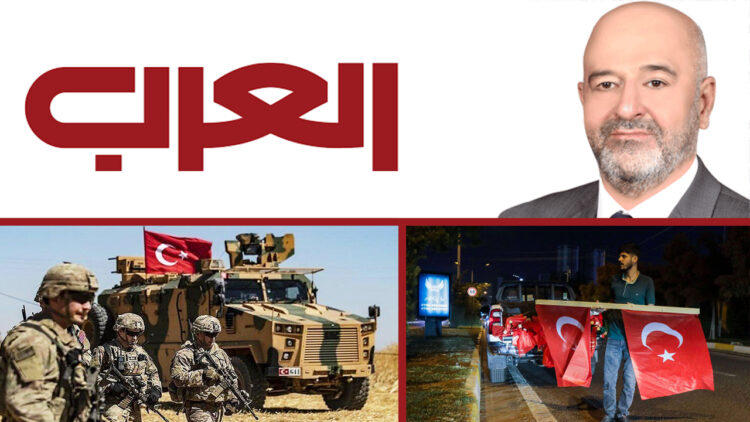
Iraqi political commentator Samir Daoud Hanoush has warned that Turkey’s ongoing military operations in northern Iraq could lead to the establishment of a “Turkish region” in the area.
In an opinion piece published in UK-based Al Arab on 23 July, Hanoush highlighted the expanding Turkish military presence along the 370-kilometre Iraqi-Turkish border. He revealed that Turkish soldiers have penetrated over 40 kilometres into Iraq, with signs reading ‘No entry to Turkish territory’ reportedly erected on Iraqi soil.
Hanoush questioned the Iraqi government’s response to the incursion, noting conflicting stances and an unclear picture. “Some claim the incursion was agreed upon with the Iraqi government, as stated by the advisor to the Iraqi Prime Minister, while others view it as Turkish occupation,” he wrote.
Current Turkish incursion is part of a broader military campaign, named ‘Claw-Lock’ and launched on 17 April 2022. Turkey asserts that the operation aims to target the Kurdistan Workers’ Party (PKK) in the Kurdistan Region of Iraq (KRI), but the operation extends into areas with no PKK presence, prompting widespread criticism and suspicion regarding Turkey’s broader objectives.
The commentator criticised the Iraqi government’s attempts to simplify and justify the Turkish invasion as a result of combating the PKK. Hanoush pointed out that despite a recent agreement for federal border guards to take over from Kurdish forces, Turkey’s military escalation has continued.
Hanoush described the current Turkish incursion as different from previous operations due to its “unlimited airstrikes” and “open-ended operations”. He warned that this could lead to the seizure of cities and potentially reach Sinjar (Şengal), homeland to Yazidi people who survived the genocidal campaign of ISIS in 2014 with the help of the very same Kurdish guerrilla forces now targeted by the Turkish military operation.
“The Turkish incursion can only be described as a covert occupation,” Hanoush stated, adding that Turkey utilises an outdated agreement from 1984 to justify its actions. This agreement, signed by then-Foreign Minister Tariq Aziz and his Turkish counterpart, allowed Turkish forces to penetrate up to five kilometres into Iraqi territory, with its validity expiring in 1985. Hanoush emphasises that no other formal agreements exist permitting Turkey to occupy Iraqi land.
The commentator also highlighted the contrast between Turkey’s actions in Iraq and its diplomatic efforts in Syria. He suggested that Turkey might have obtained American and Western approval for this invasion.
Hanoush criticised the actions of Popular Mobilisation Forces chief Faleh al-Fayyadh, who recently honoured the Turkish ambassador in Baghdad while Turkish troops violate Iraqi sovereignty. “This act appeared to be an apology for the Turkish occupation,” he wrote.
The article revealed that in July 2022, the Chief of Staff of the Iraqi army disclosed the presence of five main Turkish military bases, over four thousand Turkish soldiers and 100 Turkish outposts near Amedi (Amêdî) and Dohuk (Dihok) in Iraqi Kurdistan.
Hanoush concluded by expressing concern over the future of Iraq’s sovereignty, stating, “Iraq is enduring a dark period, likened to prey beset by neighbouring countries, and all expressions of regret are futile for a nation lost due to political folly.”