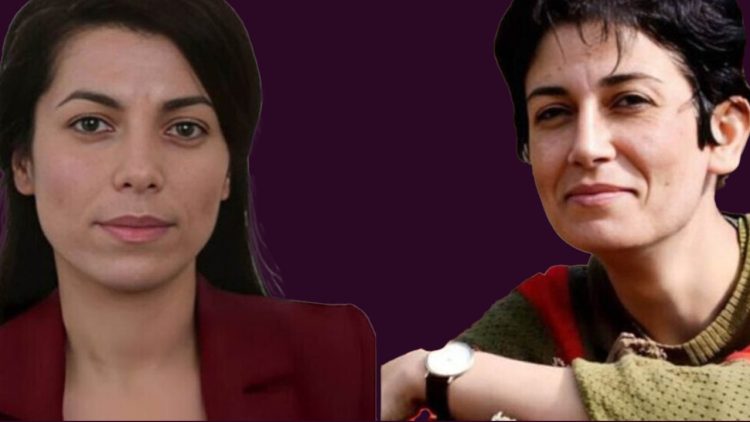
On Sunday 22 December 2024, Warisheh Moradi, a member of the Free Women’s Society of East Kurdistan (KJAR), and Pakhshan Azizi, another Kurdish socio-political woman activist, both sentenced to death on charges of “rebellion“, were allowed one-hour visits from their families in Tehran’s Evin Prison on the occasion of Iran’s Mother’s Day.
Moradi’s cousin Khaled Ali Panah was interviewed for television regarding the visit: “Nine months after Warisheh’s last meeting with her family, her relatives were finally able to see her for an hour on Sunday 22 December,” he said. He further disclosed that Warisheh has been deprived of medical treatment despite suffering from severe digestive issues.
Regarding efforts to overturn her death sentence, Ali Panah said: “Warisheh’s family remains in constant contact with both of her lawyers to seek a reconsideration of the charge of ‘rebellion’, as Warisheh has never participated in armed conflict against the Islamic Republic of Iran.” He added that her legal team has appealed to the Supreme Court of Iran to challenge the ruling.
He noted in another part of the interview that Azizi’s family had also had the opportunity to visit her.
Before her family visit, Moradi had managed to send a number of short messages out from Evin prison, in which she referred to the 35% rise in the number of executions of female prisoners in Iran. She wrote: “The Islamic Republic of Iran is retracing the path of the 1980s, continuing to kill prisoners and freedom fighters while waging wars beyond its borders. History must not be allowed to repeat itself,” adding, “I have no regrets. I will fight against all forms of oppression targeting women, from Kurdistan to Balochistan, and from Iran to Afghanistan, until the ideals of freedom are fully realised.”
Meanwhile, another female political prisoner and Nobel Peace Prize laureate Narges Mohammadi, who has been granted a 21-day temporary release from Evin Prison for medical treatment, met with the Speaker of the Norwegian Parliament Massoud Garakhani, where she highlighted the plight of the two Kurdish women. She later commented on X, formerly Twitter: “As I speak to you, cellmates, Pakhshan Azizi and Varisheh [sic] Moradi, are facing execution sentences, 5 of my cellmates are suffering from serious health conditions & many are being denied access to medical care.”
Human rights activists assert that the pressure and restrictions imposed on political prisoners are part of the strategy of the security apparatus to force them to capitulate, and that the denial of visiting rights, communication and medical care remain a tool of repression against them, despite persistent domestic and international protests.
The cases of Moradi and Azizi consistently draw widespread condemnation from human rights organisations as glaring examples of human rights violations in Iran.