

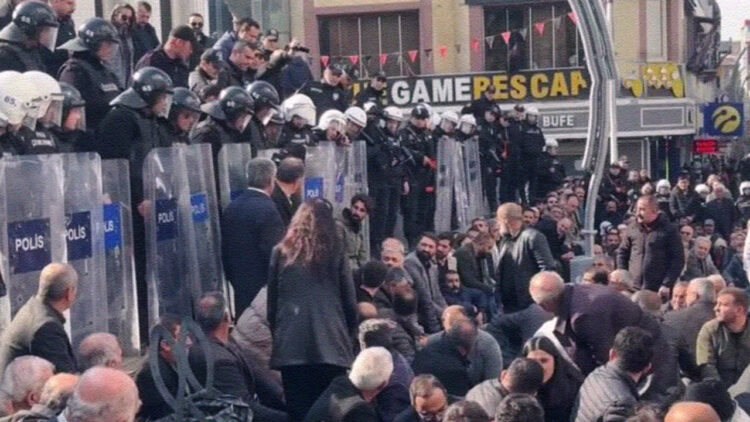
Early on Monday, the Turkish Interior Ministry appointed trustees to the municipalities of Mardin (Mêrdîn), Batman (Êlih) and Halfeti (Xelfetî), removing elected mayors from the pro-Kurdish Peoples’ Equality and Democracy (DEM) Party. The move has sparked strong criticism from the opposition, which accuses the government of undermining democratic processes in Kurdish-majority areas. International press have also covered the anti-democratic move, spotlighting perspectives from both the country’s mainstream and pro-Kurdish opposition.
Germany’s die Zeit quoted the DEM Party describing the removal of elected mayors as a ‘coup’, while also noting the government’s contention that the newspaper quoted deposed Kurdish politician Ahmet Türk, who said on X that he did not want to back down “in the fight for democracy, peace and freedom”. “We will not allow the will of the people to be abused,” he added.
Other coverage generally relied on news wires in Turkey. News agency reports carried by the global press also cited the DEM Party, who denounced the mayors’ removal as “a major attack on the Kurdish people’s right to vote and be elected”. “The government has adopted the habit of snatching what it couldn’t win through elections through using the judiciary, the police and the trustee system,” according to the statement released to press.
In their coverage, France’s Le Monde gave further background on the coup, which comes amid rapid political developments in Turkey. The ministry’s decision follows a pattern of similar trustee appointments in Kurdish-majority municipalities in recent years, a move widely condemned by the opposition. The practice of Turkey’s ruling Justice and Development Party (AKP) deposing elected Kurdish mayors has been ongoing for about a decade since the AKP suffered a loss of its majority in elections in 2015. Last week, Istanbul’s Esenyurt District Mayor Ahmet Özer was arrested and replaced with a government-appointed trustee.
Earlier this year Van (Wan) Co-Mayor Abdullah Zeydan was also temporarily deposed after a contentious ruling that had initially diverted the certificate to an opposition candidate, though widespread protests and appeals for justice led to his position being reinstated.
Despite these ongoing attacks on the democratic process in Turkey, as Le Monde notes, “President Erdogan… stated on Wednesday that he wanted to ‘reach out to the Kurdish brothers’,” following a period of resumed peace talks in which the ‘head of state and his main ally, Devlet Bahçeli, have been hinting for two weeks at the possibility of an early release of the historic leader of the PKK, Abdullah Öcalan’.
The situation in Turkey therefore remains tense, with the government imposing a ban on protests and demonstrations in an attempt to limit the reaction to the deposition of the elected mayors. With international press generally focused on the US elections and its potential implications for Israel’s US-backed wars in Gaza and Lebanon, there has not yet been a significant degree of international scrutiny on this latest twist in the complex political developments underway in Turkey.


