

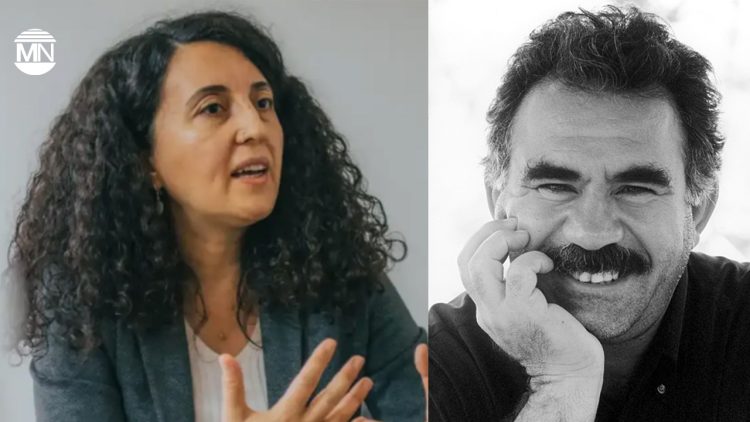
On 15 February, Kurds worldwide will mark the anniversary of what they call the “international conspiracy”—the multinational operation that led to the capture of Kurdistan Workers’ Party (PKK) leader Abdullah Öcalan in 1999. According to the Peoples’ Equality and Democracy (DEM) Party, this event was not merely an arrest but a coordinated effort by global powers to suppress the Kurdish movement.
In an interview with JinNews on 3 February, DEM Party Foreign Relations Commission spokesperson Ebru Günay said that Öcalan’s continued isolation in İmralı Prison remains a major obstacle to a democratic resolution of the Kurdish question. “Öcalan’s ideas challenge the dominant powers in the Middle East. His forced removal and ongoing isolation are part of a broader strategy to silence alternative political visions in the region,” she said.
Günay said that the plot did not end with Öcalan’s extradition to Turkey, but continues even now through the severe restrictions imposed on him: “The isolation imposed on him is an extension of the same international conspiracy. Preventing him from communicating with the outside world is a political decision aimed at blocking his influence.”
The DEM Party also criticised Western states for their role in Öcalan’s capture. Günay noted that European countries had refused to grant him asylum and closed their airspace to him despite the risk that he might be executed in Turkey at the time. “International law was violated at every step – his abduction, his extradition and his trial. The very states that claim to uphold human rights chose to ignore them in Öcalan’s case,” she said.
Günay pointed to continued resistance as a factor countering the conspiracy. “Two things have kept this struggle alive: Öcalan’s political vision and the mobilisation of the Kurdish people and their allies. The campaign for his freedom is growing, and the demand for justice is stronger than ever.”
Kurdish movements call 15 February the “Black Day” (Rojê Reş), commemorating it with protests and demonstrations calling for an end to Öcalan’s isolation and for a political solution to the Kurdish question.


