

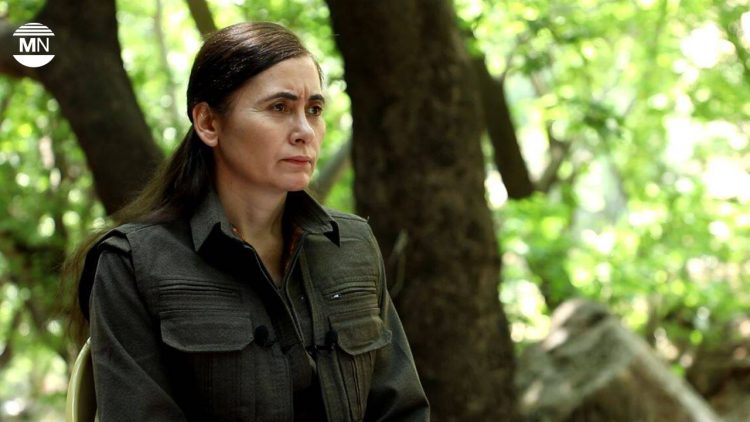
“Without transformation in the state, these decisions cannot be put into practice,” Helin Ümit of the Kurdish Freedom Movement declared in an interview with Medya Haber TV on Tuesday, following the 12th Congress of the Kurdistan Workers’ Party (PKK). Her statement comes amid what she described as a historic transition: the PKK’s formal end to its armed struggle and its shift toward democratic politics, announced after decades of guerrilla warfare.
Ümit provided the movement’s first extended public response to the decisions made at the PKK’s 12th Congress and to the earlier “Peace and Democratic Society” call issued by Abdullah Öcalan, the PKK’s imprisoned founder, on 27 February.
The PKK’s congress, she said, marks “a significant turning point for the people of Kurdistan, the peoples of the region, and the future of humanity.” Ümit emphasised that the decisions taken reflect a “strong determination for change”, not a retreat. “This is a highly significant step,” she said. “It is a move that has made the Kurdish existence visible and positioned it as a key actor.”
She warned, however, that the Turkish state has yet to take meaningful steps in response. “If no legal regulations are made, how will we progress?” she asked. “If Leader Apo [Abdullah Öcalan] remains imprisoned on İmralı, how will this be possible?”
The PKK’s decision to halt armed operations inside Turkey, Ümit explained, was not taken lightly. It followed both internal debate and what she described as a serious consideration of comments by the Turkey’s far-right Nationalist Movement Party (MHP) leader Devlet Bahçeli. In October, Bahçeli surprised observers by publicly calling for Kurdish-Turkish peace and proposing that Öcalan should be allowed to speak in parliament and benefit from the “right to hope”, a legal term referring to the possibility of eventual release.
“We took these words seriously,” Ümit said. “Even though Bahçeli is historically one of our most hard-line opponents, this was seen as a rupture in Turkey’s political history.” Yet she added that the call remained unanswered by the government: “There is still no progress regarding the right to hope.”
Ümit criticised what she called the “profiteering class” that benefits from continued conflict. “From media figures to arms manufacturers like Bayraktar, there is a segment that does not want the war to end,” she said. She identified elements within the ruling Justice and Development Party (AKP) as obstructing the formation of a parliamentary commission that most opposition parties have already supported.
“If there is no transformation on the state’s side, it is impossible to implement these decisions,” she said. “Even if we say, ‘We will engage in democratic politics,’ how will we do so if no space is opened?”
Ümit also expressed concern over the political targeting of the opposition Republican People’s Party (CHP), suggesting that recent judicial operations may be aimed at neutralising potential voices for change. “We are questioning this: is the process being sabotaged or brought under control?” she asked.
She was equally clear in distancing the Kurdish Freedom Movement from any alleged political deals with the AKP: “There is no such situation. Our stance is clear: whoever genuinely fights for democratisation, we will stand behind them.”
Ümit called for a democratic constitution grounded in social consensus. “Most constitutions in Turkey have been top-down products of military coups,” she said. “The next one must be built from the ground up.”
A central element of that change, she argued, must be a reckoning with history. “Those who cannot look at the past together cannot look to the future together,” she said, calling for a truth-seeking commission to address historical injustices against the Kurds, including the denial of their constitutional identity.
Turning to the issue of disarmament, Ümit stressed that unilateral calls for the PKK to lay down arms without political guarantees would amount to a demand for surrender. “To impose ‘disarm, surrender, go to prison’ without discussion and without establishing conditions implies guilt,” she said. “But we are not guilty. We are members of a movement that has waged one of the most just struggles in history.”
She recounted her conversations with young female guerrillas, one of whom told her: “Our leader’s physical freedom must be realised. Our leader must lead this process.”
The PKK’s 12th Congress declared an end to its armed struggle in Turkey, but Ümit claimed that Turkish military operations had continued regardless, particularly in northern Iraq’s PKK-held zones. “There is a Turkish army that insists on war,” she said. “The army does not act independently—it reflects the stance of the political authority.”
Criticising the current media climate, Ümit said the press must change its language if a democratic Turkey is to emerge. “The use of the term ‘terrorism’ and the extreme language used to refer to Leader Apo are absolutely unacceptable to us,” she said.
Concluding with a reference to Öcalan, she noted, “We are just getting started… The intellectual universe and freedom system developed by Leader Apo is only now beginning its journey.”


