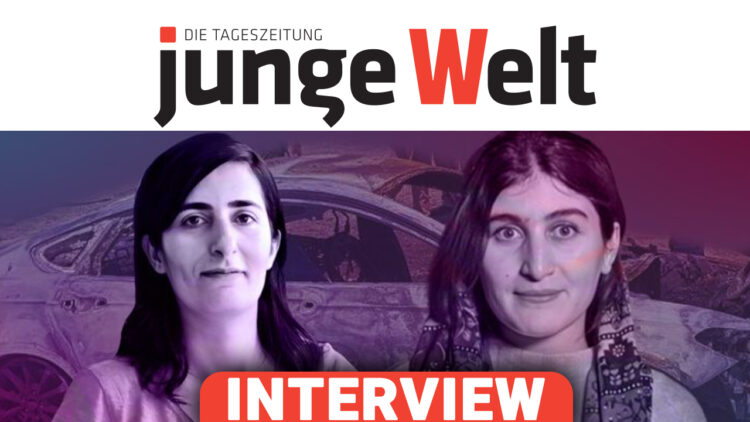
Kemal Heme Reza, General Director of the Chatr Multimedia Production Company, for which Gulîstan Tara and Hêro Bahadîn were working when they were killed in a Turkish drone attack, explains the dangers journalists face in the Kurdistan Region of Iraq (KRI) in an interview conducted by Tim Krüger for the daily newspaper junge Welt.
Read the fully translated interview below, lightly edited for clarity:
Tim Krüger: On 23 August, a combat drone, presumably Turkish, fired on a vehicle carrying a team from your company near the town of Sulaymaniyah (Silêmanî) in northern Iraq. Can you tell us exactly what happened?
Kemal Heme Reza: The airstrike happened on Friday morning, a little after 10am, when our journalists were travelling in the Shahrizor (Şehrizor) region. They were on their way to the Hawraman (Hewreman) region to shoot a documentary. Before they could reach their destination, their car was attacked by missile from a Turkish drone. Three of our journalists were in the car at the time. Our colleague Rêbin Bekir was driving. He was very lucky and was thrown out of the vehicle by the blast wave. He escaped with broken bones and is still in hospital. Fortunately, his situation is stable. But our other two journalists Gulîstan Tara and Hêro Bahadîn were killed. Gulîstan Tara came from the city of Batman (Êlîh) in the Kurdistan region of Turkey. She was 40 years old and had worked for Kurdish media for almost 25 years. Gulîstan was a very good, professional journalist and had been with our company for four years. Hêro Bahadîn was born in Sulaymaniyah (Silêmanî) in 1992 and had been working for us as a journalist for seven years. After the explosion, the car went up in flames and was completely burnt out. Both their bodies were also burnt to the bone. When Hêro’s father was at the hospital to identify his daughter, he called me and asked: “Mr Kemal, tell me which one of them is my daughter.” He couldn’t recognise her because there’s nothing left, just bones. It’s really hard to bear.
TK: Just a few days before the attack, Reporters Without Borders had published an alarming report on the attacks on media professionals and also referred to the journalist Murad Mirza Ibrahim, who was killed by a Turkish airstrike in the Sinjar (Şengal) region in July.
KHR: Whether in Sinjar (Şengal) or Sulaymaniyah (Silêmanî), the Turkish army attacks all journalists who try to oppose their portrayal of ‘reality’. It makes no difference where you work or which part of Kurdistan you come from – if you work as a journalist for freedom, you will find yourself in their crosshairs. For Turkey, the motto still applies today: ‘Only a dead Kurd is a good Kurd.’
TK: So this is not ‘collateral damage’?
KHR: No, by no means. All journalists who expose Turkish fascism, who report on how they are burning Kurdistan and expose how they are murdering civilians, must expect to be targeted. Since its foundation in late 2009, our company Chatr Multimedia Productions, has always been at the forefront when the Turkish army attacks civilians anywhere, and reports on how they are plundering the Kurdistan Region of Iraq. I think that’s why they targeted our team.
TK: The Kurdish regional government in northern Iraq also severely restricts press freedom. Recently, a colleague from Roj-News was sentenced to over three years in prison on flimsy grounds. What is the reason for this?
KHR: The conditions for journalists here are very bad. We are not only threatened by the Turkish attacks, but the militias of the Barzani party KDP [Kurdistan Democratic Party] are also fighting the free press. There are many colleagues in prison in the areas controlled by the Barzani clan. The Barzani family maintains very close links with the Turkish intelligence service MİT, and fears journalists who shed light on their good relations with Turkey. They steal all the money and oil and are afraid that someone might draw attention to this. On paper, they are also Kurds, but the Barzanis act just like [Turkish President Recep Tayyip] Erdoğan. Good and honest journalists are in danger here in Kurdistan.