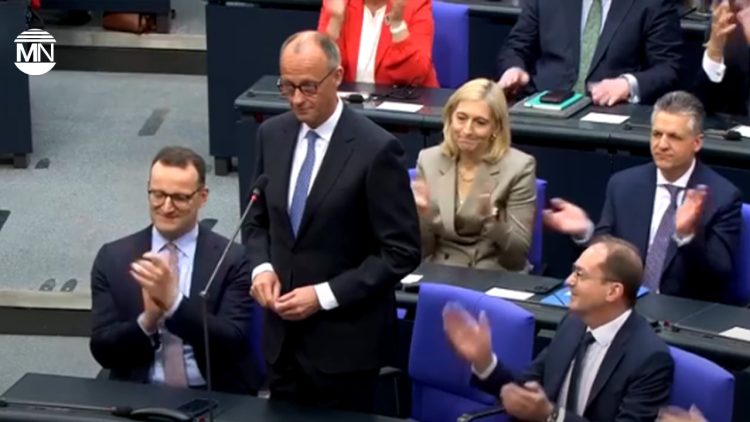
Friedrich Merz was elected Germany’s new chancellor on Tuesday in a second-round parliamentary vote, scraping a narrow majority after an embarrassing rebellion from within his coalition. The surprise revolt has cast immediate doubt over the stability of Europe’s largest economy just as it grapples with far-right advances, economic stagnation and shifting global alliances.
Merz, 69, leader of the centre-right CDU/CSU alliance, secured 325 votes – just nine above the 316 needed – after 18 lawmakers from his fragile coalition with the Social Democrats (SPD) blocked his path in an earlier secret ballot. The unexpected mutiny delayed the swearing-in process by seven hours and has raised alarm about the cohesion of the so-called “black-red” alliance.
“A visibly relieved Merz told Bundestag speaker Julia Klöckner, ‘I accept the election’, after his narrow victory was confirmed. He later presented his cabinet to President Frank-Walter Steinmeier and assumed office from outgoing chancellor Olaf Scholz.
Merz, a former corporate lawyer with no prior government leadership experience, has pledged to deliver “strong and dependable governance in times of profound upheaval.” Yet his government’s credibility is already under strain, and analysts warn the fractured start may haunt every major legislative vote.
His coalition barely holds a majority in the Bundestag, while the far-right Alternative für Deutschland (AfD) – now the largest opposition bloc – has surged in popularity by capitalising on public frustration over migration and economic stagnation. The AfD came second in February’s snap election and may benefit further if the new coalition falters.
The internal rebellion appeared linked to Merz’s controversial move to reform Germany’s strict fiscal rules to release major spending on infrastructure and defence. Although the policy was meant to signal German resolve amid rising global tensions and waning US support for NATO, it alarmed fiscal conservatives in his own party.
The Ukrainian president, Volodymyr Zelenskyy, congratulated Merz and urged stronger German leadership in Europe and the transatlantic alliance.
In his first week, Merz will visit Paris, Warsaw, and Brussels, reaffirming Germany’s EU and NATO commitments. He is also expected to lead commemorations on Thursday marking the 80th anniversary of the end of World War II in Europe.
Despite winning the February election, Merz remains deeply unpopular. A recent ZDF poll showed only 38% of Germans support him as chancellor, with 56% saying he is the wrong choice. His SPD partners are even more sceptical – 62% of SPD voters oppose his leadership.
Political observers warn that unless Merz quickly asserts control, internal mistrust could paralyse his government and embolden the AfD, which Germany’s intelligence agency has labelled a confirmed far-right extremist party.
Angela Merkel, Merz’s long-time rival and predecessor, watched Tuesday’s tense proceedings from the Bundestag’s VIP gallery. Merz, who shifted the CDU to the right since 2022, must now govern from a position of weakness and navigate Germany through what many see as its most fragile political moment in decades.