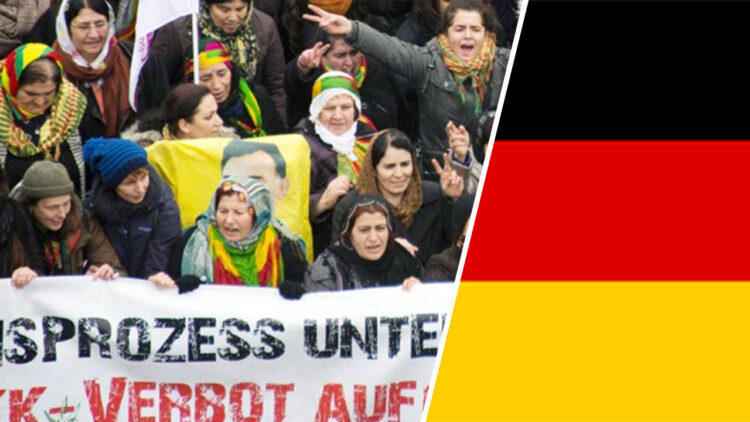
Germany has intensified its crackdown on Kurdish activists under anti-terror laws, with nearly 70 individuals facing trial for alleged links to the Kurdistan Workers’ Party (PKK) since 2011, according to the AZADÎ Law Office.
The surge in prosecutions follows Germany’s adoption of Section 129b of its anti-terror legislation, originally enacted to combat international terrorism. However, critics argue that the law is disproportionately used against Kurdish activists, drawing comparisons to Turkey’s repressive policies.
Speaking to Özgür Politika on Friday, AZADÎ lawyer Arno-Jermaine Laffin highlighted the growing role Germany plays in targeting Kurdish opposition figures across Europe. “Most European countries are reluctant to prosecute Kurdish activists, but Germany has taken on the task of persecuting Kurdish dissent, effectively inheriting this role from Turkey,” Laffin stated. He added that since Federal Prosecutor Peter Frank met with Turkish President Recep Tayyip Erdoğan in 2022, the pressure on Kurdish activists has escalated. “This meeting marked a turning point, leading to a spike in arrests and extraditions,” Laffin explained.
The legal basis for these prosecutions, Section 129b, allows Germany to prosecute individuals for alleged membership in foreign terrorist organisations, even if their activities occurred outside Germany. Although originally intended to combat Islamist terrorism, the law has increasingly been applied to Kurdish political activists. In 2010, the Federal Court of Justice ruled that the law could be used in cases involving the PKK, leading to a wave of investigations and arrests of Kurdish activists.
Laffin warned that Germany’s approach is “Europeanising repression” against the Kurdish movement, as other European countries have extradited Kurdish activists at Germany’s request. In one recent case, Mehmet Ali Yılmaz, who held Swiss residency, was arrested in Spain and extradited to Germany. “The fact that activists are being arrested in one European country and sent to Germany for prosecution is deeply concerning,” Laffin noted.
Berlin prepares for a massive rally on 27 November against ban on the PKK
Yener Sözen, a lawyer representing several Kurdish activists, criticised Germany’s actions, stating that “Germany has adopted one of the harshest policies against Kurdish and Turkish political figures, second only to Turkey itself.” He emphasised that Germany is attempting to export this repressive approach to other European Union countries, pressuring them to adopt similar policies against political dissent. “Germany is essentially sending the message, ‘We’re doing it, so can you,’” Sözen said.
Sözen further explained how extradition requests from Germany have resulted in politically motivated decisions by European courts. He referenced the case of Serdar Karakoç, a journalist who had lived in the Netherlands for 24 years. Despite the Dutch prosecutor acknowledging that Karakoç’s activities did not violate Dutch law, he was extradited to Germany in 2023 under Section 129b. “This sets a dangerous precedent where actions that are legal in one country are criminalised in another through political pressure,” Sözen remarked.
Massive demonstration in Berlin challenges Germany’s ban on PKK activities
As Germany continues to extend its crackdown on Kurdish activists, concerns are mounting about the broader implications for political freedoms in Europe. “The international community needs to pay attention,” Sözen urged, calling for greater efforts to create public awareness and challenge Germany’s political influence on extradition policies across the EU.
The growing trend of extraditions and trials of Kurdish activists has drawn widespread criticism, particularly as Germany’s actions increasingly resemble the harsh policies employed by Turkey. “We are seeing an alarming shift in how Europe handles political dissidents, and Germany is at the forefront of this troubling development,” Sözen concluded.