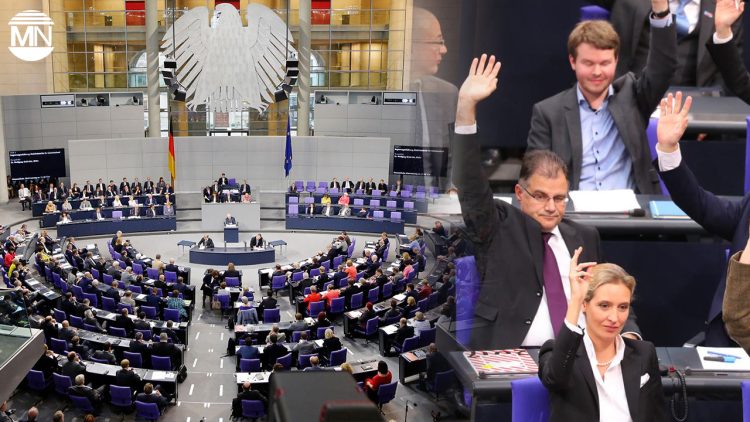
On Wednesday evening, the conservative German Christian Democrats (CDU/CSU) secured parliamentary approval for a non-binding proposal on migration, with votes from the liberal Free Democrats Party (FDP) and independent MPs also helping its passage. The measure passed by a narrow margin – 348 to 344 – despite an outcry from the Social Democratic Party (SPD) and the Greens, who shouted “shame on you” at CDU/CSU leader Friedrich Merz.
This result signals the collapse of Germany’s long-standing political ‘firewall’ against the far right. Traditionally, mainstream parties have avoided working with the Alternative for Germany (AfD), an approach designed to keep extremist influence at bay. The proposal in question calls for tighter border controls and urges authorities to turn away all asylum seekers at Germany’s borders. Critics say such a policy would violate international legal obligations.
Merz, who recently declared that the CDU/CSU would press ahead with its proposals “regardless of who votes for them”, has insisted that he is not actively seeking support from the AfD. Nevertheless, he has argued that recent crimes allegedly involving asylum seekers highlight the urgency of tightening Germany’s migration policies. While most of the focus has been on the CDU/CSU’s ‘five-point plan’ and ’27-point plan’, a separate ‘Immigration Limitation Act’ is due to be voted on in the coming days – raising the possibility of further cooperation across the right-wing divide.
The vote has sparked heated exchanges in the Bundestag, with SPD parliamentary leader Rolf Mützenich accusing the CDU/CSU of abandoning the political centre, and Greens co-leader Britta Haßelmann warning of a dangerous precedent. The AfD, on the other hand, called the result a “historic moment”.
Observers note that the impact could go beyond the parliamentary vote. Recent opinion polls have shown growing support for the AfD, potentially changing Germany’s political landscape. While immediate cooperation between the CDU/CSU and AfD remains unlikely, the result demonstrates an emerging bloc capable of putting pressure on Germany’s minority government. Analysts warn that this realignment could herald a deeper shift to the right, especially as debates over asylum policy continue to dominate public discourse.