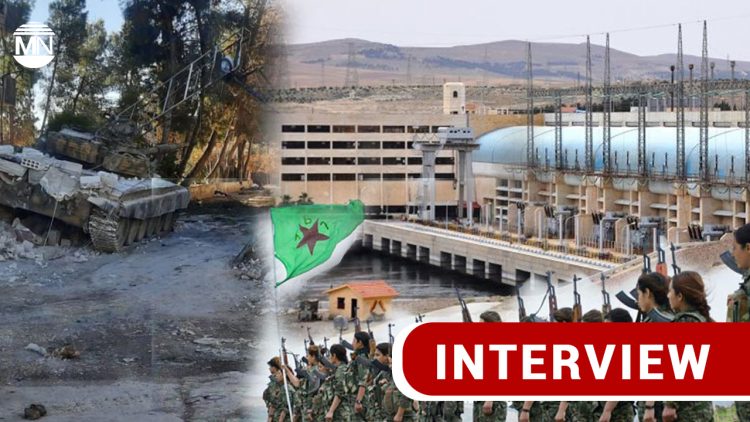
In this interview, first published in the German newspaper Junge Welt, journalist Tim Krüger speaks with German climate and human rights activist Lea Bunse. She was injured in a Turkish drone attack while taking part in a peace vigil at Tishreen Dam in northern Syria. Bunse offers insight into why she travelled to the region, the impact of these attacks on local communities, and the broader political context surrounding the conflict. Her testimony highlights ongoing calls for international solidarity, as well as appeals for recognition of the region’s autonomous administration.
You were injured during a peace vigil at the Tishreen Dam in northern Syria. What happened exactly?
I was injured in a Turkish drone attack on 21 January during the vigil at the Tishreen Dam. Shortly before, a theatre group from Qamishli had just performed, including the actor Bave Teyar. He later died [on 18 January] from shrapnel wounds. After the performance we were dancing when suddenly the bombing began. Two people were killed and more than 70 injured, including journalists. In the days before this attack, Turkish drone strikes on the Tishreen Dam had killed 20 civilians and injured well over 160. I was hit by three pieces of shrapnel during the explosion. Compared to many others, I am doing well.
As a German activist, why did you decide to join the protest?
In Germany I was active in human rights and climate protection. I had heard that an autonomous administration based on women’s liberation, ecology and democracy was being built in Rojava. I wanted to see it with my own eyes, so I came to northeastern Syria. When Turkey began to expand its attacks on the areas governed by the Autonomous Administration of North and East Syria, at the same time as the fall of Assad was unfolding elsewhere, the people here organised resistance in many places. The peace vigils at the Tishreen Dam are part of this resistance. Like thousands of others, I took part. I went with one of the civilian convoys made up of local women who were determined to prevent the dam from being destroyed and the land from being flooded and occupied.
What is the military objective of Turkey and its allied militias?
The dam on the Euphrates is of strategic importance. On the one hand, it is the main source of energy in northern Syria and is vital for agriculture and water supply. On the other hand, both the Tishreen Dam and the M4 bridge near the village of Qara Quzak (Qere Qozaq) are critical links between the areas west and east of the Euphrates. Turkey’s heavy bombardment, which began on 8 December, is aimed at completely encircling Kobani and cutting it off from all supplies. President Erdoğan plans to illegally occupy more territory and dismantle the autonomous administration. He wants to establish a neo-Ottoman Empire based on political Islam. To this end, he is using jihadist mercenary groups openly allied to the Islamic State. This war is being waged against the principles of democracy, women’s liberation and the “democratic nation” model developed by Abdullah Öcalan and put into practice here. Erdoğan launched this offensive to prevent this model from taking root elsewhere.
Will the protests continue despite these losses?
The people are determined to defend their freedom and their country. As in the past, international solidarity is crucial. Even while I am in hospital, the peace vigil continues. The next convoy has arrived and more are planned. As long as Turkey continues its attacks, the resistance here will continue. The international community and German politicians have a responsibility to recognise the Autonomous Administration and end Turkey’s war of aggression. Germany has a central role because it supplies arms to Turkey. The media must report on these developments because we are witnessing an illegal war of occupation. Turkey must be called to account.
Lea Bunse is a climate and human rights activist from Germany, currently in northern Syria.