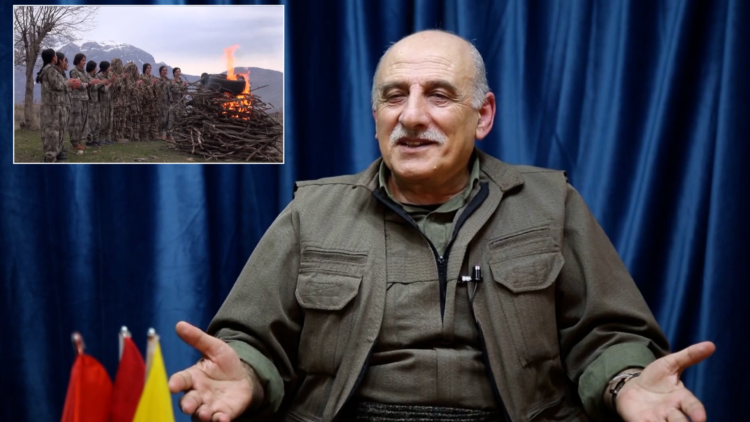
“The Kurdish struggle takes its power from the people, the women, the youth, and the workers,” said Duran Kalkan, a senior executive member of the Kurdistan Workers’ Party (PKK). In an interview coinciding with the PKK’s 46th anniversary, he discussed the resilience of the decades-long struggle, its transformation into a women-led movement, and its evolving vision under Abdullah Öcalan’s leadership.
Tracing the PKK’s origins to the 1970s, Kalkan highlighted the radical conditions in which it emerged. “The PKK was born at a point of the most revolutionary, radical, and libertarian thought,” he said. Öcalan’s identification of Kurdistan as a “colony” challenged hegemonic systems beyond Turkey and rejected nation-state solutions. Instead, the PKK became a democratic socialist party, advocating for social ecology and women’s liberation.
Kalkan credited the PKK with ensuring the survival of Kurdish identity. “Without Öcalan and the PKK, Kurdishness, as one of the most ancient societies still in existence, would have disappeared,” he asserted. He pointed to Rojava, the Kurdish-led region in northern Syria, as an example of democratic confederalism and a women’s revolution that showcases a new way of life.
“Democratic confederalism can put an end to the contradictions of the Middle East,” Kalkan said, arguing that mutual respect for identities underpins freedom for all. He emphasised the movement’s commitment to addressing the roots of sectarian and ethnic conflict through democracy.
The Kurdish struggle, Kalkan noted, is deeply rooted in women’s resistance. “Kurdish women, with roots going back thousands of years, have resisted male domination and the statist mentality,” he explained. Inspired by Kurdish women, Öcalan developed the slogan “Jin, Jiyan, Azadî” (Woman, Life, Freedom), which Kalkan called “the basis of social freedom”.
Kalkan condemned patriarchal systems for viewing women as a threat. “Women are seen as the most dangerous by the power and state system and are therefore attacked, oppressed, and arrested,” he said. He criticised narrow definitions of violence against women, arguing that invisible male-dominated violence is often overlooked.
Discussing the PKK’s adaptability, Kalkan said, “The PKK is not an ordinary movement. It is a movement that analyses, evaluates, and envisions a new life.” He highlighted Öcalan’s fearless approach to change, stating, “Anything that cannot change itself and that repeats the old cannot succeed.”
Reflecting on the PKK’s 46-year history, Kalkan described the source of its enduring strength: “The PKK takes all its power from the people, especially women, young people, and workers. This is the secret of its resilience and transformation.”