

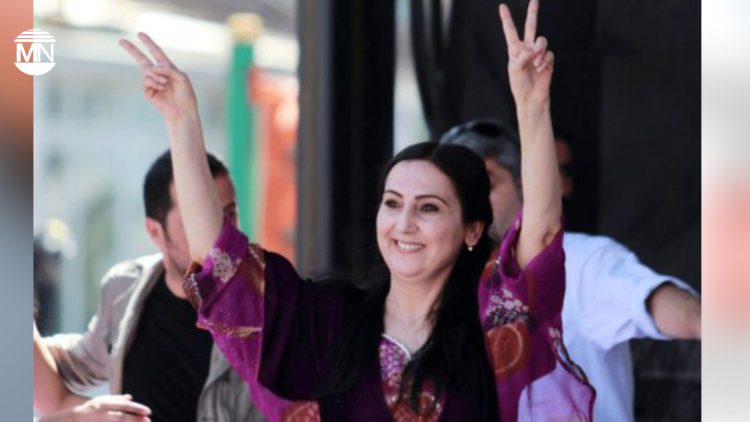
Figen Yüksekdağ, former co-chair of the pro-Kurdish Peoples’ Democratic Party (HDP), has stated that a lasting peace in Turkey can only be realised through society’s determined struggle. Speaking from Kandıra Prison in north-west Turkey, Yüksekdağ offered a comprehensive political analysis of recent developments following a major shift within the Kurdish movement.
On 1 March, the Kurdistan Workers’ Party (PKK) announced a ceasefire and formally declared the end of its armed struggle at its 12th congress from 5-7 May. This came shortly after Abdullah Öcalan, the PKK’s imprisoned founder and ideological figurehead, issued a public call for “Peace and a Democratic Society” on 27 February. These coordinated announcements have opened what many regard as a new chapter in Turkey’s long-running Kurdish question, turning attention toward the government’s response.
“The PKK congress was a long-anticipated political development,” Yüksekdağ told journalist Rozerin Gültekin of the women’s news outlet JinNews. “It formalised the spirit of Öcalan’s call and reflected the accumulated history, sacrifices and democratic experiences of the Kurdish Freedom Movement.”
But Yüksekdağ was quick to stress that these developments alone are not sufficient. “What matters now is how this political space is used — how we confront the nationalism and war economy that dominate society,” she said. “The truly difficult task begins now: to guide this process together with the people — with women, youth, workers, the poor and the rural communities.”
The former HDP leader, who has been imprisoned since 2016 on charges widely criticised as politically motivated, argued that the path to peace requires a broad societal effort. “It is not possible to reach a real solution without the determined will of the people,” she said. “This is not something that can be left to the discretion of the powerful. Peace must be fought for from below.”
Yüksekdağ pointed to what she described as a deep political and democratic crisis in Turkey, noting that the country has never been able to radically reinvent itself in over a century of republican rule. She argued that the new moment could be a turning point if social movements and political actors are able to seize the initiative.
Referencing the last line of the PKK’s formal declaration — a quote from revolutionary figure Deniz Gezmiş — she underscored the enduring vision of solidarity between Kurds and Turks: “Long live the brotherhood of the Kurdish and Turkish peoples. Long live a fully independent Turkey.” She described this as a symbolic bridge linking past revolutionary movements to today’s calls for democracy.
Regarding the situation of political prisoners, Yüksekdağ criticised the Turkish government’s inaction. “You cannot solve any political problem while holding nearly 10,000 political prisoners and half a million inmates in your prisons,” she said. She called for urgent reforms, including the release of elderly and ill detainees, the right to parole, and the abolition of politically discriminatory legal practices.
On the role of women in this potential new phase, Yüksekdağ underlined the centrality of the women’s freedom struggle. “Women have been the greatest victims of war and violence, and they must now be at the forefront of the peace process,” she said. “From the Rojava women’s revolution to the protests following the death of Jina Mahsa Amini in Iran, women have shown that they are the organisers of freedom.”


