

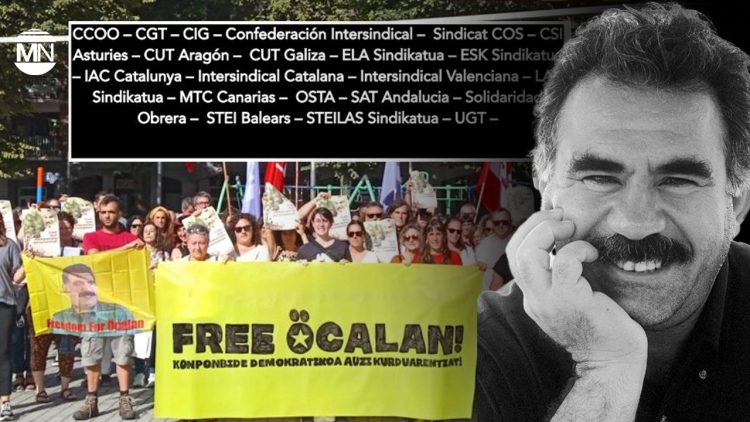
On the 26th anniversary of Abdullah Öcalan’s capture, 21 trade unions from Spain, France, Germany, Italy, the Basque Country, Catalonia, Galicia, and other European regions have reiterated their demand for his release, framing his continued imprisonment as a barrier to peace and democratic transformation in Turkey and beyond.
Öcalan, the historic leader of the Kurdish movement, has been held in solitary confinement on the prison island of İmralı since 1999. His prolonged isolation has drawn widespread condemnation from human rights organisations, which argue that his treatment violates both international human rights law and Turkey’s own legal framework.
The conflict between the Turkish state and the Kurdistan Workers’ Party (PKK) has persisted for decades, and Öcalan has consistently positioned himself as a key figure in efforts to broker peace. He has proposed a democratic and pluralistic solution that recognises Kurdish rights within Turkey’s constitutional framework. However, peace negotiations were abandoned in 2015, and since then, restrictions on Öcalan’s access to legal counsel and communication with the outside world have tightened significantly.
In a rare breakthrough, a Peoples’ Equality and Democracy (DEM) Party delegation including MPs Sırrı Süreyya Önder and Pervin Buldan met with Öcalan on 28 December 2024 and 22 January 2025—the first full meetings in nine years. This followed a family visit in October by his nephew Ömer Öcalan. The visit raised hopes of rekindling dialogue, but campaigners warn that any new peace process cannot be fair or transparent if one party remains in prison, without the ability to communicate freely with his movement or the Kurdish people.
Supporters argue that Öcalan’s philosophy of Democratic Confederalism, which promotes gender equality, direct democracy, and ecological sustainability, has been a catalyst for social transformation across Kurdish regions. This model has influenced movements in Rojava (North and East Syria) and beyond, offering an alternative to the centralised nation-state paradigm.
Among the 21 trade unions calling for Öcalan’s release are: ELA Sindikatua (Basque Country), LAB Sindikatua (Basque Country), UGT (Spain), CGT (France), IAC Catalunya (Catalonia), Intersindical Catalana (Catalonia), CUT Galiza (Galicia), Solidaridad Obrera (Spain), SAT Andalucía (Andalusia), and CIG (Galicia).
These unions argue that Öcalan’s continued imprisonment is not just an issue for the Kurdish people but a wider test of democratic accountability in Turkey and international human rights standards.
“The international community cannot look the other way,” the unions declared, calling for political mechanisms to facilitate dialogue.
“Peace in Kurdistan is beneficial for all, and although peace always has powerful enemies, we must convince all sides that it is a win-win scenario.”
Öcalan’s supporters maintain that his release is not only about justice for an imprisoned leader but a necessary step towards breaking the cycle of repression and conflict.
There has been no response from the Turkish government regarding the latest calls for Öcalan’s freedom.


