Jürgen Klute
The European Parliament (EP) is making clear demands on the Council of the EU regarding a reform of EU refugee policy. The rescue of refugees at sea should be made a core task of border surveillance. Binding rules for sea rescue should be included in the new regulation for joint Frontex operations at sea. All European and national laws that criminalise the rescue of refugees in distress at sea should be reformed. Furthermore, procedures for a fair and proportional distribution of refugees among all EU member states were called for in order to relieve the burden on southern European states. Refugees should no longer be sent back to the countries that took them in if the asylum system in those countries is overburdened. Furthermore, the EP called for fair access to the European asylum system and the development of legal access options in the context of labour migration.
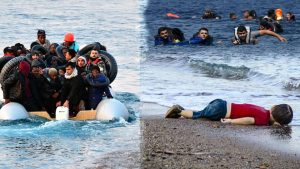
Anyone who has followed the migration policy debates at the EU level in 2024 may well have rubbed their eyes in disbelief at these demands and wondered if they had slept through something. The introductory sentences do indeed describe the demands of the EP – but not from 2024, in fact from a resolution adopted by a large majority of the EP on 23 October 2013– three weeks after the sinking of a refugee boat off the Italian Mediterranean island of Lampedusa, in which 360 people lost their lives.
One year later, on 2 October 2014, one day before the first anniversary of the refugee tragedy off Lampedusa, Cecilia Malmström, then EU Commissioner for Home Affairs, published a statement in which she declared:
‘The images of Lampedusa are still in my mind. They are a terrible reminder that we must strive to ensure that Europe remains open to those seeking protection […] I want to be very clear – when it comes to the admission of refugees, solidarity between EU member states is still largely non-existent. This is probably the biggest challenge for the future.’
At the beginning of 2025, it must be said that the EU has not risen to the challenge Malmström outlined – neither in terms of solidarity among EU member states nor in terms of refugees.
Eleven years after the refugee tragedy off the coast of Lampedusa, thousands of migrants are still losing their lives in the Mediterranean. The EU accepts illegal pushbacks. It finances North African states to prevent migrants from crossing to Europe, thereby tolerating massive human rights violations. Detention centres for asylum seekers are also to be set up outside the EU – the aim is to prevent asylum seekers from entering EU territory if at all possible.
The German government, under the leadership of the SPD (Social Democratic Party of Germany), is at the forefront of this: it supports a tightening of EU migration policy and is unlawfully introducing border controls to prevent migrants from entering the country, thus implementing AfD (Alternative for Germany) demands – despite massive protest from Luxembourg.
Instead of defending the rule of law and human rights, as they are sworn to do by their oath of office, governments are dividing societies by playing different social groups off against each other, instead of de-escalating and resolving conflicts, as the Dutch writer Ilja Leonard Pfeijffer recently and accurately analysed in his essay ‘This is how it goes when the far right take over a country’s government’. Only Spain is currently making an exception and is returning to the model of circular migration to a limited extent with regard to labour migration – a sensible solution in view of labour migration.
How did this development come about?
The European Union is a mirror of its member states. With some delay, the shift to the right in the member states also arrives in Brussels and Strasbourg. The number of right-wing extremist governments in the Council of the EU has increased – they nominate the EU Commission candidates, who are then elected by the EP.
Since the European elections in June 2024, there are significantly more right-wing extremist MEPs in the EP than ever before. German MEPs are being pushed by their parties and government members to vote in favour of a more isolationist EU in the hope of winning votes from the AfD, although there is sufficient scientific evidence that this strategy strengthens right-wing parties.
Only when the societal left in the member states once again succeeds in making democracy, human rights and the rule of law the self-evident and unquestioned foundations of peaceful societal coexistence and a dignified life for everyone, will EU migration policy once again develop in the direction called for by the EP 11 years ago.
Jürgen Klute is a former Die Linke (The Left) MEP and spokesman for the Kurdish Friendship Group in the European Parliament from 2009 to 2014. He is editor of Europa.blog and a columnist for Medya News.