

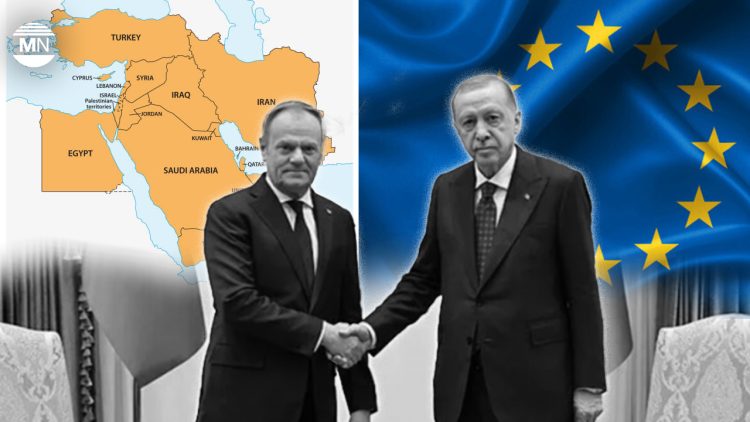
Turkish President Recep Tayyip Erdoğan’s recent diplomatic statements display a significant shift in Turkish foreign policy rhetoric. This shift can be seen in Erdoğan’s recent diplomatic discussions, and new initiatives to renew Turkey’s EU accession—a process stalled for seven years due to concerns over Turkey’s democratic regression. Erdoğan has exhibited a discernible transformation in his political overtures, shifting from nationalist assertiveness to a more conciliatory tone, ostensibly aligning with shifting regional power structures. This pivot was most prominently reflected in his recent endorsement of the Syrian Kurdish peace agreement.
During a joint press conference with Polish Prime Minister Donald Tusk on 13 March, Erdoğan underscored Turkey’s strategic imperative of EU integration, describing full membership as a fundamental geopolitical objective. “We have consistently reaffirmed that full EU membership remains our strategic ambition,” Erdoğan asserted. “We seek to advance our partnership with the EU on the principles of mutual benefit and respect. If the EU aims to regain its geopolitical influence, this objective is only achievable through Turkey’s accession.” He further urged Poland to enhance its support for Turkey’s stalled membership bid.
Turkey’s EU accession process formally began in 1987 with its application for membership and was officially granted candidate status in 1999. Negotiations commenced in 2005; however, progress stalled due to concerns over human rights, rule of law, and democratic governance. The process effectively froze in 2018 when the European Council concluded that Turkey’s regression in democratic standards precluded further negotiations. Erdoğan’s renewed push for membership raises questions regarding the EU’s potential response, particularly given the European Commission’s previous stance that substantive democratic reforms would be required before any resumption of accession talks. The European Commission has yet to issue an official response to Erdoğan’s statement. However, given the EU’s prior stance that meaningful democratic reforms must precede any further negotiations, the bloc is expected to assess Turkey’s domestic policy trajectory before considering a formal re-engagement in the accession process.
This diplomatic outreach coincides with Erdoğan’s recalibrated approach to Syria. Just a day prior, he publicly endorsed the agreement between the Syrian Democratic Council and the Syrian interim authorities, signalling a pragmatic shift in Ankara’s approach to the Kurdish question in Syria. This endorsement contrasts sharply with his administration’s prior hardline stance against Kurdish governance structures and armed factions.
Erdoğan’s endorsement of the Syrian peace agreement followed an initial period of conspicuous silence from Ankara—an anomaly given Turkey’s historical role as a primary stakeholder in Syria. In contrast, the United Nations, the United States, France, Germany, the Gulf states, and the Kurdistan Regional Government (KRG) in Iraq swiftly endorsed the 10 March agreement, signed by Syrian interim President Ahmed al-Sharaa (al-Julani) and Syrian Democratic Forces (SDF) Commander Mazloum Abdi. The agreement is widely viewed as a watershed moment in the political normalisation of Syria.
In his eventual response, Erdoğan framed the agreement as a stabilising measure while preserving Ankara’s established counterterrorism discourse. he stated in Ankara:
“The implementation of yesterday’s memorandum will serve Syria’s security and stability. The ultimate beneficiaries will be our Syrian brothers and sisters. Every effort to eradicate terrorism in Syria is a step in the right direction”.
Nevertheless, Turkey’s continued military interventions in northern Syria raise questions regarding its long-term policy vis-à-vis Kurdish governance structures.
Turkey’s prolonged military presence in Afrin (Efrîn), Bab, Azaz, Tell Abyad (Girê Spî), and Ras al-Ayn (Serêkaniyê) remains a contentious issue, with multiple international human rights organisations documenting widespread human rights abuses, including forced displacement, extrajudicial killings, torture, and demographic engineering. A recent People’s Tribunal on Rojava (North and East Syria) found Turkey guilty of war crimes and crimes against humanity in these territories.
Parallel to these regional developments, Erdoğan’s rhetoric aligns with an ongoing Kurdish reconciliation process. Since October 2024, indirect negotiations between Turkish state actors and imprisoned Kurdish leader Abdullah Öcalan have resumed. These dialogues culminated in Öcalan’s 27 February 2025 “Call for Peace and Democratic Society,” in which he called for the cessation of armed struggle, the dissolution of the Kurdistan Workers’ Party (PKK), and the initiation of a democratic transformation within Turkey through structured negotiations. Erdoğan’s rhetorical realignment suggests that these clandestine discussions may be shaping broader policy shifts.

In another significant development, Erdoğan signalled openness to engaging with the pro-Kurdish Peoples’ Equality and Democracy (DEM) Party’s İmralı delegation, which represents imprisoned Kurdish leader Abdullah Öcalan. Addressing journalists following his weekly parliamentary speech on 12 March, Erdoğan stated that he would grant a meeting should the delegation formally request it. Shortly thereafter, the DEM Party submitted an official request, and a meeting is anticipated in the near future.
Erdoğan’s remarks also encompassed broader regional conflicts. Addressing the ongoing war between Russia and Ukraine, he welcomed recent US-Ukrainian negotiations, particularly Ukraine’s willingness to consider a ceasefire. “We regard Ukraine’s acceptance of a ceasefire as a constructive and significant step. Now, we urge Russia to reciprocate in a similarly constructive manner,” he remarked, reaffirming Turkey’s role as a mediator.
Elaborating on Turkey’s established position, Erdoğan reiterated Ankara’s advocacy for a “fair peace” that ensures mutual security and stability. “Since the outset, our stance on this conflict has been unequivocal. We seek an end to hostilities through an equitable and just peace framework,” Erdoğan stated. He reaffirmed Turkey’s willingness to facilitate negotiations, including hosting diplomatic summits and providing infrastructural support for de-escalation mechanisms. These remarks indicate an effort to consolidate Turkey’s role as a key intermediary in post-conflict regional dynamics.
Concluding with a broader vision, Erdoğan declared:
“Our region has endured decades of war, instability, and suffering. It is time to break free from this cycle and establish a sustainable framework for peace and stability.”
His remarks reflect an attempt to reposition Turkey as a central diplomatic actor, distancing itself from past policies that exacerbated regional tensions.
Erdoğan’s rhetorical transformation signifies a marked departure from his administration’s historically assertive nationalist policies. Historically, Erdoğan has oscillated between conciliatory overtures and hardline policies, particularly concerning domestic political opposition and military operations in Syria and Iraq.
The timing of Erdoğan’s diplomatic overtures suggests a strategic response to shifting geopolitical currents. The Syrian Kurdish agreement, endorsed by multiple international stakeholders—including the United States, Germany, and the United Nations—represents a profound reconfiguration of regional power structures. Simultaneously, Turkey’s economic struggles and deepening diplomatic isolation have heightened the imperative for recalibrating its relations with the European Union.
While Erdoğan’s softened rhetoric signals the possibility of genuine diplomatic engagement, it remains unclear whether this shift constitutes a tactical manoeuvre or the inception of a sustained policy transformation in regards with Kurdish reconciliation process. The extent to which Ankara follows through on these rhetorical shifts will determine whether Turkey is truly repositioning itself as a facilitator of regional peace or merely adapting its discourse to navigate a complex and rapidly changing geopolitical landscape.


