

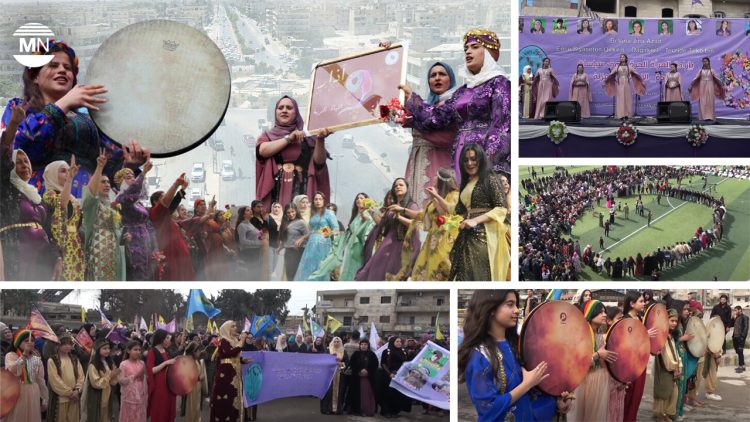
On the eve of 8 March, International Women’s Day, displaced women in northeastern Syria (Rojava) have voiced their struggle for gender equality and justice. Highlighting both their suffering and their aspirations, they called for the release of imprisoned Kurdish leader Abdullah Öcalan and the dream of returning to their homeland.
Gender equality is a necessity
Amina Hassa, displaced twice by assaults from the Turkish government and its allied mercenaries, reflected on the significance of International Women’s Day, emphasising the transformative power of gender equality:
“Women must demand their rights. Since the establishment of the Autonomous Administration of North and East Syria (AANES), the lives of women have undergone a profound transformation. This experience has awakened political consciousness and shattered old limitations. Once confined to agriculture and child-rearing, women now demonstrate their ability to excel in any field. Men, too, must adapt to this shift, recognising women as equals rather than subordinates.”
Extending her greetings on International Women’s Day, she shared her hopes:
“We yearn for the liberation of our land and cities from Turkish occupation. We dream of self-determination for the Kurdish people and victory in our struggle. A day like 8 March will only feel complete when we can return to our homes. But true fulfilment will remain elusive until Abdullah Öcalan is free.”
Her words underscore the inseparable link between women’s liberation, national freedom, and the philosophy of Jin, Jiyan, Azadî—Woman, Life, Freedom.
Emîra Micris, a displaced Arab woman, stressed that despite years of struggle, women have yet to secure their full rights:
“Gender equality is not a privilege—it is an absolute necessity. Women work harder, contribute more to society, and navigate adversity with greater resilience and intelligence. This is not a matter of choice; it is long overdue.”
In an interview with JINHA, Emîra Micris, voicing the hopes and struggles of displaced women, asserted that 8 March will only hold true meaning when the Turkish occupation ends.
“As long as women remain displaced and our leader, Abdullah Öcalan, remains imprisoned, 8 March cannot be meaningful for us,” she stated.
She further emphasised: “Our greatest hope is the release of our leader and his return to society. Our dream is a free homeland and a world free from violence—one where men and women enjoy full equality.”
The women of Manbij: from liberation to oppression
The women of Manbij (Minbîc) Canton, who lived in freedom for eight years, now find themselves once again under the rule of Islamist groups and Turkish-backed mercenaries following the events of late 2024.
Their greatest fear is the return of oppressive laws that confine them to their homes, strip them of their rights, and subject them to systemic violence.
The defeat of ISIS by the Syrian Democratic Forces (SDF) brought a fleeting spring of freedom. Under ISIS rule, women were denied even the most basic rights, including education, but after Manbij joined the AANES, they regained their agency. Now, with the Ba’ath regime’s collapse and the Turkish-backed occupation of Manbij, those hard-won freedoms have been erased.
For security reasons, many of these women choose to remain anonymous, but their message is clear:
“We are living under house arrest,” one woman says. “Life has returned to the days of ISIS.”
By contrast, in Hasakah Canton—under the governance of AANES—women will celebrate International Women’s Day in full freedom.
Across this diverse region, Syriac, Kurdish, Armenian, Arab, and Assyrian women mark 8 March as a testament to their hard-won rights. They affirm: “Women spearheaded the Rojava Revolution, shaping its path—a struggle made possible by the ideas of Abdullah Öcalan.”


