

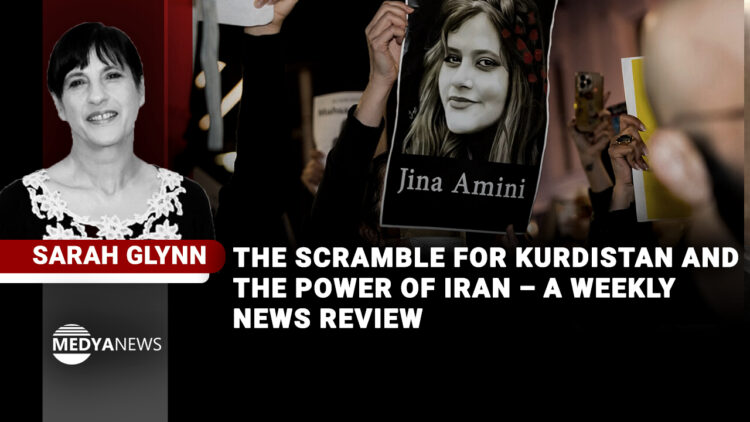
Sarah Glynn
Today is the anniversary of the death of Jina Amini, which sparked Iran’s “Jina Revolution”. Across the world, there will be colourful demonstrations in support of “Woman Life Freedom” – though the full meaning and Kurdish origins of that slogan have generally been submerged by liberal feminism and Iranian nationalism. But in the Kurdish cities of Iran, where the uprising began, the might of the Iranian army and security forces have massed to crush any resistance, and every day has seen more detentions of activists and of relations of those killed in the uprisings. In the first 12 days of September, at least 99 citizens have been identified as arrested by the Iranian government, of whom two thirds are Kurdish. Hengaw Organization for Human Rights has been publishing a seemingly endless stream of portraits of people who have been taken from their homes. A part of the population will be intimidated by this show of brute force, but others are concluding that they have nothing more to lose and that this time they will resist any state violence with widely available smuggled weapons.
There are concerns that the revolutionary movement lacks sufficient support from people living in the power centres of Iran, though here, too, places of resistance, such as Tehran’s Ekbatan district, have been recognised by the state, which has brought in extra security forces. And there has even been resistance within Shiite religious circles, with eulogists protesting the state’s violence during Muharram ceremonies. Large religious audiences have echoed lyrics such as: “the palace built on blood will eventually crumble”.
Writing this review on Friday, I don’t want to attempt to predict what might happen, and will focus instead on the situation in Iraq, but developments in both countries are closely connected.
The Kurdistan Region of Iraq in crisis
The Kurdistan Region of Iraq is “bleeding economically and haemorrhaging politically”. Not my words, but those of its Prime Minister, Masrour Barzani, in a letter to President Biden that pleads for US government intervention, which was leaked to Al-Monitor this week. Barzani describes the autonomous region as in existential crisis, raising his concerns about the collapse of “the very model of a Federal Iraq that the United States sponsored in 2003 and purported to stand by since”. Kurdistan is indeed threatened from all sides, but it is also fatally threatened from within by Barzani’s own party, which dominates the regional government. External and internal threats are intimately linked in a network of self-interested and brutal political power games.
No-one should have any illusions in America’s self-promoted image as world policeman, especially in the week when the world remembered the fiftieth anniversary of the US-supported coup against Chile’s democratically elected President Allende, and least of all in post-2003 Iraq. Unlike Chile, of course, the business-friendly Kurdistan Regional Government has been favoured by the West, which has been prepared to overlook its acknowledged corruption and growing authoritarianism, but, for now, American intervention in this part of the world has taken a back seat behind their proxy war against Russia and their obsession with China. However, the US is not the only external country seeking to gain influence over the region.
Iraqi Kurdistan is at the centre of a struggle for control between the regional powers of Turkey and Iran, with the latter also exerting influence through the Iraqi government, which has a strong pro-Iranian bias. To make matters worse, the region’s internal politics is dominated by two political parties that are run like feudal fiefdoms by two families, each with their own peshmerga forces. These two parties are so antagonistic towards each other that, in the early nineties, they took the region into a civil war, which left the Kurdistan Democratic Party (KDP) of the Barzanis in control of Erbil and the north half of the region, and the Talabanis’ Patriotic Union of Kurdistan (PUK) in control of Sulaymaniyah and the south.
The KDP has developed increasingly close links with Turkey, while the PUK has ties with Iran. The PUK is notionally to the left of the KDP, and generally more sympathetic towards the PKK, though they have also fought the PKK on occasion. The PKK, which has had bases in the region since the early eighties, has been facing major assaults by the Turkish military, which now effectively occupies parts of the northern mountains, and the KDP has been assisting Turkey in their attacks. KDP involvement in Turkey’s war against the PKK has become increasingly prominent.
For years, the KDP and PUK have operated a 50/50 power sharing system. This discouraged inter-party violence, but also consolidated patronage networks, stifling potential for the development of any sort of meaningful democracy. Recently though, aided by destructive power struggles within the PUK, support has shifted significantly towards the KDP, and they now want to end power sharing and capitalise on this. They would rather ally with Arab groups than allow the PUK to win positions, and the PUK would rather seek intervention from the federal government in Baghdad than allow the KDP to reduce the share of resources allotted to Sulaymaniyah.
The KDP has allowed the region to become dependent on Turkey economically, and this has been exacerbated by disputes between the Kurdistan Regional Government and the Iraqi Federal Government about budget allocations and control of the region’s oil. In 2014, following a cut in funding from the federal government, the Kurdistan Regional Government made a deal to sell this oil directly through Turkey on terms that were very favourable to the Turks and that also allowed leading KDP figures to amass substantial private fortunes.
The legality of this agreement was disputed by the Iraqi Federal Government, who challenged Turkey in the International Chamber of Commerce in Paris. Nine years later, last March, a decision was reached in favour of Iraq, which required that Turkey deal directly with Iraq and also pay Iraq $1.5 Billion in compensation.
There are many uncertainties about the feasibility of the new agreement between Erbil and Baghdad, but, for the moment, Turkey is refusing to comply with the ruling and will allow no oil to be exported through the pipeline without major concessions from Iraq. Billions of dollars of oil exports have been stopped. Meanwhile, budget disputes continue, with the Kurdistan Region protesting that they have not been given their promised share. As a result, public sector salaries have not been distributed for two months, and many employees, including teachers and health workers, have announced that they will not work until they are paid. A delegation from the Kurdistan Regional Government met with Iraqi leaders and political parties this week, and the Iraqi Council of Ministers is scheduled to hold a meeting on the issue on Sunday.
Intervention by Turkey
Beyond a general interest in expanding Turkish power, President Erdoğan has made clear that he wants to reverse the concessions agreed by Turkey a hundred years ago in Lausanne, and revive Turkish claims to the Kurdish areas of both Iraq and Syria. And Turkish foreign policy is predicated on the need to stifle any independent Kurdish organisation that could provide encouragement to those seeking Kurdish rights within Turkey. The PKK is the main focus of their aggression, but their apparent support for the KDP is, in reality, another attack on Kurdish freedoms. Erdoğan has made the Barzanis his vassals, and has exploited Barzani ambitions in order to take control of parts of Iraqi Kurdistan and to destroy the potential for Kurdish unity.
Despite pleas from Kurds everywhere, KDP involvement in Turkey’s attacks on the PKK’s mountain bases has moved from background support to direct engagement with the guerrillas. On Wednesday, it was reported that the KDP had moved 200 military vehicles with heavy weapons to Sîdekan, and early on Thursday morning, the KDP forces attacked PKK positions leading to an exchange of fire. This is not the first direct KDP/PKK engagement in the current Turkish campaign, but previous occasions involved only small numbers of fighters. This latest clash brings fears of serious escalation.
Intervention by Iran, and the exiled Kurdish Iranian groups
Iran has been growing their influence in Iraq and Syria, as well as using their opposition to American imperialism to secure their position in the emerging world order. The chaos following the US invasion allowed them to make important power gains in Iraq, both through the militias that they have backed, and through sympathetic parties in government. They oppose Turkish influence, and pro-Iranian militias have attacked Turkey’s Bashiqa military base near Mosul, but, like Turkey, they also do not want to enable Kurdish freedoms and provide encouragement to their own Kurdish population. When it comes to attacking the guerrillas of the Kurdish Freedom Movement – the PKK who operate in Turkey and their ideological cousins in the Kurdistan Free Life Party (PJAK), which operates in Iran – Turkey and Iran will work together.
Since before the US invasion and the growing Iranian influence, Iraq has provided sanctuary for various Kurdish opposition groups from Iran – the Kurdistan Democratic Party of Iran (PDKI), Komala (which has split into different groups), and the Kurdistan Freedom Party (PAK). Unlike PJAK, which has fighters in the mountains of Qandil, beyond the reach of government authorities, these groups are dependent on the good will of the Kurdistan Regional Government. They have mountain bases for their fighters, and also refugee camps that include families. They are armed – like other political entities in Iraq – though there have been stretches of time when they have refrained from carrying out any armed attacks against Iran. In the uprising that was sparked by the death of Jina Amini, they did not attempt military intervention, but instead called for protest to remain peaceful for fear of inciting an even more violent response. They did, however, put out calls for general strikes that gained mass responses across the Kurdish provinces of Iran.
Iran didn’t need much excuse to launch missile and drone attacks last September at Kurdish camps across the border. These left at least 16 dead and 58 injured, with many women and children among the casualties. Through the attacks, Iran publicly blamed outside influence and Kurdish “separatism” for the growing unrest, ignoring widespread discontent, and they demonstrated their ability and willingness to use lethal force. These were not the first or the last Iranian attacks, but they were exceptionally large.
Last March, Iran and the Iran-friendly government in Iraq signed an agreement whereby Iraq promised to remove the Kurdish groups from the border areas and to disarm them. If this is not done by 19 September, Iran threatens more and deadlier attacks. The Kurdistan Regional Government, which has continued to strengthen relations with Iran even during this year of protest, does not want to put themselves in the firing line, and has been trying to move the groups into new civilian camps away from border areas. They are concerned that the situation should not be used as an excuse for further federal intervention and for imposing Iraqi federal control over the region, and they want border control to be done by their peshmerga and by Kurdish border guard units.
It’s hard to find out what is happening – organisations don’t like to advertise acts of surrender. Kurdistan Watch claimed on Thursday that “The only Iranian Kurdish rebel group that has neither laid down any of its arms nor vacated its bases is PJAK”, but this doesn’t tell us if the whole of these groups has disarmed and moved, of just a part of them. The KDP military convoy mentioned earlier may have been connected with these events, and intended to keep the PKK from taking over the vacated areas.
In the middle of all this, the Kurdish Iranian parties have issued a joint call for another general strike in Iran’s Kurdish provinces today.
Syria
Although this is little discussed, Iran has also played a strong hand in the political manoeuvrings of the Syrian civil war, using support for the regime to strengthen their influence in the region. In the uprising in Deir ez-Zor (Derezor) that I looked at last week, the fighting was fuelled by Iranian-backed groups that had crossed over from the west bank of the Euphrates. North Press reports that Iran has now brought together many of the smaller militias into a thousand strong organisation under the tribal leader who played a central role in the uprising. Its aim is to continue the fight against the Syrian Defence Forces (SDF) of the Autonomous Administration of North and East Syria.
Meanwhile, Turkey, too, continues to attack the forces that are fighting ISIS. Three members of the SDF’s Women’s Protection Units (YPJ) were killed when their car was hit by a Turkish drone near Manbij (Minbic) yesterday.
Turkey
In Turkey, examples of denied justice and brutal authoritarianism continue to mount. The case of Republican People’s Party (CHP) MP and human rights lawyer, Sezgin Tanrıkulu provides a chilling reminder that many of these problems are not limited to a particular leader or party, but are endemic in Turkish politics. Tanrıkulu is facing a criminal investigation after criticising the Turkish Armed Forces (TSK) on live television. He told viewers, “Nothing the TSK did is immune to criticism. As members of parliament, it is our duty to question these actions. Was it not the TSK that staged the coup on September 12 [1980]? Was it not this military that attempted the coup on July 15 [2016], burned down villages [in the 1990s], and threw 15 villagers out of helicopters, as confirmed by the European Court of Human Rights ruling? The [2011] Roboski [massacre] happened most recently… If everything had been done correctly over the past 40 years, Turkey would not be in this situation.” He is accused of “degrading the Turkish nation and state” and “provoking the public to hatred and hostility.” For Erdoğan, this makes Tanrıkulu ‘terrorist scum”.
Instead of defending him, Tanrıkulu’s own party has distanced themselves from his words, with the party spokesperson tweeting that they “cast a shadow over our cherished Turkish Armed Forces and are unacceptable”, and that the case would be deliberated on by the party authorities. The CHP leader’s pre-election promises of self-criticism and reconciliation seem to belong to a different world.
Other news reports tell of lawyers under investigation for terrorism for meeting with their clients; of a long term political prisoner denied access to the books that he wrote behind bars; of a hotel worker sacked for going to a meeting of the pro-Kurdish leftist Peoples’ Democratic Party (HDP); of new rules that extend the reach of Turkey’s state-run religious bodies into education for children as young as four.
Strasbourg
The Islamisation of Turkish schools was the subject of a demonstration outside the European Parliament this week, as Alevi communities from across Europe attempted to draw attention to what is happening. Turkey was roundly criticised in the parliamentary chamber too, in the debate on the commission report that looks at their progress, as an accession country, towards meeting the EU’s membership criteria – negative progress in this case. The report outlines their oppressive domestic policy and aggressive foreign policy, and manages to avoid the – once obligatory – reference to Turkey’s “legitimate right to fight terrorism”. However, after all the criticisms, it still promises Turkey preferential treatment. The EU accession process is on ice though not closed, so ought still to provide an incentive for Turkey to address its human rights record, but this incentive is undermined by agreements to provide some of the benefits of EU membership anyway.
As I finish this review on Friday night, wondering what tomorrow’s anniversary will bring, I want to revisit the bravery of Jina Amini’s parents who are determined to carry out her memorial ceremony despite the authorities’ attempts to intimate them into silence, and to highlight the situation of other relations of people killed – including Jina’s uncle – who have been detained and disappeared from contact. And I want to remember the moment when Jina was buried and an anonymous hand wrote on her tombstone, “Dearest Jina, you will not die. Your name will become a symbol”.
Sarah Glynn is a writer and activist – check her website and follow her on Twitter


