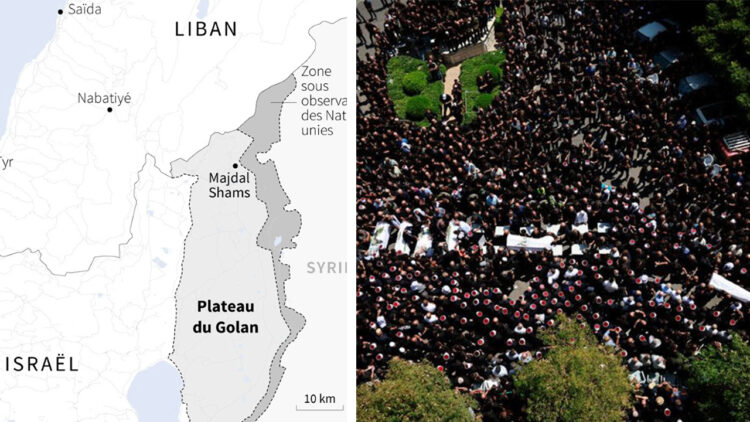
Global leaders engaged in urgent diplomacy on Sunday to deter Israel from escalating its assaults further on Lebanon, amid fears that a broader regional conflict could ignite following a rocket attack that killed 12 children playing football in the Druze town of Majdal Shams in the Israeli-occupied Golan Heights.
Israel announced on Sunday that it would respond forcefully against Hezbollah after accusing the group of the deadly attack on the football field in Majdal Shams. Hezbollah, however, denied any involvement, saying the rocket was an Israel defence missile which had misfired. Israeli Prime Minister Benjamin Netanyahu stated that the attack would not go unanswered, and the cabinet authorised him and the defence minister to determine the timing and nature of the response.
The White House quickly backed Israel’s claims, with a statement attributing the attack to Hezbollah: “It was their rocket, launched from territory they control. It should be universally condemned.” The US also emphasised its commitment to finding a diplomatic solution along the Blue Line, aiming to halt all attacks and ensure the safety of civilians on both sides of the border.
US Secretary of State Antony Blinken echoed these sentiments, stating that while Israel has the right to defend its citizens, the US “does not want to see the conflict escalate further or spread”. Blinken confirmed ongoing talks with the Israeli government to find a resolution.
UN Secretary-General António Guterres condemned the killing of the 12 children and called for maximum restraint from all parties involved. He reiterated his call for avoiding further escalation. The UN Interim Force in Lebanon (UNIFIL) and United Nations Special Coordinator for Lebanon (UNSCOL) are maintaining contact with both Lebanon and Israel, urging both sides to halt the intensified exchanges of fire that risk igniting a wider regional conflict.
French President Emmanuel Macron also reached out to Netanyahu, affirming France’s commitment to preventing further escalation and advocating for a political solution to the Blue Line* issue based on UN Resolution 1701. The Élysée Palace confirmed Macron’s call for all parties to exercise restraint and avoid exacerbating the situation.
Lebanese Foreign Minister Abdallah Bou Habib revealed that Lebanon has asked the US to urge Israel to show restraint, while the US has conveyed a similar message to Hezbollah.
Meanwhile, Iran warned Israel against retaliatory strikes in Lebanon, with Foreign Ministry spokesperson Nasser Kanani stating that any action could lead to an escalation of war in the region.
Communities in northern Israel remain on high alert, and evacuations continue in areas near the Lebanese border, reflecting the heightened tensions and the fear of further attacks. The potential for a larger Israeli offensive on Lebanon, extending beyond the current airstrikes in the southern part of the country, has raised significant concerns about a broader regional war, amplifying the ongoing conflict beyond Israel’s assault on Gaza.
(*) The “Blue Line” refers to a demarcation line established by the United Nations. It was created to serve as a boundary between Israel and Lebanon, particularly after the Israeli withdrawal from southern Lebanon in 2000. The Blue Line was drawn to confirm the withdrawal and establish the line of Israeli withdrawal as well as to mark the boundary for the UNIFIL, which monitors and ensures the cessation of hostilities between the two countries. The Blue Line is not a political border but a temporary boundary meant to help maintain peace and prevent conflict in the region. It is frequently cited in discussions about Israeli-Lebanese relations and has been a point of contention and conflict in the past.