

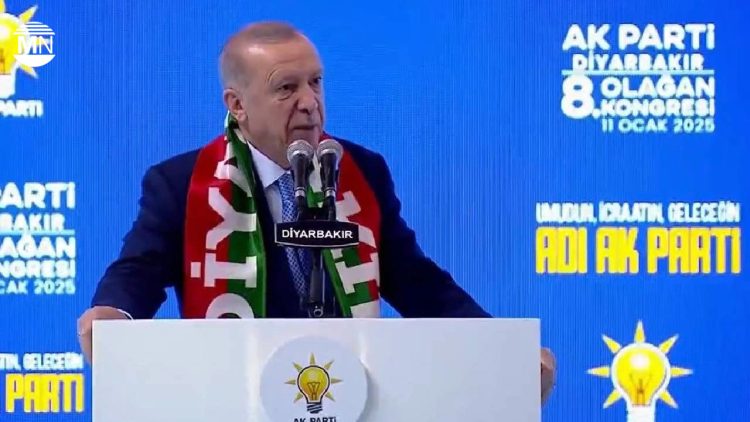
Turkish President and Justice and Development Party (AKP) leader Recep Tayyip Erdoğan stressed the importance of unity and a peaceful solution to the Kurdish question in his speech at the Diyarbakır 8th ordinary provincial congress of the Justice and Development Party (AKP) on 11 January 2024. His remarks come as political actors, including the Peoples’ Equality and Democracy (DEM) Party, continue to discuss steps to end decades of tension. However, Erdoğan’s characterisation of the issue as an ‘imperialist game’ has been noted for its populist tone.
The president stressed the symbolic importance of Diyarbakır (Amed), describing it as “a city of shared civilisation” and “a seal of Islam” that reflects the nation’s destiny. Calling for unity, Erdoğan said: “Our brotherhood is an Islamic brotherhood, a brotherhood of destiny.” Framing the Kurdish issue as a matter of national stability, he stressed that the government’s ultimate goal was to dismantle terrorist groups and eliminate their influence on politics.
“Our efforts are aimed at ensuring the self-dissolution of the terrorist organisation, the surrender of its weapons and the end of its control over political spheres. This is essential to close the chapter of separatist terror once and for all,” Erdoğan said, referring to the Kurdistan Workers’ Party (PKK). He also reiterated his commitment to tackling economic challenges and thwarting attempts to destabilise Turkey in the midst of regional conflicts.
He criticised foreign influence, suggesting that the Kurdish issue was being manipulated by foreign powers in order to weaken Turkey. “We are dismantling the last links of the imperialist game that has caused so much suffering to our nation,” he said, vowing to protect Turkey’s unity and sovereignty.
The Turkish president has made many similar statements since the beginning of the process to resolve the Kurdish question through parliament, which was initiated at the call of Devlet Bahçeli, leader of the Nationalist Movement Party (MHP). The MHP, which pursues a more right-wing and nationalist policy than the AKP, has made statements in favour of a solution through dialogue and politics, while Erdoğan’s statements have appeared to be more populist. Erdoğan referred to previous attempts to solve the Kurdish question, including efforts initiated during the presidency of the late Turgut Özal, but made statements that could be interpreted as solving the problem through militaristic methods.
In a parallel development, a delegation from the pro-Kurdish DEM Party met with imprisoned Kurdish leader Selahattin Demirtaş to discuss ways forward for peace. The meeting, which took place in Edirne prison, discussed recent steps taken by the government to reduce tensions and find a political solution. Sources close to the DEM Party described the dialogue as constructive, while Demirtaş stressed the need for genuine democratic reforms and mutual trust. The DEM Party delegation is also scheduled to meet with the party’s other co-chair, Figen Yüksekdağ, before their anticipated second visit to İmralı to engage with Abdullah Öcalan.


