

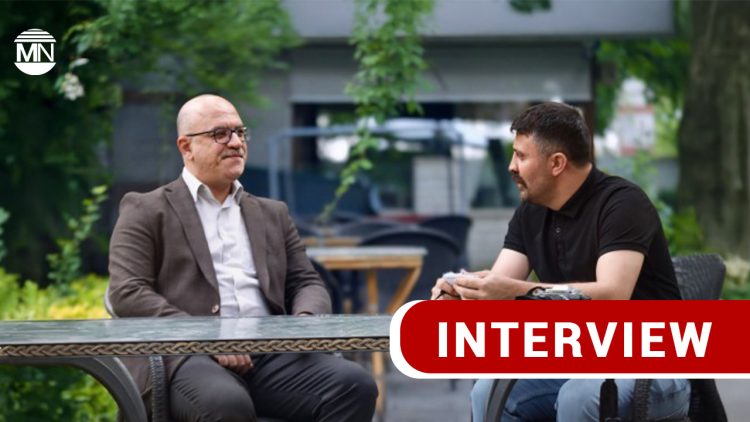
“Democratic politics and law are stronger than weapons,” said Faik Özgür Erol, a lawyer from the Asrın Law Office and member of the İmralı Delegation, quoting imprisoned Kurdish leader Abdullah Öcalan during a recent interview with Selman Güzelyüz of Mezopotamya Agency on Tuesday. Speaking after the Kurdistan Workers’ Party (PKK) declared an end to its armed activities in May, Erol emphasised the urgency of legal and political steps by the Turkish state to transform a historic peace opportunity into a democratic breakthrough.
The remarks come at a critical time in Turkish politics. Since the symbolic handshake between Nationalist Movement Party (MHP) leader Devlet Bahçeli and MPs of the pro-Kurdish Peoples’ Equality and Democracy (DEM) Party during the opening of Parliament on 1 October 2024, attention has returned to long-stalled efforts for peace. On 27 February, Abdullah Öcalan issued a significant message from İmralı prison: a ‘Call for Peace and a Democratic Society’. The PKK’s congress in early May responded by announcing its dissolution. Yet, months on, the government has made no move to institutionalise this momentum.
Erol explained that Öcalan considers the PKK’s decision not merely tactical, but the result of a deep reassessment of leftist political traditions and national liberation strategies. “He said what had been done signifies a major paradigm shift,” Erol noted. “Rather than pursuing a nation-state through armed struggle, Öcalan is advocating for a democratic nation rooted in coexistence and rights.”
The “democratic society” Öcalan proposes is not only a framework for Kurds, but “a political strategy proposed for all oppressed peoples”, said Erol. He added that the concept stems from Öcalan’s critical analysis of 20th-century socialism and his conclusion that a just society must be built “from the grassroots, not the state”.
Central to Öcalan’s vision is rebuilding the broken relationship between Kurds and Turks on new legal and moral foundations. “We are clearing the traps and mines that have disrupted this relationship one by one,” Öcalan told the delegation in their meeting on 18 May. His proposal, said Erol, is for “a new contract based on the law of brotherhood”.
That “contract”, according to Erol, cannot remain rhetorical. “It is neither realistic nor normal for the next phases of the process to proceed solely through unilateral declarations,” he said. “Those who lay down their arms must henceforth be able to trust the law. An inclusive legal framework must be introduced.”
Erol warned that failing to take steps in the legal and political spheres risks repeating past cycles of sabotage. “Many previous peace initiatives have been undermined by forces that see themselves as above the law,” he said. He described Öcalan’s insistence on the rule of law as a safeguard against these “normless powers”.
Reflecting on regional implications, Erol stressed that Öcalan’s proposals extend beyond Turkey. “This is not just about Kurds and Turks. It’s a universal question of how we can coexist,” he said. In a Middle East plagued by war, “the peace process holds the power and capacity to prevent another Halabja, another Gaza, another Sinjar.”
Öcalan’s broader political vision includes democratic socialism, which he links to “being human”. Erol explained that Öcalan’s critique of authoritarian socialist states led him to embrace a model in which democracy and socialism are inseparable. “A system without democracy cannot survive,” Öcalan said, adding: “The promise of freedom to women is incredibly valuable… We are cracking open the door to hope.”
Erol also addressed the role of the DEM Party, which Öcalan sees as a key actor in advancing this new paradigm. “The DEM Party has the potential to appeal to all segments in Turkey as a democratic socialist force,” he said. “This process also offers the party an opportunity to redefine itself and grow.”
Asked about the role of civil society, Erol pointed to recent displays of unity—such as the collective mourning after the passing of Kurdish politician Sırrı Süreyya Önder—as signs that a shared democratic ethos is possible. “Civil society has a central role in establishing the legitimacy of this process,” he said. He called for a parliamentary commission, ideally led by the Speaker of Parliament, to carry the process forward institutionally.
Despite growing public support, concerns remain about Öcalan’s isolation. Although he has communicated messages through delegations, his access to media, legal teams, and the public remains limited. “There have been relative improvements,” Erol admitted, “but not a significant change. For him to fulfil his role, he must be able to address and reach both Kurdish and Turkish societies.”
Ultimately, Erol urged all actors to abandon what he called “lose-lose politics” and embrace a future shaped by law, dialogue, and mutual respect. “Leadership is not about winning the biggest war,” he concluded. “True leadership is the ability to make the greatest peace.”


