

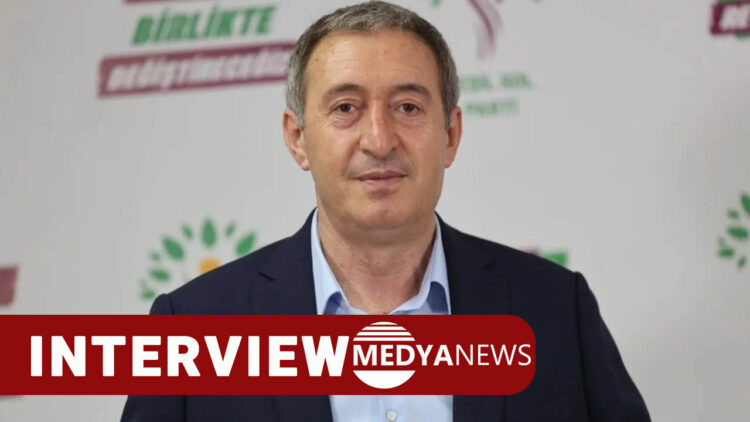
Tuncer Bakırhan, co-chair of the Peoples’ Equality and Democracy (DEM) Party, has stressed the need for genuine dialogue and negotiation to resolve Turkey’s long-standing Kurdish problem. In a television interview, Bakırhan commented on the recent suggestion by Devlet Bahçeli, leader of the Nationalist Movement Party (MHP), that imprisoned Kurdish leader Abdullah Öcalan should be included in talks. Bakırhan acknowledged Bahçeli’s remarks as a significant shift, but stressed that words must be translated into concrete steps towards a meaningful peace process.
“The Kurdish issue does not only concern the Kurds; it concerns all 85 million people living in Turkey,” said Bakırhan. Highlighting the wider social and economic impact of the unresolved issue, he noted, “From unemployment to poverty, many of the challenges we face are directly linked to this issue.” Underlining the party’s commitment to democratic solutions, Bakırhan added, “We have been beaten, imprisoned and persecuted, but we have never abandoned our principles.”
On the role of Öcalan, Bakırhan pointed out that the Kurdish leader’s influence cannot be ignored. “Öcalan has always been an important actor, not only for the Kurdish people but for the democratisation of Turkey as a whole,” he said. The DEM Party has made a formal request to visit Öcalan in İmralı prison to hear his views and help move the stalled process forward. “If a real solution is sought, the isolation imposed on İmralı must end and Öcalan’s insights must be taken into account,” Bakırhan argued. He also expressed hope in Öcalan’s ability to contribute constructively, saying, “Despite his years in solitary confinement, he remains focused, disciplined and committed to a democratic solution”.
Bakırhan also analysed the ongoing relationship between the ruling coalition of the Justice and Development Party (AKP) and the MHP. Describing Bahçeli’s statements and actions as part of a calculated strategy, Bakırhan said: “There is a significant gap between the government’s rhetoric and its practices. This is not a process that Bahçeli has invented on his own; there are projects and programmes that underpin their approach to the issue”. He also hinted at the possibility of a division of roles within the coalition, explaining that “there may be a division of roles, but there are clear differences in nuance, content and quality”.
Bakırhan illustrated his claim by highlighting inconsistencies in Bahçeli’s approach. “Bahçeli praises [Kurdish politician] Ahmet Türk one week and takes a completely different stance the next” he said. The DEM Party co-chair called on the government to clarify its intentions and said, “First of all, they have to be clear. How are they going to solve this problem? That is what we and the public want to know.”
Commenting on the government’s replacement of democratically elected DEM Party mayors with state appointed trustees in Kurdish-majority municipalities, Bakırhan criticised the policy as both undemocratic and ineffective. “They have tried this twice before. The trustees have bankrupted and destroyed these municipalities. In the region, your party has become little more than a signboard party. Why are you trying a third time?” Bakırhan asked. Referring to alleged corruption in the trust-run municipalities, he said: “We handed over the Siirt municipality with zero debt. Now it has a debt of 500 million Turkish Liras”.
Bakırhan criticised the government’s approach to the Kurdish issue, particularly the accusations linking the DEM Party to the Kurdistan Workers’ Party (PKK). “We have no agenda other than our own,” he said, adding, “Our party represents all shades of Turkey’s diverse society, from Alevis and Sunnis to Kurds, Armenians, women and youth. To label us as a ‘Kandil party’ is not only wrong, but an attempt to undermine our legitimate struggle”.
Reflecting on the regional and international dimensions of the Kurdish question, Bakırhan acknowledged that the issue has moved beyond Turkey’s borders. “The Kurdish question is now a regional and global issue with its epicentre in Syria, Iraq and Iran,” he noted. However, he insisted that Turkey’s internal Kurdish problem could still be resolved within a democratic framework. “Turkey has the capacity to resolve this issue through democratic means, and doing so would also pave the way for regional stability,” he said.
Bakırhan concluded by reiterating the DEM Party’s commitment to being a constructive force in any process aimed at resolving the Kurdish question. “We are a party of peace and democracy. The Kurdish question is not only a state problem, it is a social problem. We will continue to reach out to the people, advocate dialogue and expand the democratic space,” he said.
As Turkey continues to grapple with the complexities of the Kurdish issue, Bakırhan’s comments underline the importance of inclusive dialogue and a return to negotiations. Whether these calls will lead to tangible change remains to be seen.


