

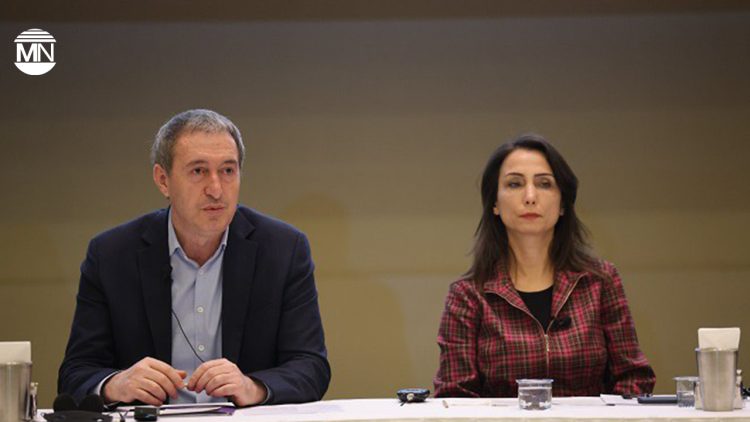
Leaders of Turkey’s pro-Kurdish opposition say the country has entered a new political phase following the latest congress of the Kurdistan Workers’ Party (PKK) and a peace call from imprisoned Kurdish leader Abdullah Öcalan.
Speaking separately on Friday, Tülay Hatimoğulları and Tuncer Bakırhan, co-chairs of the Peoples’ Equality and Democracy (DEM) Party, said the PKK’s congress had created a historic opportunity to resolve the decades-long Kurdish conflict through democratic means.
The PKK announced it had held its 12th congress from 5 to 7 May, in response to Öcalan’s “Call for Peace and Democratic Society”, issued from prison in late February. While the PKK has not disclosed the full outcomes, the announcement has been described by several parties as a potential step towards disarmament and political reconciliation.
“Today marks not the end, but the beginning of a new chapter,” said Hatimoğulları. She urged the government and political parties to seize what she called a “milestone in Turkish political history” by building a democratic and legal framework for lasting peace.
Bakırhan described the current moment as a turning point for Turkey, calling it “a day that could be remembered in the history of democratic transformation.” He said the possibility of ending 40 years of armed conflict offered a real chance for reconciliation and social healing.
The DEM Party, which has its roots in Turkey’s Kurdish political movement, has taken on an active role since the start of renewed contact with Öcalan in late 2024. Party representatives met with President Recep Tayyip Erdoğan in April, shortly before the death of Sırrı Süreyya Önder, a key figure in past peace efforts.
Öcalan, who is held in the high-security İmralı prison, had been denied all communication with the outside world for nearly four years until he was granted a family visit in October 2024. A party delegation met him three times in early 2025. During these visits, Öcalan called on the PKK to hold a congress and consider ending its armed campaign, stating that the organisation had “fulfilled its historical mission” and should now disband voluntarily.
While details from the PKK congress remain limited, the group has confirmed that it met in two locations and evaluated Öcalan’s message. It also honoured recently deceased peace negotiator Sırrı Süreyya Önder.
The Turkish government has responded with cautious optimism. Ruling Justice and Development Party (AKP) deputy leader Hasan Basri Yalçın said the state was prepared to respond positively if the PKK committed to disbandment and disarmament.
Bakırhan stressed that all parts of society must now play a role. “If political institutions, the executive, the media, and civil society assess this moment together, then a historic door may open for the country,” he said.
Hatimoğulları echoed this sentiment, adding that her party was ready to take on responsibility. “This is the time to act with reason and democratic conviction,” she said. “We call on all political forces, including parliament, to be part of this transition.”
Both leaders acknowledged the role of multiple actors in the process and thanked those who had supported a peaceful resolution. They also emphasised that any move towards lasting peace must include broader legal reforms. These include a potential general amnesty, recognition of Kurdish language rights in education, and restoration of democratic local governance—many municipalities in Kurdish regions have been placed under state-appointed trustees, known as kayyum.
Human rights groups and observers have supported the party’s calls. Lawyer and activist Eren Keskin said the moment required abandoning “enemy law” approaches and adopting equal justice.
As discussions continue, all sides await further details from the PKK and possible statements from the Turkish presidency. DEM Party figures have suggested that Erdoğan may issue an official response in the coming days.


