

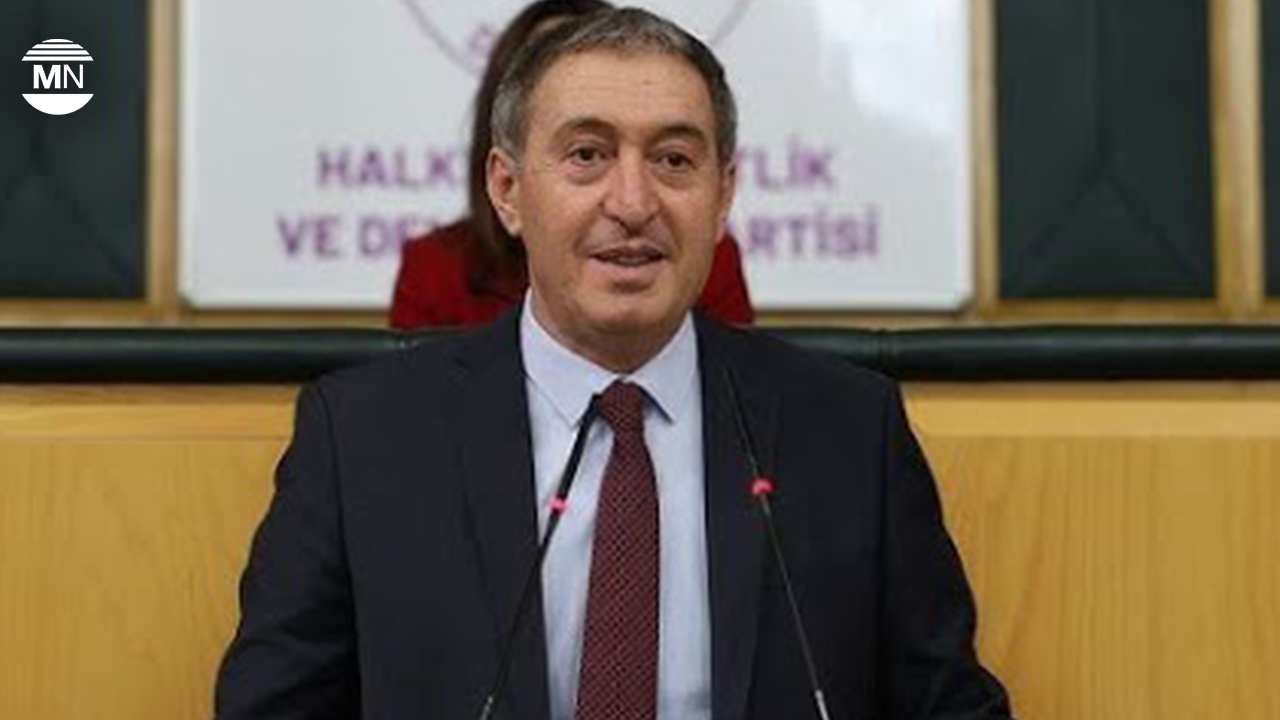
“Let our route be peace and democratic equality, not pain and repression,” said Tuncer Bakırhan, co-chair of Turkey’s pro-Kurdish Peoples’ Equality and Democracy (DEM) Party, in a powerful call for inclusive reform during his party’s parliamentary group meeting in Ankara on Tuesday.
Bakırhan addressed the unfolding peace process in Turkey and the wider Middle East, saying that a new political path must be charted by Turkey’s peoples—not external powers or entrenched elites. His remarks come amid behind-the-scenes talks and growing public debate on a possible political resolution to Turkey’s century-old Kurdish question.
Bakırhan made his remarks during a party group meeting in the Turkish Parliament this week. He called for broad political engagement in a developing peace initiative, criticising the government’s silence and inaction while urging equal citizenship for Kurds and Alevis, judicial reform, and an end to appointed trustees in Kurdish-run municipalities. Bakırhan framed the process as one of “democratic consensus” and “equal brotherhood”, rooted in local agency and inclusive governance.
“Let the peoples of Turkey decide our direction,” he said. “Let our course be a democratic republic where Kurds and Alevis are equal citizens. Otherwise, our fate will be dictated by imperial and hegemonic forces, bringing only blood, pain, and tears.”
Referring to recent regional realignments, Bakırhan said that the Middle East is once again in flux and that Turkey cannot remain passive in this moment of historical change. “Some powers are shifting positions. Old balances are dissolving,” he said. “We say: let us chart our own course together.”
Central to this path, Bakırhan stated, is the concept of a “Democratic Nation”—a vision where no citizen is treated as superior or inferior due to their ethnicity or faith. “These lands are home to Turks, Kurds, Alevis, and Sunnis. People from every colour of society live here. If we accommodate all these colours, we can steer our course accurately.”
Citing the importance of Abdullah Öcalan, the imprisoned Kurdish leader, Bakırhan said: “Mr Öcalan’s call opens the door to a space where we can define our course, write our script, and act together… A democratic Turkey and Middle East is no longer a dream.”
Yet the path forward, Bakırhan warned, is undermined by a severe lack of trust. “There is hesitation among both the Kurdish people and the peoples of Turkey,” he said. “For a process to proceed properly, an environment of trust must be established.”
He placed much of the responsibility for building this trust on the ruling Justice and Development Party (AKP) and its partner, the far-right Nationalist Movement Party (MHP). “All political parties have a duty,” he added. “It is not only the DEM Party that must act—everyone should be braver and contribute with words and deeds.”
Despite the DEM Party’s engagement, Bakırhan criticised the government’s passivity: “Why is the government not in the field? During elections, they go district to district, village to village. But when it comes to a century-old issue, they disappear.”
Bakırhan also took aim at human rights abuses in Turkey’s prisons, citing alarming Ministry of Justice data. “On average, two ill prisoners die every day,” he said. “In 515 days, 1,026 ill prisoners have lost their lives. Had they been treated, perhaps they would still be alive today.”
He called for an immediate revision of the enforcement law and the release of arbitrarily detained individuals. “Prisons should be emptied. Families should be able to celebrate a double holiday.”
Another key demand was an end to the practice of appointing state trustees to municipalities won by Kurdish candidates—a measure Bakırhan labelled “undemocratic and a violation of public will.” At a recent local governance meeting in Diyarbakır (Amed), he said, the focus was on restoring local democracy as a foundation for trust.
Media, too, must change, he said. “The media must urgently change its language. Peace begins with language and spreads through society.”
In response to recurring public questions, Bakırhan clarified the DEM Party’s position: “We have no problem with this country’s capital, language, or flag. These have never been points of contention. Our issue is with the undemocratic regime that denies Kurdish and Alevi identities.”
He summarised the party’s proposal as “state plus democracy”. “We want a country where the Kurdish language, culture, and identity are not excluded; where Alevis are equal citizens. We want democratic and equal citizenship.”
With the DEM Party’s recent engagement with MHP leader Devlet Bahçeli and upcoming field visits planned, Bakırhan signalled that the party will continue pushing for broader participation. “Hopefully, in the coming days, we will witness many political parties—led by the government—sweating in the field, raising awareness, and contributing to this process.”


