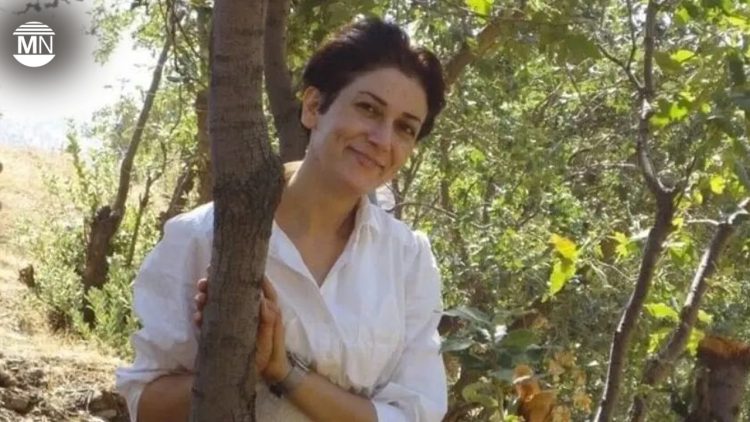
On 8 January 2025, the Iranian Supreme Court upheld the death sentence for Kurdish political prisoner Pakhshan Azizi, ignoring significant procedural flaws and evidence of her peaceful humanitarian work. This decision comes amid a broader context of increasing executions in Iran, with at least 54 political and security prisoners currently facing death sentences.
On 24 July 2024, Judge Iman Afshari, head of Branch 26 of the Revolutionary Court of Tehran, issued the original death sentence for Pakhshan Azizi.
According to her legal counsel, Amir Raisian, “Branch 39 of the Supreme Court has upheld the death sentence against Pakhshan Azizi, disregarding numerous procedural and substantive flaws in the case”. Raisian emphasised, “Azizi was never involved in any armed operations or military organisations. The court ignored critical evidence demonstrating that her activities in northern Syria refugee camps were entirely peaceful and humanitarian in nature”.
He further stated that the sentence was issued in violation of fair trial standards, with the court failing to address the significant errors in the case.
In an interview with Sharq daily, Raisian elaborated, “The Supreme Court has given no consideration to investigative shortcomings or evidence”, demonstrating that the imposition of the death penalty on Azizi, alongside 54 others on political-security charges, has ignited widespread concern. In response to the death sentences, Narges Mohammadi posted a reaction on her X (formerly Twitter) account that Azizi’s aid activities in refugee camps in northern Syria were “purely humanitarian and apolitical”.
Expressing grave concern regarding the confirmation of his client’s death sentence, Raisian emphasised that the defence team will promptly file a formal petition for retrial with the Supreme Court. He stated his hope that the assigned judicial panel will give due consideration to the substantive objections raised within the case and rectify the identified procedural deficiencies.
Iran International TV Network, citing an exclusive source, reported that the Iranian judicial system has succumbed to the demands of the security apparatuses, and has disregarded evidence substantiating Azizi’s humanitarian work in northeast Syria, thereby placing her at imminent risk.
The imposition of the death penalty on Azizi, alongside 54 others on political-security charges, has ignited widespread concern.
In response to the broadcasters’ death sentences, Narges Mohammadi, Nobel Peace Prize laureate, posted a reaction on her X account:
“The confirmation of Pakhshan Azizi’s death sentence by the Supreme Court reflects the regime’s determination to escalate the suppression of women and take revenge on the magnificent and powerful ‘Women, Life, Freedom’ movement. The IR [Islamic Republic] seeks to intensify fear & vengeance by beginning the execution of a female political prisoner. It is our duty not to remain silent. I call on all freedom seekers worldwide, international human rights organisations & the United Nations to unite against the policy of executions”.
In parallel, United Nations High Commissioner for Human Rights Volker Türk expressed grave concern over the alarming surge in executions in Iran, particularly highlighting the unprecedented rise in women facing capital punishment.
Türk emphasised the disturbing trend, stating, “It is deeply troubling that yet again we see an increase in the number of people subjected to the death penalty in Iran year-on-year”. The situation reached a critical point in December 2024, when approximately 40 people were executed in a single week.
The High Commissioner underscored the urgency of addressing this issue, declaring, “It is high time Iran stemmed this ever-swelling tide of executions”.