

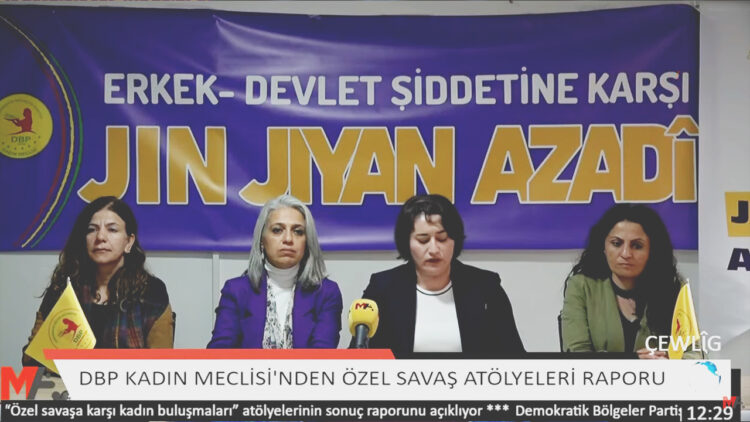
The Women’s Council of the Democratic Regions Party (DBP), a pro-Kurdish political party operating at regional level in Turkey, has documented systematic state policies targeting Kurdish women through poverty, forced migration and psychological operations in its latest workshop report, vowing to strengthen organised resistance.
The findings emerged from 73 workshops conducted across 15 provinces, reaching 3,200 women over three months. The workshops, led by Free Women’s Movement (TJA) activists under DBP’s guidance since 4 July, were conducted in native languages including Kurmanji and Kirmanckî dialects of Kurdish.
“Youth are primary targets of these policies through drugs, forced migration and psychological operations,” Berivan Bahçeci, DBP Women’s Council spokeswoman, said while presenting the report at pro-Kurdish Peoples’ Equality and Democracy (DEM) Party’s Bingöl (Çewlîg) provincial office. The presentation was attended by DBP Co-Chair Çiğdem Kılıçgün Uçar and Women’s Council members.
Turkish “special war” policies target Kurdish women through their bodies
The report identified twelve key methods of special warfare used by the Turkish state against the Kurdish population, particularly targeting Kurdish women. These include creating economic dependence by forcing women into poverty and reliance on male or state support, undermining autonomy. Members of the security forces coerce women into emotional relationships and then blackmail them using audio and video recordings.
The Turkish state pressures young women in universities to become informants or engage with security forces, threatening their futures or families if they refuse. There is widespread impunity for security forces involved in harassment and rape, leaving women vulnerable. The circulation of drugs in Kurdish regions, with the age of drug carriers and users dropping significantly, is another serious issue.
State-appointed officials, including imams, promote assimilation under the guise of religion, undermining Kurdish identity and women’s roles, the report noted. Kurdish women are also targeted for forced prostitution, and many impoverished women are driven to suicide through forced relationships. Arbitrary detentions force young people, especially women, away from their home regions.
Economic underdevelopment and a lack of employment opportunities in Kurdish-majority areas push many to support the ruling parties or to deny their ethnic identity for survival. The Turkish state also exploits feudal mindsets and divides communities to weaken the fight for women’s equality. Families are threatened to distance women from the struggle for Kurdish rights, identity, and freedom. These methods aim to erode the social and political autonomy of Kurdish women.
Key objectives, outlined in the report, behind the Turkish state’s policies targeting the Kurdish population include weakening social solidarity by dividing Kurdish communities and preventing collective resistance, as well as diminishing Kurdish identity through forced assimilation, repression of the Kurdish language, and cultural erasure.
“The primary aim of these strategies is to prevent the construction of a democratic nation as an alternative to capitalist modernity by controlling social and political structures through gender, nationalist and religious axes,” the report stated.
Another goal is to increase economic dependency by fostering poverty and limiting opportunities, making Kurdish communities, particularly women, reliant on government aid or male-dominated structures. The state also conducts psychological operations and propaganda to manipulate public perception and discredit Kurdish movements, while forcing migration to change the demographic makeup of Kurdish-majority regions.
Policies of violence and pressure are used to suppress resistance through arrests, torture, and sexual violence, while encouraging ethnic and sectarian conflicts within Kurdish communities weakens unity and resistance. These tactics aim to dismantle Kurdish cultural and political autonomy, ensuring submission to state control.
The council proposed several solutions, including expanding solidarity networks, developing collective economic projects and establishing alternative education programmes. “Women’s organised struggle is currently the most promising force and has the capacity to achieve social change,” the report concluded.
Referencing recent incidents in Hakkari (Colemêrg), where ruling Justice and Development Party (AKP) administrators and security forces were allegedly involved in forcing young women into prostitution and drug use, and similar cases in Van (Wan) and Şırnak (Şirnex) involving harassment by military personnel, the council reinforced the need for women’s self-defence.


