

Fréderike Geerdink
Struggle is nothing without imagination. I thought of that when I saw pictures and speeches this weekend of the commemoration of the bombing in Suruç on 20 July 2015, in which 33 young people lost their lives. During commemorations, the group that was bombed that day was referred to as ‘düş yolcuları’, dream travellers. Could the struggle – any struggle, I would say – have a better goal than to fulfil the dreams of those who gave their lives for it?
The dream travellers on 20 July 2015 were mostly leftist Turkish young people from all over the country who came to Suruç to show their solidarity with Kobani, the Kurdish town just across the border in Syria. It was half a year after the Kurdish forces of the YPG and (women’s forces) the YPJ had broken the ISIS siege of Kobani, which was the first successful resistance against the genocidal group that was conquering large swaths of land in both Syria and Iraq in those days. Kobani was still in tatters. The young people wanted to cross the border to hand out toys to children and show their solidarity with the locals.
Then suddenly, when they were gathering in a cultural centre in the morning, one person in the group – an ISIS member – detonated himself. In the blast, 33 people died, and around a hundred were injured.
Memorials
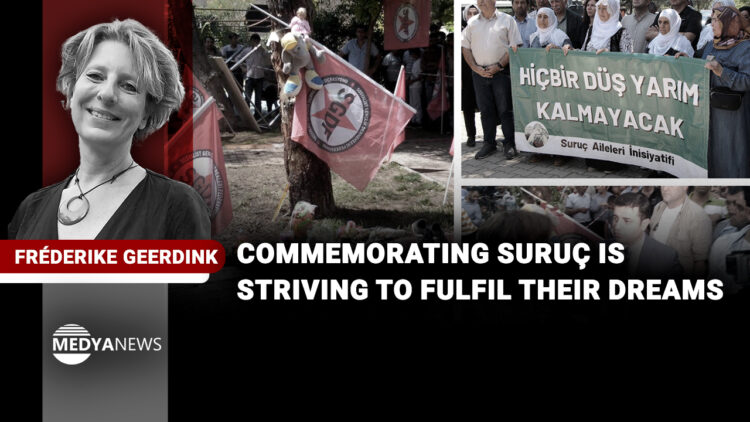
It’s nine years ago and I was still working as a Kurdistan correspondent at the time, based in Amed (Diyarbakır). I arrived in Suruç the morning after the massacre. I started out in the Amara Cultural Centre, where it happened, and found make-shift memorials with flags (of SGDF, the Socialist Youth Associations Federation) and the toys meant for Kobani, people busy putting up flowers, and politicians, including Selahattin Demirtaş, giving speeches and interviews and supporting the people. Here and there, the blood of the victims remained visible on sidewalk tiles and on greenery in the courtyard.
Two of the victims were buried in the graveyard of Suruç on the same day. It was so hot, so dry, the mourners were covered in clouds of dust. Other victims were brought home and buried there. They were all commemorated at their graves today. Missed for who they were, and missed for the dreams they held. People wanted to gather at the Suruç graveyard too, but the police didn’t allow it – showing painfully how little if anything at all has changed in Turkey since then.
Submission
Dreams are inspiring, but for those in power, they are dangerous. People who dream of a better future and who contribute to making that future happen, show that they refuse submission to the dominant narrative. That goes a step further than struggling against the oppression you face, or the oppression you see done to others. By dreaming, you take your struggle into your own hands, instead of just reacting to the injustices brought about by those in power.
Dreaming and imagining a better world, does something much greater too. It enables a focus on finding ways to start building that better future. By doing that, you prepare yourself and others for the day you can put it all into practice. Which brings me to another anniversary from this week, and that is the 12th birthday of the revolution in Rojava, or, Kurdistan in Syria. On 19 July 2012, the Kurdish self-defence forces of the YPG captured Kobani, and embarked on their experiment with bottom-up democracy, which lasts until this very day in the northeast of Syria.
Öcalan
If there hadn’t been a movement that had been imagining a new order for many years and had started to experiment with it, the Rojava revolution could never have happened. The revolution is based on the political ideas of jailed Kurdish leader Abdullah Öcalan, and strives to organise people on a local level. Every community, regardless of ethnicity, religion or language, has the right to govern their own affairs, educate their children in their own language and practise their religion and culture freely. No community is dominant, so everybody is equal.
The communities are again connected via councils that work together in larger structures to meet common needs. Eventually, the system undermines oppressive structures, like nation-states and borders. If you want to know more, you can google ‘democratic confederalism’ and Öcalan’s name.
Trouble
This system didn’t come out of nowhere. It had been debated and promoted for years, mostly in Bakur, or Kurdistan in Turkey, by the Kurdish political movement. They created spaces to organise people and to practise with local councils, pushing the borders of the strict regulations of the state – and constantly getting in trouble for it but persisting anyway. They hadn’t expected Syria to be the place to actually put democratic confederalism in practice, but that’s what happened in 2012. They were ready.
Do you see the symbolism that Kobani holds? Do you see how it started with a dream, which developed into something real? Do you see how the young Turks who came to Suruç to travel to Kobani in solidarity are the embodiment of the dream, and how much hope they represent? They merged dream and reality, they set an example, they inspired, they energised. Working to fulfil their dreams means liberating us all.
Fréderike Geerdink is an independent journalist. Follow her on Twitter or subscribe to her acclaimed weekly newsletter Expert Kurdistan.


