

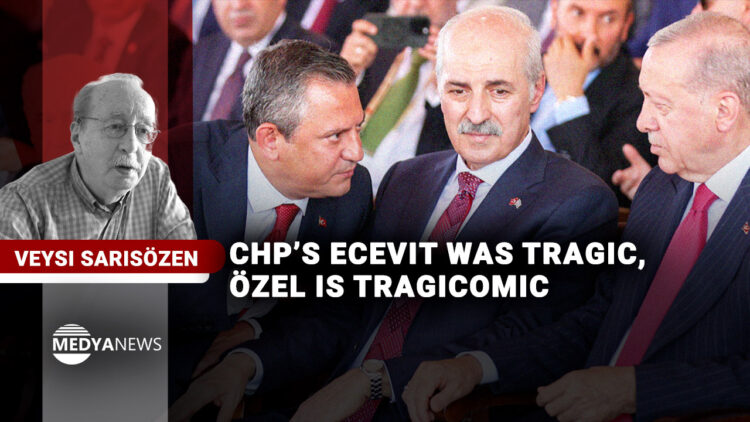
A photograph showing Turkish President Recep Tayyip Erdoğan alongside Republican People’s Party (CHP) leader Özgür Özel and other top officials, has sparked significant criticism and concerns over Turkey’s intentions in the region. Veteran journalist Veysi Sarısözen described the image as symbolic of a broader strategy to normalise and potentially expand Turkey’s territorial occupations, in an article for Yeni Özgür Politika published 22 July.
“The ‘occupying state’ posed in full assembly: Erdoğan, with Özel beside him, Nationalist Movement Party (MHP) leader Devlet Bahçeli right under his nose, Hulusi Akar, the Minister of Defence, and other officials, all lined up like beads on a 33-bead rosary, all of them mocking the United Nations, the Council of Europe, and the entire world,” Sarısözen wrote.
Sarısözen’s critique highlighted the ongoing occupation of Cyprus, where Turkey controls more than 30% of the land. Despite multiple UN Security Council resolutions, including Resolutions 365 and 367 [in 1974 and 1975] declaring Turkey as an occupying force and Resolution 541 [in 1983] deeming the ‘Turkish Republic of Northern Cyprus (KKTC)’ illegal, Turkey remains entrenched.
Currently, no state apart from Turkey recognises this illegal entity. “This is the legal situation, but for fifty years, Turkey continues to be an occupying force on the territory of the Republic of Cyprus,” Sarısözen noted.
Drawing parallels between the situation in Cyprus and Iraqi Kurdistan, Sarısözen questioned why Masoud Barzani, President of the Kurdistan Democratic Party (KDP), does not foresee a similar future for his region. “In my opinion, Barzani and his accomplices have long forgotten about ‘Independent Kurdistan’. They are taking steps to separate Başûrê Kurdistan (Iraqi Kurdistan) from Iraq and annex it to Turkey,” Sarısözen stated, implying a betrayal of Kurdish independence.
Sarısözen asserted that Turkey, in conjunction with the KDP, aims to dominate Iraqi Kurdistan from Erbil (Hewlêr) to Suleymaniyah (Silêmanî), potentially establishing a “Barzani Republic” akin to the Turkish Republic of Northern Cyprus if the Kurdistan Workers’ Party (PKK) resistance can be overcome and the US allows Turkey to fill the vacuum.
The journalist criticises Özel for aligning with Erdoğan and participating in what he describes as a facade of eased political tensions. Sarısözen recalled the 1971 Turkish invasion of Cyprus, which was facilitated by similar political manoeuvring between CHP leader Bülent Ecevit and the Islamist right party National Salvation Party (MSP) leader Necmettin Erbakan. “The current image we see, with Özgür Özel sitting in Ecevit’s seat and Erdoğan pulling the rug from under Erbakan, represents preparations to invade and annex Iraqi Kurdistan under the guise of ‘détente and normalisation’.
Sarısözen’s scathing commentary does not spare Özel, depicting him as a caricature of the former CHP leader Ecevit. “When the Turkish army enters Erbil with the code ‘Ayşe will go on holiday’ tomorrow, Özgür Özel will be nothing more than a caricature of Karaoğlan Ecevit,” he remarked, using Ecevit’s nickname.
Sarısözen concludes by questioning the integrity and independence of CHP under Özel’s leadership. “Seeing Özgür Özel among these posers and show-offs makes me think once again that CHP has ceased to be a ‘founding party with a voice in the state’ and has become an ‘extension’ in the hands of the state and the global powers supporting that state.”
*Turkish Foreign Minister Turan Güneş told Prime Minister Bülent Ecevit that “Ayşe will go on holiday”, meaning Turkish forces were ready for the 1974 invasion of Cyprus.


