

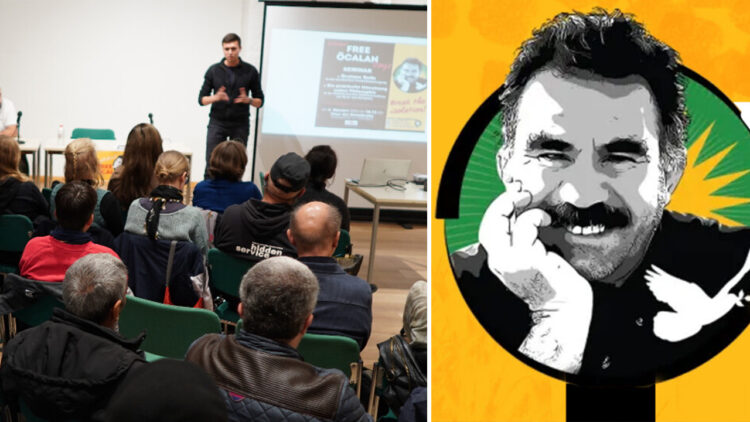
Kurdish and German activists gathered in Berlin on Friday as part of the “Global Days for Öcalan’s Freedom”, holding a panel discussion on the philosophy and influence of imprisoned Kurdish leader Abdullah Öcalan. The event, held at the Haus der Demokratie, brought together participants to explore Öcalan’s role in shaping the Kurdish Freedom Movement and his contributions to global discussions on democratic governance, autonomy, and women’s liberation.
Tim Krüger, a German journalist and activist, spoke at the panel, highlighting Öcalan’s development of the Democratic Autonomy and Democratic Confederalism concepts in the early 2000s. Krüger explained that Öcalan’s ideas “opened the door for revolutionary movements worldwide,” adding that Öcalan’s philosophy on ecology, social sciences, and women’s rights had a profound global impact. “His ideas on autonomy and women’s ideology pave the way for future discussions on how to build sustainable and just societies,” he said.
Krüger also addressed the Turkish state’s historical oppression of the Kurdish people, noting that “the Kurdish national movement arose in response to cultural repression and denial of basic rights.” He emphasised that Öcalan’s ideas are not only significant for the Kurdish struggle but for broader revolutionary movements seeking democratic and equal governance.
The event, which was attended by dozens of Kurdish and German activists, underscored the ongoing campaign for Öcalan’s release. “Efforts to secure Öcalan’s physical freedom should be a priority for the international community,” Krüger added, calling for increased pressure on global institutions to address the isolation of the Kurdish leader, who has been imprisoned since 1999.
The panel is part of the Free Öcalan Global Days initiative, a series of events taking place across Europe throughout October. These events highlight Öcalan’s contributions to peace in the Middle East and the broader struggle for self-determination and gender equality, with supporters insisting that Öcalan’s freedom is key to resolving the Kurdish issue and achieving lasting peace in the region.


