

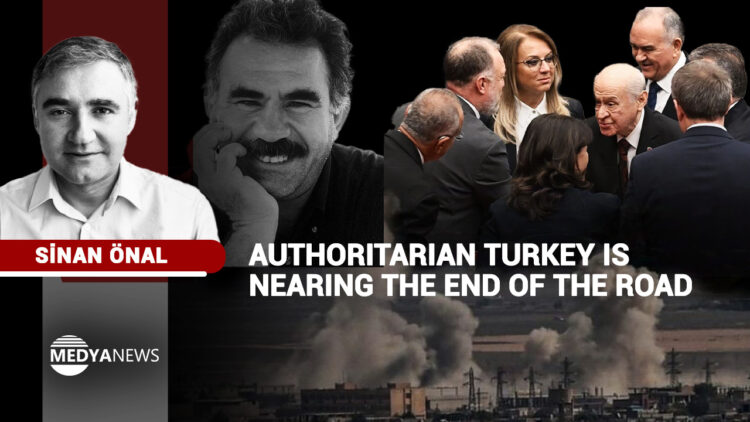
Sinan Önal
The political landscape in Turkey has taken unexpected turns since the beginning of October. It all started with an unprecedented gesture by the leader of the ultranationalist coalition partner, the Nationalist Movement Party (MHP), extending an olive branch to the co-chairs of the pro-Kurdish Peoples’ Equality and Democracy (DEM) Party. This act, a rare demonstration of reconciliation, has since unfolded into weekly spectacles of rhetoric and debate. Each week seems to chip away at the edifice of Turkey’s entrenched authoritarian nationalism. The ruling elites, historically driven by assimilationist and colonialist ideologies, now appear eager to engage in rhetoric of pluralistic democracy with the Kurdish population. The most radical and astonishing statement came on 22 October when MHP leader Devlet Bahçeli called for the Kurdish People’s Leader, Abdullah Öcalan—held under one of the most isolating incarcerations in modern history for the past 25 years—to be brought to the Turkish Grand National Assembly to initiate a new political era.
While the established order, the press, the bureaucracy, politics and the intellectuals are in a state of shock, and the government officials are in a state of stress and panic about how to adapt, the Kurdish people and their friends, who have made the struggle for freedom and democracy their way of life, are acting very cautiously, but also with the self-confidence and sweet dignity that their revolutionary resistance, which has been going on uninterruptedly and with increasing momentum for decades, has reached a new stage. From the beginning of October until now, every week has been a series of performances that break the metaphors and routines of the familiar order, forcing all the actors to take up new positions.
For the past 26 years, and especially during the last 43 months of enforced isolation, Öcalan’s imprisonment has epitomised the repressive heights of the Turkish state. However, on 23 October, this phase entered a new chapter when Öcalan’s nephew, DEM Party MP Ömer Öcalan, was permitted a restricted family visit lasting one hour and forty minutes. A brief message was conveyed: “Isolation continues. If conditions allow, I possess the theoretical and practical power to shift this process from a violent, conflict-driven path to one grounded in law and politics.” This statement, succinct yet seismic, reverberated across Turkish politics, overshadowing the government’s weeks of verbose rhetoric.
This period has been marked by a cascade of events, shaking not just Turkey but the wider Middle East and global political arenas. On 23 October, the Kurdistan Workers’ Party (PKK) claimed responsibility for an attack on a cutting-edge Turkish defence aviation facility in Ankara. In retaliation, the Turkish state launched its most extensive aerial strikes to date on regions governed by the Autonomous Administration of North and East Syria (AANES). This was followed by a crackdown on democratic Kurdish politics, involving the removal of elected mayors and the appointment of government trustees, escalating tensions to their peak. Meanwhile, acts of public resistance, empathetic overtures from opposition parties towards Kurdish democratic politics, and condemnations of these authoritarian measures by Europe and the international community have continued to punctuate daily events.
Explaining these developments within the constraints of this brief column is challenging, given their complex local, regional, and global contexts. Nonetheless, it is evident that authoritarian Turkey is nearing the end of the road. Consistent with its century-long tendency towards top-down change, the state appears to be adapting to the new global order with an upper-hand approach, attempting to preserve the status quo while signalling reform. This mirrors the actions of İsmet İnönü, the nationalist leader who, between 1945 and 1950, reversed his earlier policies, famously declaring, “If the country is to become communist, we will be the ones to make it so.”
A parallel dynamic is unfolding today, as the state attempts to steer towards a ‘normalisation process’, while maintaining its grip on power. The past decade has been shaped by the “subjugation doctrine” endorsed by Turkey’s National Security Council on 30 October 2014, aimed at crushing the Kurdish Freedom Movement. However, after ten years of extraordinary resistance at local and national levels, alongside shifting dynamics in the Middle East and globally, Turkey’s ruling system appears compelled to return to the baseline democratic conditions of Europe.
As a NATO member since World War II, Turkey has in recent years engaged in actions that starkly contradict the alliance’s norms. Collaborations with NATO’s geopolitical rivals, trade agreements, and military exchanges—culminating in its support for Hamas during last year’s attacks on Israel—have revealed the limits of the latitude granted to Ankara. The anti-American governance model established post-2016 has tested the patience of the US and is increasingly viewed as an obstacle to Washington’s new strategies in the Middle East and Asia.
The broader context reflects the global shifts underway since the fall of the Berlin Wall. Slow but steady growth in Chinese capitalism, which now poses the greatest threat to Western hegemony, has prompted the US to fortify the Middle East’s border regions while applying soft power and financial pressure on Asia. The American strategy, evident since the Trump administration, involves containing Iran, strengthening partnerships with Arab states, and pressuring Turkey to politically recognise the Kurds.
The 5 November election of Donald Trump—one of the most remarkable in US history—has exacerbated Turkey’s political and economic crisis. With the announcement of key appointments in Trump’s new cabinet, including figures openly opposed to Erdoğan’s past manoeuvres, it has become clear that the Turkish president’s expectations of renewed cooperation with Washington are unlikely to materialise.
Key figures such as National Security Advisor Mike Watz, Secretary of State Marco Rubio, and Intelligence Chief Tulsi Gabbard, who previously opposed Erdoğan’s war against the Kurds, signal a cold winter ahead for Turkey. Their appointments underscore the improbability of Erdoğan securing the concessions he enjoyed during Trump’s first term.
The peaceful, grassroots struggle of the Kurdish political movement and Turkey’s democratic forces holds the potential to transform this long-awaited winter into a lasting democratic spring. Abdullah Öcalan’s release from his imprisonment on İmralı Island could mark not only a pivotal moment for Turkey but also a turning point for the region and the world. The coming days and weeks are poised to bring significant developments that could reshape history.
Sinan Önal is a political scientist, currently an envoy of the Kurdistan National Congress, who formerly acted as an adviser in policy-building and international affairs to the left-wing alternative and pro-Kurdish parties DTP, BDP, and HDP in Turkey. Mr Önal also represented the pro-Kurdish party in the United States in 2012/2013, and in Germany in 2017/2018.


