

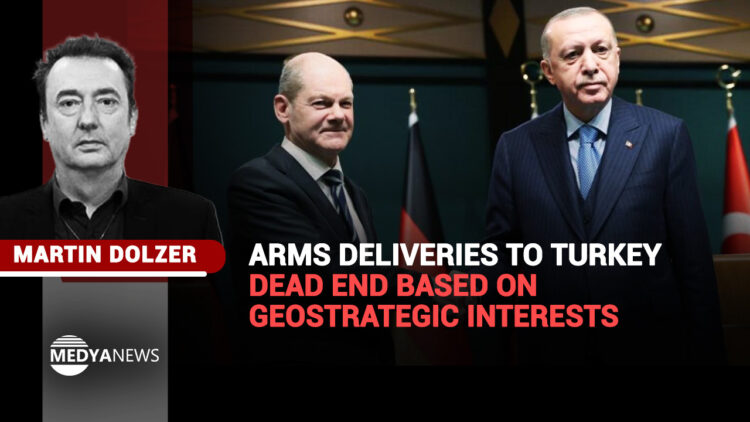
Martin Dolzer
Since the founding of the Federal Republic of Germany, relations between the German and Turkish governments have largely been characterised by an instrumental approach. This has not changed for a good 70 years. Instead of placing human rights and international law as well as a foreign policy relationship on an equal footing at the centre of their own policies, economic and geostrategic interests have regularly been the main driving force of the federal governments in the orientation of their “Turkey policy”. This is no different with the current decision by the Federal Security Council on the delivery of German weapons worth at least 236 million euros from the beginning of October 2024. This includes 100 anti-aircraft missiles and torpedoes for the Turkish navy as well as material for the modernisation of Turkish submarines and frigates. The companies benefiting from these orders include MBDA (37% owned by Airbus) and Thyssenkrupp.
Whether during Franz Joseph Strauss’s collaboration with Turkish fascists in the 1960s or during the German government’s collaboration with the Turkish government after the 1980 military coup with its massive repression and extermination policies against any left-wing opposition; whether during the village expulsions and massive attacks on the Kurds in the early 1990s or during the plot against Abdullah Öcalan late in the same decade; whether during numerous chemical weapons operations by the Turkish army against Kurdistan Workers’ Party (PKK) guerrillas and the civilian population in the late 1990s or regularly in northern Iraq for a good part of the last four years; whether during the massacres of Roboski (Roboskî) in 2011 and in the cellars of Cizre (Cizîr) in 2016 or during extrajudicial executions of Kurdish politicians and journalists in Rojava, northern Syria; whether in the imprisonment of more than 30,000 opposition members as political prisoners by the Erdoğan regime in recent years or in the total isolation of Abdullah Öcalan for more than three and a half years – the federal German governments have always not only accepted serious and systematic violations of human rights conventions and international law under the responsibility of the Turkish governments largely without criticism, but also provided the country with massive economic, security and military support.
Over the decades, masses of armaments such as weapons, tanks, ships and other military infrastructure have been delivered to Turkey or given away as gifts, militarily relevant licences have been granted, prison infrastructure (F-type) has been influenced and left-wing political Turks and Kurds in Germany have been criminalised. Decisive pressure on the Turkish government to respect human rights was never exerted seriously and in the long term. Turkey was too important as a hub for raw materials in the Middle East, as a NATO partner and as a buffer against refugees from Iraq or Syria.
The extent of arms deliveries or repression against left-wing Turks and the Kurdish movement in Germany has fluctuated depending on the political climate. The German government recently severely restricted arms exports to Turkey, after Turkey began, around 2015, to gradually distance itself from being tied solely to the West and to seek closer contact with Russia and the BRICS states, as part of its own neo-Ottoman project and in spite of its NATO membership and its candidacy for membership of the EU. In 2023, Germany only approved 17 projects totalling 1.22 million euros.
There are certainly several reasons for the current U-turn. However, it has nothing to do with either a value-based nor feminist foreign policy – unless value-based means nationalist, and feminist means inhumane economic policy, neo-colonialism and war-orientation. The current U-turn is probably due firstly to the fact that purely the economic interests of German defence companies are to be served. Secondly, the German government is trying to prevent Turkey from drifting completely in the direction of the BRICS states. Thirdly, Germany’s position as a more independent “great power” within NATO also plays a role.
The type of foreign policy described above leads to a dead end. It does not pursue a long-term strategy and therefore has no perspective of its own. Furthermore, the neo-Ottoman project of the Erdoğan regime is clearly still being underestimated by the German government.
To better understand this U-turn, it is also helpful to look at the global situation. The fact that the German government followed the USA into sanctions against Russia and is continuing to promote the war in Ukraine – a proxy war to maintain the USA’s sole global hegemony – through arms deliveries and escalation instead of diplomacy, is just as much a mistake as further arms deliveries to Israel in spite of the genocide against the Palestinians.
The global economic dominance of the USA and the Western states has already been broken – US military hegemony is now to be maintained following the implementation of plans for parts of the Greater Middle East Project (the US plan to destroy the sovereignty of Iraq, Libya, Syria and Iran) and the conflict in Ukraine (the US plan to destabilise and militarily bind Russia) through an escalation of the conflict with China (up to war in the next 5-10 years, according to plans by several leading US think-tanks). The BRICS states and large parts of the Global South, on the other hand, are striving for a more multi-polar world. The fact that their own interests also play a role in this is rooted in the practice of international relations and in history.
In this situation, the question is: what can be done to influence the reorganisation of global hegemony in a direction in which the interests of the populations, human rights and international law are at the centre of developments?
The right answer and also an answer to arms deliveries to Turkey and plans for mass deportation from Germany, which could also affect many left-wing Turks and Kurds, would be mass protests and massive resistance in the political and civil society sphere. I think it would be right for people in Germany to organise themselves intensively in the peace movement, in the internationalist sense of the word – by which I also mean beyond the borders of their own reference groups and communities – instead of falling for the divisive politics of those in power and even reproducing them.
It is devastating to portray migrants as scapegoats for the economic crisis and to adopt right-wing demands for isolation and deportation. The current crisis is the crisis of capitalism, which is exacerbated by sanctions, militarisation and wars. In wars, the poor die first and people are forced to flee again and again. The same applies to support for autocratic regimes such as the Erdoğan government. People are threatened with repression and even death and are forced to flee. Overcoming these causes would be a good approach so that everyone can decide freely where they want to live. Isolation, on the other hand, is nonsense and contrary to human rights. Refugees living here in Germany could be given the opportunity to train in qualified professions by reactivating the dual training system, among other things, instead of exploiting them as cheap labour without legal protection or arguing for their deportation, which is not feasible anyway.
It is also disastrous to defame all people who pursue a consistent peace policy or criticise the system as being open to the right. In times of crisis, it is necessary to reach out to people who are confused so that they do not fall into the hands of the right. We should discuss how best to do this and thus prevent further right-wing developments.
At the centre of a functioning democratic society is the personal development of people, and not the profit of large companies and the already privileged. This requires dialogue and the intention to find ways to resolve social conflicts in both foreign and domestic policy without violence and without suppressing constructive decision-making. Every conflict has a history. The origins of conflicts and, in the worst case, wars, can rarely be explained with simple black-and-white accusations and can only be resolved by recognising different, legitimate interests.
The peace demonstration in Berlin in October 2024 was a good first step towards joint organisation. A political force that acts in the spirit of my remarks must first be developed and built up in Germany. Since Die Linke has become a system-supporting war party and the social left currently far too often has its back to the wall, a lot of work is still needed to achieve this.
Martin Dolzer is a journalist and former German parliamentarian, and has written for Junge Welt and Neues Deutschland. He is the author of ‘The Turkish-Kurdish Conflict. Human rights, peace, democracy in a European country?’


