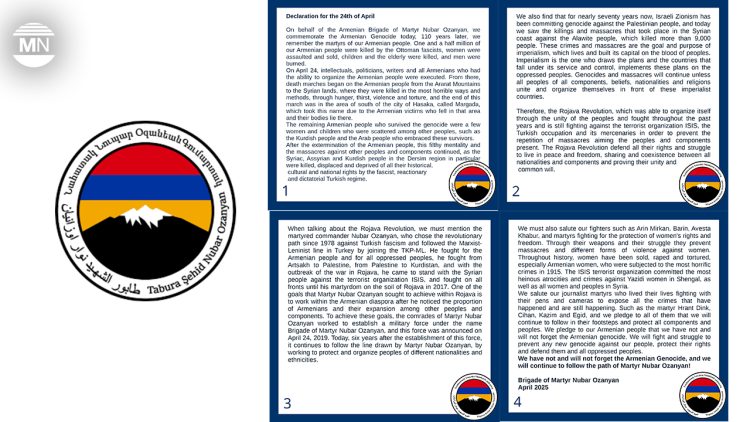
On the 110th anniversary of the Armenian genocide, a military unit formed by Armenian fighters in Syria’s autonomous northeast has vowed to continue resisting oppression and defending all vulnerable communities. The Brigade of Martyr Nubar Ozanyan, named after an Armenian revolutionary killed in 2017 while fighting the Islamic State (ISIS), issued a declaration on the eve of the anniversary, condemning both historic and ongoing atrocities.
“We remember the martyrs of our Armenian people,” the brigade said. “One and a half million of our people were killed by Ottoman fascists,” they continued, recalling the beginning of the genocide on 24 April 1915, when Armenian intellectuals, politicians and writers were arrested and executed across the Ottoman Empire.
The group, based in the Kurdish-led autonomous region known as Rojava, —linked the 1915 massacres to present-day violence. It denounced Israeli actions in Gaza, attacks on Alawite communities in Syria, and Turkish operations against Kurds, describing them as part of “imperialism’s genocidal logic”.
The brigade traced its roots to Nubar Ozanyan, a Marxist-Leninist who joined the Turkish Communist Party/Marxist-Leninist (TKP-ML) in 1978 and later fought in Palestine, Artsakh (Nagorno-Karabakh), and Rojava. He was killed in 2017 during clashes with ISIS. The brigade named in his honour was established on 24 April 2019 to organise and defend Armenians and other minorities.
The unit described its purpose as preserving the memory of the genocide while actively resisting future ones. “We have not and will not forget the Armenian genocide,” the statement declared. “We will fight and struggle to prevent any new genocide against our people.”
Their declaration also honoured women fighters and martyrs—such as Arin Mirkan, Barin, and Avesta Khabur—for their role in protecting communities from violence, particularly from ISIS. It condemned historic violence against Armenian women in 1915 and linked those crimes to the atrocities committed against Yazidi (Êzidî) women in the recent conflict.
The brigade also paid tribute to journalists who exposed crimes against humanity, including Hrant Dink, the Armenian journalist assassinated in Istanbul in 2007. “We salute our journalist martyrs who lived their lives fighting with their pens and cameras.”
Though relatively small in number, the Brigade of Martyr Nubar Ozanyan represents a fusion of historical memory and current resistance. It sees itself as part of a broader anti-imperialist front that includes Kurds, Arabs, Syriacs and other minorities in the region.
The Autonomous Administration of North and East Syria (AANES), governing the Rojava region, has previously acknowledged the Armenian genocide and allows communities to commemorate it freely—something Armenian groups say is not possible in neighbouring Turkey, where recognition of the genocide remains a criminal offence under certain legal provisions.
The brigade ended its declaration with a call for global unity: “Genocides and massacres will continue unless all peoples—of all components, beliefs, nationalities and religions—unite and organise themselves in front of these imperialist countries.”