

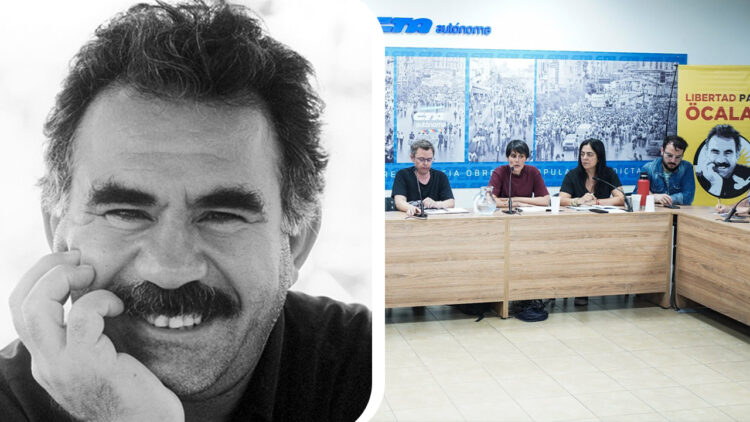
This week, the CTA Autónoma Workers’ Federation in Argentina hosted a meeting to gather support for the international campaign for the freedom of Abdullah Öcalan in Latin America.
Öcalan, who is the leader of the Kurdistan Workers’ Party (PKK), has been imprisoned by Turkey since 1999, in conditions of extreme isolation.
“This Wednesday, the National Headquarters of the Autónoma CTA hosted the launch of a continental campaign within the framework of the global campaign that began last year under the slogan ‘Freedom for Abdullah Öcalan, a political solution to the Kurdish question’. It is in answer to the call of the Kurdish Women’s Movement and trade unions, human rights organisations and politicians around the world, and is led by political organisations, human rights organisations, trade unions, and feminist organisations,” wrote the CTA.
The event was attended by union leaders, MPs, representatives of human rights organisations and activists from different political and social groups. The launch was attended by members of Autónoma CTA, the Labour and People’s Party – Revolutionary Communist Party (PTP-PCR) and the Workers’ Socialist Movement (MSI).
María José Cano, head of the CTA’s Human Rights Directorate, said “We are proud to launch this campaign for Öcalan’s freedom”.
The federation is also collecting signatures expressing support for the campaign, the signatures will be sent to the Inter-American Court and the relevant institutions of the Council of Europe.
The Workers’ Party (PO) and the Party of Socialist Workers (PTS) have also expressed their commitment to the campaign along with the Lawyers’ Guild, the Feminists of Abya Yala, the International League for the Rights of Man, the Permanent Assembly for Human Rights (ADPH), and the Cachito Fukman Militant Assembly.
“The Kurdish people are fighting for their most basic rights in the territories that are in four countries. For example, in Turkey the government expelled and did not recognise mayors who won the municipal elections in the Kurdish region of Turkey and the state intervenes with the excuse that they are terrorists, even imprisoning people for singing in Kurdish at weddings. There are 10,000 political prisoners, including Öcalan,” said Leandro Albani, an Argentinean writer who has authored books on Kurdistan.
“The Turks bomb Syrian Kurdistan (Rojava) on a daily basis, hit by war and violence and blockades in Syria. The Turks also bomb Iraqi Kurdistan,” Albani said. “In Iranian-occupied Kurdistan there are political prisoners, and the state has sentenced several Kurdish women… The world turns its back on the Kurdish people, and there is no reaction to Turkey’s attack,” the writer continued.
Aida Fento, a representative of the Kurdish women’s movement in Latin America (MMK), said: “These are very key moments for our movement. Abdullah Öcalan is recognised as the reber [guide] of the Kurdish movement. Thanks to his leadership and the seeds Öcalan has planted, the Kurdish people are a growing force.”
“After he was kidnapped and imprisoned, he was subjected to an unfair trial, and as Amnesty International said, it was a trial lacking evidence and Turkey refused the right to appeal,” Fento argued.
“Isolation is a measure that all governments use to discipline people. There is no other example of the conditions in which Öcalan is isolated today.” she continued.
Fento also highlighted that, in 2022, the UN Human Rights Committee and the European Court of Human Rights called on the Turkish state to release Öcalan, but that this never happened.
Felipe Meléndez, a member of the Academy of Democratic Modernity (ADM), attended the meeting by video link. Meléndez explained that he sees Öcalan’s kidnapping in the framework of “a third world war that is underway, initiated by a secret operation that began in 1960 when the communist bloc of the USSR [Soviet Union] was on the rise against capitalism. This operation operates against any resistance movement.”
“A persecution then begins against those who embody the community values of the peoples, and who seek to advance on resources such as gas, oil, and minerals to restructure capitalism and the energy route in the East,” he concluded.
Supporters in Latin America can join the campaign here.


