

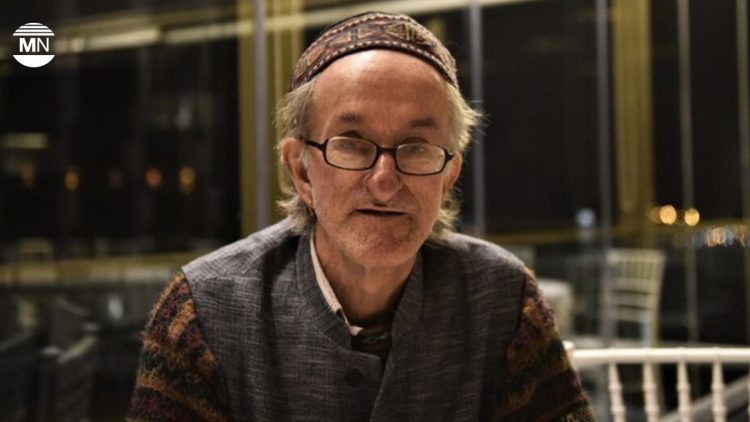
Anthropologist Dr. Felix Padel has called Abdullah Öcalan’s peace initiative an “incredible breakthrough” and argued that the Turkish state should respond constructively to the Kurdish leader’s latest call for peace. In a recent interview with Mezopotamya Agency, Padel expressed admiration for Öcalan’s model of democratic confederalism – a women-led, grassroots eco-democracy pioneered in Rojava, north-east Syria.
“The model of democratic confederalism, which to some extent has been put in place in Rojava, is something the world absolutely needs to learn from – if humanity is to progress to the next stage of beginning a democratic civilisation,” Padel said.
Padel, who received his doctorate from Oxford University while studying in New Delhi and is known for his work with Adivasi communities in India, praised the Kurdish movement’s long-standing commitment to democratic ideals, especially in the face of state repression. He described Öcalan’s vision as “deeply relevant” not just for the Middle East but for global democracies where political decisions are increasingly dominated by corporate lobbies and militarised interests.
“The model of democracy we see in places like Britain or India often isn’t very democratic at all—decisions happen behind closed doors, and there’s no continuity between governments. Democratic confederalism offers something different: participation, accountability, and a society built from the grassroots up.”
Highlighting the Kurdish movement’s disarmament gesture at the recent PKK congress, Padel urged Ankara to respond in kind: “It’s a courageous act. This call for the PKK to end its armed activities must be seen as a gesture of strength and peace. [President] Erdoğan has gained credibility globally for his stance on Palestine—he could gain far more by showing real leadership on the Kurdish issue.”
Padel also argued that freeing Öcalan—imprisoned since 1999—would signal a serious commitment to democratic dialogue: “It would free up so much more than one man’s liberty. It would unlock a wider potential for justice and reconciliation.”
He further underlined the significance of women’s liberation within Öcalan’s paradigm, especially the concept of Jineology, the science of women, which he said places Kurdish women “at the forefront of one of the most democratic movements in the world.”
“This is a struggle not just against external oppression, but against internal patriarchy. And that makes it genuinely democratic,” he said.
Calling for a global shift away from militarised economies and extractive industries, Padel warned: “The Earth’s ecosystems are being destroyed. Öcalan’s ecological vision, influenced by thinkers like Murray Bookchin, offers real alternatives. Turkey and the international community must take responsibility.”
Padel concluded by urging academics, media, and policymakers to break their silence: “The Kurdish people are resisting forced assimilation—just as they have for thousands of years. It’s time the world recognised that, and supported their vision of peace.”
Related Articles
Turkey must solve Kurdish question to ensure peace, DEM’s Bakırhan says amid regional tensionsCall grows for parliamentary commission on Turkey’s Kurdish peace processHow far can Rojava swim against the imperialist tide? Last week in Kurdish news


