

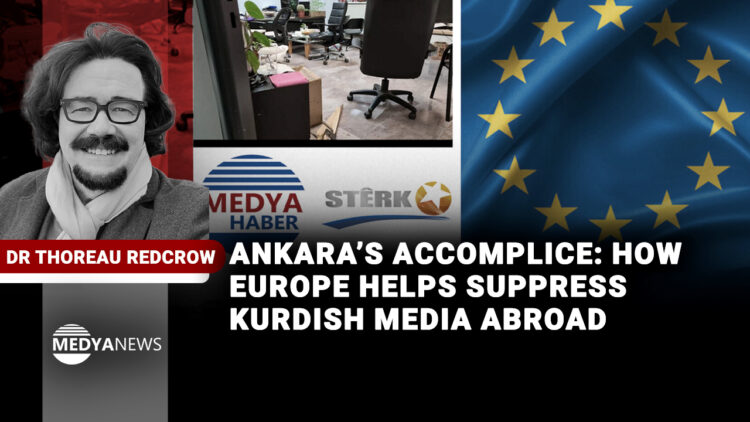
Dr Thoreau Redcrow analyses European complicity in suppressing Kurdish media abroad. Highlighting a raid by Belgian police on Kurdish TV stations Stêrk TV and Medya Haber on 23 April 2024, Redcrow shows how European actions echo Turkish tactics against Kurdish journalists. He emphasises the need for Europe to protect the Kurdish media and uphold democratic values and press freedom.
On April 23rd, 2024, around 200 armed Belgian federal police officers amassed at 1 a.m. in the town of Denderleeuw, in East Flanders (Belgium). Anyone observing this massive show of force and the militarized posture of the small army that was preparing for a nighttime siege, would have assumed they were about to storm an enemy fortress and take casualties in their attempt to capture some notorious criminal or mafia boss in the process. In fact, Belgian police even brought a water cannon that was available if needed. However, their real target that night was a television station building with no people inside, housing the Kurdish media channels Stêrk TV and Medya Haber.
This “target” of this raid was not a guarded base housing weapons, narcotics, or hostages, but a series of offices containing filming studios, computers, and editing equipment. The only “armaments” inside the premises were television cameras, “loaded” with the testimonies representing millions of Kurds in European exile and the cruelty of those states occupying Kurdistan that denied them their human rights and drove them to seek refuge in a new country. But the mistake such Kurds made on this night was believing they were now safe to tell their story of survival in their new home nation, far away from the secret police, death squads, and torture chambers they had fled.
On that night, over a span of four hours until 5:30 a.m., hundreds of Belgian police looked and acted more like the Turkish deep state gendarmerie or neo-fascist Grey Wolves gangs that many Kurds had escaped from in Turkey, than representatives of the law for a European state with constitutional protections. Indeed, these Belgian police cut the phone lines, broke down doors, smashed ceilings, damaged large LED screens, severed camera cables, wrecked technical equipment, disabled the broadcasting signal, and seized computers containing journalistic sources—which are supposed to be protected as anonymous under a free press.
Brussels authorities also disregarded Belgian law, which prohibits conducting surprise house searches between 21:00 and 05:00, relying instead on the one exemption for stopping “terrorism,” which apparently an empty Kurdish news studio is to them. So, rather than contacting the media company’s lawyers and presenting a legal search warrant to inspect the premises—as one would expect in a democratic society—Belgian police simply looted and vandalized these TV stations of Kurdistan in exile, in a style that was reminiscent of how the Turkish military’s jihadist gangs have terrorized and stripped down the Turkish occupied city of Afrin over the last six years.
Timing is Everything
But as if that were not bad enough, while Belgian police were ransacking Kurdish media stations, Turkish police were simultaneously carrying out night raids on the homes of nine Kurdish journalists throughout Turkey in Istanbul, Ankara, and Riha (Urfa). In further indignity, four of the journalists arrested were female, with at least one of the women (Esra Solin Dal) strip-searched by Turkish police and subsequently held in solitary confinement for eleven days. But that is not surprising when you consider that in 2019, Turkey was identified as having the highest number of imprisoned female journalists in the world, and their longest-serving jailed journalist is a woman—Hatice Duman, imprisoned since 2003.
Moreover, those familiar with the historical timeline of Turkey’s oppression of Kurdish rights know that the Turkish state never chooses dates for their actions by accident, and these raids were scheduled on the night after Kurdish Journalism Day, where Kurds were celebrating the 126th anniversary of the first newspaper representing Kurdistan. In the same way that the Turkish military will often carry out deadly drone strikes or invasions on important Kurdish holidays to psychologically assault the joy of Kurds, in this instance they wanted to send an ominous message that Ankara’s repressive tentacles can reach into European cities and stifle free speech abroad, just like at home.
Unfortunately, this was not even the first time Belgian authorities tried to crush Kurdish media on behalf of Turkey; previously, Belgian police raided Kurdish TV channels in 1996 and 2010. In this way, the process seems to curiously operate on an annual 14-year cycle—emerging like dormant underground periodical cicadas to follow Ankara’s commands. In the last 2010 case, Belgian authorities seized all computers and hard drives but never found any criminal evidence, so following their harassment of the Kurdish press, charges were never brought. But then, just as now, actual convictions are not the point, but rather intimidation of Kurdish activists and a display of obedience to Turkey’s wishes based on financial interests.
In this latest case, Belgian authorities did not want to assume all the blame for themselves and claimed that the raids were actually done at the behest of France and the same French authorities who have recently been shamefully handing over Kurdish asylum seekers like Serhat Gültekin to Erdoğan’s regime, so he can parade them in front of Turkish flags in handcuffs and publicly humiliate all Kurds by mocking them with such nationalistic displays. But whether it is leaders in Brussels or Paris obediently following Ankara’s dictates, it makes little difference to the Kurdish community in Europe, who are endangered by such servility.
Past is Prologue
Yet, in a dark irony, these Kurdish TV stations are only broadcasting in Belgium because many other European nations have been even worse when it comes to repressing Kurdish media. For instance, Denmark, France, Germany, and the United Kingdom have all previously banned and criminalized Kurdish TV stations at the behest of Turkey. In the case of the latter, MED TV, an influential Kurdish cultural media channel from 1995–1999, was eventually shut down in London by the chairman of the Independent Television Commission (ITC), Sir Robin Biggam, who had financial interests in the British defense contractor BAE Systems, which was selling weapons to Turkey.
But, to comprehend the importance of Kurdish media like MED TV at the time, which is instructive in understanding the importance of stations like Stêrk TV and Medya Haber now, one needs to appreciate the key role it played in preserving a Kurdish culture that Turkey has always wanted to eradicate.
First, consider that in Turkey, it was legally forbidden to speak Kurdish in public until January 25, 1991. But even once the language ban was officially lifted, Kurdish journalists had to wait until 2002 for publications in Kurdish to be allowed. So, it was within this political climate in the late 1990s that MED TV’s weekly programming included news broadcasts in Kurdish, language lessons in standard Kurmancî, old Turkish movies now dubbed in Kurdish, and perhaps most importantly, live studio discussions with telephone callers from various parts of the globe. As a result, Turkey made it a criminal offense for Kurds to point their TV satellites towards Europe, where they could receive MED TV in their mother tongue.
During a House of Lords debate on human rights in Turkey, Raymond Jolliffe (aka Lord Hylton) spoke of the impact he witnessed from such stations in occupied Northern Kurdistan (southeast Turkey), testifying:
“When I went to Diyarbakir [Amed] and Mardin in December 1995 for the Turkish general election, I enquired particularly whether that TV station [Med-TV] was being received and what the public response was. I was told that the viewers were positively rapturous. Old [Kurdish] people had wept for joy after such a long period of cultural starvation. For all, it was a new window on the world and, what is more, in their own language.”
Tragically, preserving such Kurdishness and creating that joy came at a high price in Kurdish journalists’ lives.
A Matter of Life and Death
You cannot understand the need for Kurdish media in Europe without considering the deadly history of oppression against Kurds in Turkey for reporting the truth of what the government was doing. For instance, from 1992 to 1994, a total of 76 journalists and staff of the Kurdish newspaper Özgür Gündem (Free Agenda) were murdered in Turkey by state paramilitary forces (JİTEM). This was followed up in 1994, when three offices of the newspapers Özgür Gündem and Özgür Ülke (Free Country) were bombed. When Turkey’s Prime Minister Suleyman Demirel was asked in 1992 about all the killings of Kurdish journalists at the time, he infamously quipped: “Those killed were not real journalists. They were militants in the guise of journalists.” This is essentially the same argument that Erdoğan uses today when assassinating Kurdish journalists in Rojava with his Bayraktar drones.
Mind you, most of these Kurdish journalists Demirel was referencing were kidnapped in ‘white toros’ (Renault) cars and shot or openly executed in the streets by Turkish police assassins. Of note, when Ankara was not murdering Kurdish journalists from Özgur Gündem during this time, they were charging them for criminal offenses by launching 336 court cases against the paper for accusations such as “portraying Turkish citizens as Kurds” and using the words “Kurd” or “Kurdistan”—telling you all you need to know about what Turkey commonly considers ‘terrorism.’
A Black Hole for the Kurdish Language
Europe is a crucial ‘incubator’ for Kurdish-language media because such outlets are criminalized and banned in Turkey. Murat Bayram, journalist and founder of Botan International (the first and only organization to offer Kurdish media training in the history of Turkey), described the threat to Kurdish media within the Turkish state, writing:
“The media in Kurdish has already experienced extinction in some fields in Turkey: There is no daily newspaper in Kurdish, there is no nationwide radio channel broadcasting in Kurdish, there is no news agency with Kurdish as its main language or there is no private TV channel offering news programs in Kurdish in satellite broadcasting or cablecasting. There is a single TV channel broadcasting news in Kurdish [TRT Kurdî]. And it belongs to the state.”
Adding to Bayram’s figures which were calculated in 2021, of the 2,164 daily magazines in Turkey, none are in Kurdish. Of the 2,582 daily newspapers in Turkey, none are in Kurdish. Of the 350 satellite channels and 172 cable television channels in Turkey, only two are in Kurdish: state controlled TRT Kurdî and Zarok TV, which offers content for children. Such shocking figures in a nation with over 20 million Kurds are all the more reason why Europe—home to several million exiled Kurds—should be a humanitarian haven to preserve the Kurdish-language media, not a coconspirator for a culturally genocidal state bent on its eradication.
No Thoughtcrimes Allowed
For all intents and purposes, there currently is no ‘press’ in Turkey. For instance, Turkey is currently ranked 158th out of 180 countries for press freedom by Reporters Without Borders (RSF). Furthermore, in 2023, Turkey also ranked as the world’s ninth largest jailer of journalists by the Committee to Protect Journalists (CPJ).
But 2023 was actually a relatively “slow year” for Ankara’s repression, as they have been running out of opposition newspapers to target since so few of them still exist. For example, earlier in 2016, Erdoğan’s regime used the pretext of an attempted military coup against his autocratic rule to shutter more than 170 newspapers and media outlets and jail over 120 journalists without a court hearing. Such actions led the organization Reporters Without Borders to announce that Turkey had essentially become “the world’s biggest prison for professional journalists.”
Yet, despite the lack of remaining targets, on April 25th, 2023, Turkey still managed a series of dawn raids targeting the homes of 128 people, including journalists, lawyers, human rights defenders, political activists, and artists in twenty different provinces. Technical equipment, computers, books, and documents belonging to journalists were also confiscated by the Turkish police during those raids—just as occurred recently in Belgium.
Such raids in Turkey occur annually, as the aforementioned 2023 raid followed similar ones in June 2022 targeting twenty journalists in Amed and in October 2022 targeting eleven Kurdish journalists in seven different cities. As Human Rights Watch described the practice, “Turkey has a long history of bringing criminal charges, including for terrorism offences, against independent journalists solely because of their journalistic work.” In fact, the Mapping Media Freedom database records an astonishing 249 separate alerts involving Turkey over the last decade.
The way that these arrests and convictions typically occur is that editors, journalists, publishers, and authors are regularly thrown in Turkish jails and charged with “provoking hostilities among the people,” which is an offense under Article 216 of the Turkish penal code. Likewise, they commonly face persecution for “the denigration of Turkishness” under Article 301 of the same Orwellian statute.
All of that is to say that the Turkish government’s repression of the Kurdish press, both within Turkey and in Europe, is a multifaceted strategy aimed at silencing dissent, controlling the narrative, and suppressing Kurdish identity or demands for autonomy. Despite international condemnation and pressure, these repressive tactics persist, posing significant challenges to freedom of expression and human rights in Turkey and beyond—like in the aforementioned case of Belgium’s recent raid.
Turkish Suppression at Home
When it comes to the Kurdish press, the Turkish government has a long history of restrictions and intimidation. Turkey’s crackdown is also evident in the closure of Kurdish media outlets. Ankara frequently uses emergency decrees or administrative measures to shut down newspapers, television stations, and websites deemed to be sympathetic to the Kurds. In nearly all cases, these closures are carried out without due process, leaving journalists and media workers without recourse to challenge the decisions.
The following list is a basic summary of how domestic suppression against the Kurdish press within Turkey operates:
‣ Legal flexibility: The Turkish government employs a combination of extralegal measures to suppress Kurdish media. Laws such as the Anti-Terrorism Law, the Turkish Penal Code, and the Press Law are often used to prosecute journalists and media outlets perceived as sympathetic to Kurdish causes. These laws are broadly worded and allow for the criminalization of legitimate journalistic activities under the disingenuous guise of “combating terrorism.”
‣ Weaponized judiciary: Kurdish journalists frequently face arbitrary arrests and detentions. They are often charged with offenses such as “spreading terrorist propaganda” or inciting violence, which are vaguely defined and open to interpretation. Many journalists spend prolonged periods in pre-trial detention, facing limited access to legal representation and no due process.
‣ Silenced opposition: The Turkish government has a history of shutting down Kurdish media outlets, both print and broadcast. Authorities justify these closures on grounds of national security or links to terrorist organizations (i.e., any Kurdish organization that defends itself). This tactic not only suppresses dissenting voices but also creates a climate of fear among journalists and media organizations.
‣ Climate of fear: Kurdish journalists and their families often face intimidation and harassment from state authorities and pro-government groups. This includes surveillance, threats of violence, and even physical attacks. Such tactics aim to deter journalists from reporting on sensitive issues relating to Kurdish rights and the Turkish state’s policies in the Kurdish-majority regions of southeast Turkey (occupied Northern Kurdistan).
‣ Muzzled speech: The threat of legal repercussions and physical harm leads many Kurdish journalists to self-censorship. They avoid reporting on topics deemed sensitive by the government, such as Kurdish identity, cultural rights, and the Kurdistan freedom movement. This censorship limits public discourse and perpetuates a one-sided narrative promoted by the Turkish state.
Turkish Repression Abroad
The criminalization of the Kurdish press in Europe on behalf of Turkey raises important questions about press freedom, human rights, and the relationship between the EU and the Turkish police state. It underscores the challenges faced by Kurdish journalists and media outlets in their efforts to report on issues of importance to their communities while navigating political pressures and legal constraints.
The following list is a basic summary of how external repression against the Kurdish press in Europe by Turkey operates:
‣ Extraterritorial reach: The Turkish government’s repression of Kurdish media extends beyond its borders, targeting Kurdish diaspora communities in Europe. Turkish intelligence agencies and diplomatic missions actively monitor Kurdish journalists and activists living abroad, using various means to intimidate and silence their dissent.
‣ Embassy ultimatums: Turkey exerts diplomatic pressure on European governments to suppress and harass Kurdish media within their jurisdictions. This includes lobbying for the closure of Kurdish TV channels, radio stations, and newspapers that are critical of Erdoğan’s despotic regime. European countries often face a dilemma between upholding freedom of expression and maintaining good trade relations with Turkey.
‣ Jurisdictional manipulation: Turkish authorities exploit legal mechanisms in European countries to target Kurdish journalists and media outlets. They file lawsuits alleging defamation or incitement, leading to the arrest or extradition of Kurdish journalists. The abuse of Interpol red notices by Turkey to seek the arrest of Kurdish journalists abroad is also widespread and cheapens the idea of what constitutes “a national security threat.”
‣ Disingenuous anti-terrorism: One common tactic used by Turkey to target Kurdish media in Europe is the issuance of international arrest warrants or extradition requests against Kurdish journalists, activists, or political figures who are perceived as challenging the oppression by the Turkish state. These individuals are typically accused of being ‘terrorists’ based on Turkey’s broad anti-terrorism laws, which have been criticized for their vague and expansive definitions. In some cases, European countries inexcusably comply with Turkey’s extradition requests, which challenges the notion that freedom of expression exists within Europe.
‣ Surveilling & intimidating: Kurdish journalists living in Europe report being under constant surveillance by Turkish intelligence agents and affiliated groups. They face threats, harassment, and physical violence, reminiscent of the tactics used within Turkey. Such actions undermine the free press that European democracies guarantee and foster a climate of fear. Kurdish activists in the European diaspora will frequently speak of receiving random threatening phone calls from the Turkish state, carried out in an attempt to scare them into silence.
‣ Regurgitating misinformation: The Turkish state provides financial and logistical support to pro-government ‘news’ outlets and think tanks operating in Europe. This quasi-state media disseminates propaganda aimed at discrediting Kurdish journalists, distorting the reality of the armed Kurdistan liberation struggle, and promoting the alternate reality of Erdoğan’s regime on all issues related to the Kurds.
As can be seen in the two preceding breakdowns, the Turkish government’s crackdown on Kurdish voices within Turkey and the European diaspora represents a grave violation of democratic and journalistic rights. Such tyranny is part of a wider ‘ecosystem’ of occupation that aims to control all Kurds wherever they reside, even going as far as wanting to control the names they give their children while abroad. You have even had Turkey submit extradition requests for Kurds who are not citizens of Turkey and have never stepped foot in the country. This is why the criminalization of the Kurdish press by collaborating states in Europe is so dangerous and inexcusable. Europe must be a safe haven for the Kurdish press and media, not an accomplice and hired ‘slave catcher’ for Erdoğan’s dictatorship.
Reactions to the Raid
Coming full circle back to Belgium’s recent raid a few weeks ago, a number of organizations, political parties, and journalists understandably denounced what occurred. So, it is only fitting that their testimonies serve as my final word on the matter, since they know firsthand just what it means to seek a “free” press both in an occupied homeland and in a European Kurdish diaspora where their new states ironically emulate the tyrant they were granted refugee asylum from.
Domestically, the Flemish Association of Journalists (VVJ) strongly condemned the raid after witnessing the damaged site, with VVJ General Secretary Charlotte Michils stating: “We denounce the show of force that accompanied the actions and the considerable damage done. We do hope that all press freedom guarantees have been met during the procedure.” Likewise, the Belgian affiliate of the European Federation of Journalists (EFJ) General Secretary Ricardo Gutiérrez urged Belgian authorities to respect the principles behind a free press, outlining how: “The confidentiality of journalistic sources equally applies to the Kurdish TV channels based in Belgium.”
With regards to journalistic critiques, the Syriac-focused Suroyo Media Foundation issued a statement condemning the Belgian security forces, declaring: “Such raids on homes and media centers in Turkey, Belgium, and France are anti-democratic and against free thought. Silencing the press and TV channels is a blow to European values.” While journalist Heval Arslan highlighted that the raids had taken place following Turkish Foreign Minister Hakan Fidan’s visit to Belgium, observing that:
“This situation is not independent of the agreements between NATO countries and Turkey. What is happening is not independent of the genocidal policies against the Kurds… It is completely related to the war policies of the Turkish state. It is related to the invasion attacks that the Turkish state wants to carry out against Southern Kurdistan [northern Iraq] and North East Syria (Rojava).”
As for Kurdish political organizations, the Co-Chairs for the Democratic Kurdish Community Council in the Netherlands (DEM-NED) released remarks, asserting: “In Europe, which constantly tells us that democracy and human rights are legitimate, this discourse has been denied by Europe itself. We must stand by our press organisations. Our media organisations are not only the voice of the Kurdish people, but also the voice of all oppressed peoples.” This was similar to Murat Ceylan, a board member for the European Kurdish Democratic Societies Congress (KCDK-E), who reminded everyone: “When the voice is silenced, the path for massacres is opened. We need to protect free press workers and our television [stations].”
But perhaps the epilogue on this topic should be given by the workers from the raided TV stations themselves, who released a statement that ended with them professing:
“We will conclude with this simple message – ‘we are here.’ We see ourselves as responsible for informing the Kurdish people and keeping our language and culture alive. In the face of all kinds of oppression, including deadly attacks against our colleagues, our pens will continue to write, and our cameras will continue to capture the truth. Kurdistan journalists have reported on the Turkish state’s massacres, immolations, and summary executions, even at risk of their lives. It was the sacrifices made by the free Kurdish press which revealed the atrocities committed by ISIS to the world, as our colleagues lost their lives in pursuit of truth on behalf of the world. The world knows this, and we will accordingly continue to pursue truth, high ethical standards, and report on what is really happening in Kurdistan.”
Thoreau Redcrow
Dr. Thoreau Redcrow is an American global conflict analyst who specializes in geopolitics, stateless nations, and armed guerrilla movements. He is a frequent speaker before the United Nations Human Rights Council in Geneva and has been a foreign policy advisor for several groups seeking self-determination. He has previously worked on the ground throughout Europe, Latin America, the Caribbean, Eastern Africa, and the Middle East. He is currently Co-Director of The Kurdish Center for Studies (English branch).


