By Zegrus Enderyari
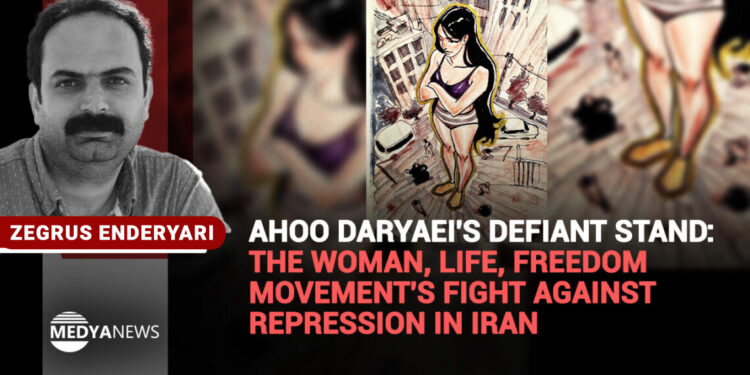
In a powerful act of defiance, Ahoo Daryaei, a young Iranian student at Tehran’s Islamic Azad University, Science and Research Branch, stood up to the regime’s repressive forces in an unforgettable way. Harassed by the university’s morality police for her so-called ‘improper hijab’, she chose not to submit. Instead, she turned her body into a symbol of protest, stripping off her clothes in defiance and marching through the campus. Her courage speaks volumes, not only for her own struggle, but for the wider movement unfolding in Iran: the ‘Woman, Life, Freedom’ Revolution.
Their stand comes in the face of brutal repression, with the authorities constantly trying to control women’s bodies and, even more so, their voices and autonomy. Now, state forces are trying to silence her by claiming she suffers from mental instability – a familiar tactic used by the Iranian regime to delegitimise dissent. Ahoo’s story echoes the experiences of countless women who have been labelled ‘unstable’ or ‘mentally ill’ for challenging authority. And yet her courage has ignited a fire of solidarity, driving the principles of Woman, Life, Freedom, a movement that has come to define the struggle for justice in Iran.
The background: A struggle against oppression
The Woman, Life, Freedom movement originated with the Kurdish slogan “Jin, Jiyan, Azadi” and gained worldwide attention after the tragic death of [Jina] Mahsa Amini in 2022. Amini, a young Kurdish woman, was arrested by Iran’s morality police for allegedly wearing her hijab ‘improperly’ and subsequently died in custody under suspicious circumstances. Her death became a flashpoint, inspiring a wave of protests across Iran, with women burning their hijabs and cutting their hair in defiance of a regime that systematically denies them their rights and autonomy.
Since then, the movement has taken root throughout Iran, uniting people across ethnic, religious and socio-economic lines. It’s not just a struggle for women’s rights, but a broader struggle for human rights and freedom. The revolution is not just about women’s bodily autonomy, but about the right to life, security and self-expression for all Iranians. At its core, Woman, Life, Freedom challenges an authoritarian system that represses all those who demand change.
Ahoo Daryaei’s act of defiance
In this context, Ahoo Daryaei’s actions are both symbolic and revolutionary. According to eyewitness accounts, after being accosted by the university’s morality police and a Basij member, she boldly took off her trousers and threw them at the officers in protest. This was not an act of mental instability, but an act of reclaiming her body and dignity from a regime that seeks to control every aspect of women’s existence.
Her stance has struck a chord across Iran. Social media and international news outlets have been flooded with calls to share her story, using her name – Ahoo Daryaei, which means ‘Deer of the Sea’ – to honour her resilience and bravery. But the regime’s response has been predictable. In an attempt to discredit her, they have publicly claimed that she suffers from mental illness, attempting to label her as mentally unstable and forcibly commit her to a psychiatric facility. This move is part of the regime’s well-worn strategy of undermining protesters by portraying them as irrational or disturbed in order to divert attention from the movement’s legitimate demands.
The politics of silencing: Pathologising protest
The attempt to pathologise Ahoo Daryaei reflects a wider pattern of repression in Iran. Historically, the Iranian authorities have used similar tactics to stifle dissent and diminish the voices of those who oppose their rule. Masih Alinejad, an outspoken Iranian journalist and activist, has experienced these tactics first-hand. When she launched the My Stealthy Freedom campaign in 2014 to challenge the compulsory hijab law, the regime claimed she had suffered a mental breakdown and spread false accusations to discredit her in the eyes of both Iranians and the international community.
By labelling dissent as mental illness, the regime seeks to isolate individuals and deter others from following their lead. But in doing so, they also reveal their fear of these acts of defiance. Every woman who stands up, every protester who challenges these oppressive structures, is an implicit threat to their control. Ahoo’s act of removing her clothes symbolically stripped the regime of its power over her body and her choices, challenging the authority of the state in a way that echoes throughout Iran.
The Woman, Life, Freedom Revolution: An enduring movement
Ahoo’s story, and the solidarity it has inspired, demonstrates the resilience of the Woman, Life, Freedom movement. Women in Iran are refusing to be silenced, despite facing unimaginable consequences. From the streets of Tehran to university campuses, Iranian women are fighting back with an unbreakable spirit. They are using every tool at their disposal – their voices, their bodies, their art – to protest against a regime that has oppressed them for decades.
The current protests in Iran, where students and professors at universities across the country have announced sit-ins and a boycott of classes, show how deep this movement has gone. The struggle is no longer just about the hijab; it’s about the right to live freely, safely and with dignity. Every act of defiance, no matter how small, chips away at the state’s control and shows the world that Iranian society is alive with resistance and courage.
Why Ahoo Daryaei’s story matters
Ahoo Daryaei’s courage embodies the spirit of Woman, Life, Freedom. Her stand against the morality police has given the movement another face, another story and another symbol of defiance. But it also underlines the danger faced by those who resist. As activists and allies, both in Iran and around the world, it is imperative that we amplify her story, refuse to accept the regime’s narrative, and demand her immediate release.
Iranian women’s struggle for freedom resonates globally as it raises universal issues of bodily autonomy, freedom of expression and gender equality. Ahoo’s bravery is an inspiration to all who seek justice and challenges the world to recognise the fundamental rights and dignity of women everywhere.
Now more than ever, Ahoo Daryaei needs the support of the international community. As calls for justice grow louder, we must demand her release from the psychiatric hospital where she has been forcibly detained, and ensure her safety. Let her name – Ahoo Daryaei, Deer of the Sea – echo across borders and media channels.
As we remember her act of defiance, let us continue to share her story and let her courage inspire a collective determination to fight for freedom and equality. This movement, Woman, Life, Freedom, is a reminder that every person has the power to choose courage over fear, and that this choice is a vital, liberating act. By standing with Ahoo Daryaei, we honour her courage and reaffirm our support for the ongoing struggle for justice in Iran.
The world is watching and the cry for women, life and freedom will not be silenced.
Zegrus Enderyari is a Kurdish activist from Eastern Kurdistan and a member of the “No to Execution, Yes to Free Life” campaign.