

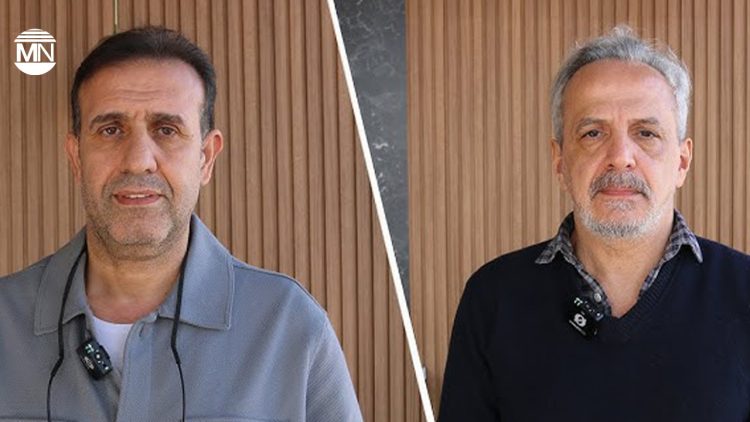
Following Abdullah Öcalan’s call for ending the armed struggle, leading academics on the Kurdish issue have affirmed that a new phase in Kurdish-Turkish relations has already begun. Vahap Coşkun, an associate professor at Dicle University of Diyarbakır (Amed), and sociologist Prof. Mesut Yeğen emphasised the historical significance of the development and the urgent need for confidence-building measures from all sides. According to Coşkun, this shift will redefine Turkey’s political landscape, moving Kurdish demands—such as equal citizenship, local governance, and cultural rights—entirely into the political sphere.
“Weapons are gone, now politics will take centre stage,” Coşkun stated, highlighting that the transformation will require legislative reforms and societal consensus. He further elaborated that two key developments must follow: the Kurdistan Workers’ Party (PKK)’s formal decision to dissolve itself and the government’s preparation of the necessary legal changes to accommodate this transition.
“Kurdish politics must now be fully integrated into the democratic framework, which means not only constitutional guarantees but also a shift in the state’s approach towards political representation, local governance, and cultural rights,” he said.
Addressing public scepticism, Coşkun noted that past failures of peace processes, particularly after 2015, have left many wary. “Society has suffered great losses before. People fear that if this attempt fails, the consequences could be severe. The only way to prevent distrust is through swift and clear confidence-building steps from all parties.”
He urged the PKK to make a clear, unconditional declaration of its next steps, while calling on the Turkish government to initiate legal and social reforms without delay. “This is not a process that can be stalled indefinitely. The sooner both sides act, the stronger public support will be,” he warned.
Prof. Mesut Yeğen, a leading expert on Kurdish political movements, underlined the regional implications of Öcalan’s call, particularly regarding North and East Syria (Rojava). He suggested that Turkey’s change in approach is linked to broader geopolitical shifts, especially the declining influence of Iran in the region.
“The process is moving forward, and legal changes will follow,” Yeğen stated, adding that while the 27 February declaration did not explicitly mention Rojava, an implicit understanding between the Turkish state and Kurdish actors in Syria may already exist.
“For the last ten years, the future of Rojava has been uncertain. The lack of direct reference to Rojava in Öcalan’s call suggests that some form of negotiation may already be underway. If a political settlement is reached in Turkey, it will inevitably have consequences for Syrian Kurdish governance,” he explained.
Yeğen argued that a gradual recognition of Kurdish autonomy in Syria could be part of a broader deal, wherein the PKK disarms in exchange for democratic reforms within Turkey and a more stable arrangement for Rojava.
In assessing Turkey’s motivations, Yeğen pointed to major geopolitical shifts: “This is not simply a moral decision for peace. The regional power balance is changing, with Iran’s influence in decline and Turkey recognising that its military approach alone cannot sustain control over Kurdish regions. This is not just a peace process—it is a security strategy for Turkey’s long-term stability.”
On the next legal steps, Yeğen stressed that the Turkish state must prepare legislative changes to facilitate the transition from armed struggle to political engagement. “Once disarmament is confirmed, the government must implement a series of reforms,” he said, listing key areas such as the release of PKK prisoners, the lifting of restrictions on Kurdish political activity, and changes to governance in Kurdish-majority regions, including an end to state-appointed trustees in municipalities.
Yeğen also highlighted the role of civil society and political actors in ensuring the success of this transition. He asserted:
"We cannot leave this to the state and the PKK alone. Civil society, journalists, political parties—all must play their role in shaping the narrative. Peace is not just about stopping conflict; it requires a cultural and political shift to sustain democratic participation."
Both academics concluded that a historic opportunity is at hand, but the success of the process will depend on clear commitments from all sides. They warned against sabotage attempts, political hesitation, or delays in legal reforms, stressing that Turkey now stands at a crossroads between a lasting peace and a return to uncertainty.
Abdullah Öcalan, the imprisoned leader of the PKK, on 27 February made a historic call for the group to disband and an end to the armed Kurdish struggle, in a declaration read by the DEM Party’s İmralı delegation in Istanbul. The announcement has been described as the “Call of the Century” and is considered a turning point in the decades-long conflict between the Turkish state and the Kurdish movement.
Öcalan has been imprisoned for 26 years, having been captured in 1999 in an international operation involving Turkish intelligence and global allies. He has since been held in İmralı Island Prison, under conditions of extreme isolation, with limited legal and family visits. Despite this, he remains a central political figure for the Kurdish movement, and his calls for peace have historically shaped political dynamics in Turkey and the broader region. The latest declaration signals a potential shift towards a political resolution to the Kurdish issue, with implications beyond Turkey, particularly in Syria and Iraq.


