

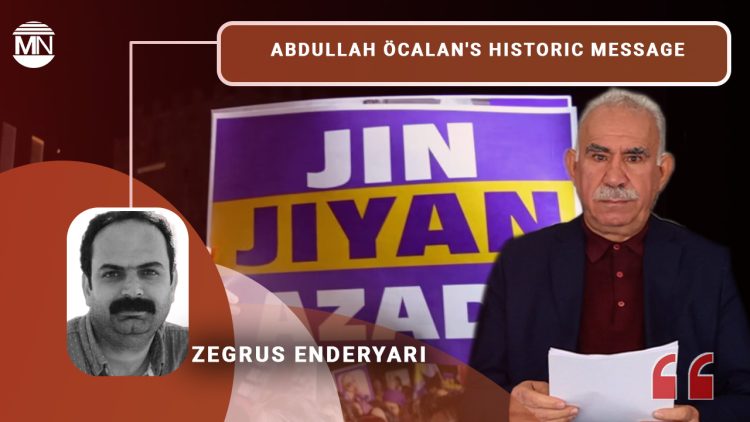
The historic message from Abdullah Öcalan, the leader of the Kurdistan Workers’ Party (PKK), calling for the laying down of arms and the dissolution of the organisation, is not only a turning point in the history of Kurdish struggles but could also have profound and multifaceted impacts on the future of Kurds in the region, especially in Turkey, Syria, Iraq and Iran. The statement reflects Öcalan’s strategic insight and wisdom in adapting to modern realities, and the need to shift from armed struggle to political and legal activism. In the following, we explore the potential impacts and opportunities arising from his message.
A fundamental transformation in the Kurdish issue in North Kurdistan
With his message, Öcalan has guided the Kurdish movement in Bakur [North Kurdistan, in southeast Turkey], which has been shaped by his ideology and leadership for more than five decades, towards a new path. This shift from armed struggle to the political and legal arena could pave the way for peaceful negotiations with the Turkish government, a guarantee of equal rights for Kurds, and the democratisation of the country’s political structure. If Ankara responds positively to this proposal, not only would the Kurdish issue in Turkey move toward resolution, but this transformation could also become a model for other countries in the region. However, the success of this process depends on the political will of the Turkish government and its adherence to commitments.
The PKK and the foundation of a democratic society
Under Öcalan’s leadership, the PKK has aimed beyond being an armed group, seeking to establish a democratic and decentralised society. The movement has created structures that preserve Kurdish cultural identity and have led to direct democracy. Öcalan’s recent message shows that this goal will now be pursued through legal and civil means. In his statement, he explicitly stresses the need to develop a “language of peace and democratic society” and distances himself from extreme nationalist deviations such as separate nation-states or self-rule as ineffective solutions.
Impact on Kurds in South and West Kurdistan
In northern Syria, the model of democratic self-administration based on Öcalan’s ideas in Rojava [West Kurdistan] has become a successful example of decentralised governance in the Middle East. Öcalan’s message could have a direct impact on this region, particularly if the PKK fully abandons the armed struggle. This could bring about a reduction of Turkish pressure on Rojava, and the region could be recognised as an autonomous entity. In Başûr (South Kurdistan, in Iraq), this shift in approach could help reduce tensions in places like Shengal (Sinjar) and strengthen cooperation among Kurdish groups, especially in the face of shared threats such as Turkish attacks or regional instability.
Consequences for East Kurdistan and the “Jin, Jiyan, Azadî” movement
Öcalan’s ideas have had a profound impact on the Kurdish democracy movement in Rojhilat (East Kurdistan, in Iran) over the past two decades. Concepts such as radical democracy, self-management and gender equality, which Öcalan has promoted, have played a role in the formation of political and civil organisations in Rojhilat. The Jin, Jiyan, Azadî (Woman, Life, Freedom) movement, which began in Rojhilat and turned into a nationwide movement in Iran, has clearly been inspired by these ideas. This movement, with its emphasis on women’s freedom, social justice and participatory democracy, shares a close connection with Öcalan’s philosophy.
If the Kurdish movement in Turkey moves toward a legal and political struggle, this shift could serve as a model for Rojhilat, turning armed activism into civil and democratic struggles. Such a transformation has the potential to act as a catalyst for advancing democracy movements throughout Iran. Given Öcalan’s iconic status among the Kurds, greater freedom for him to offer practical solutions (as promised in his meeting with representatives of the Peoples’ Equality and Democracy [DEM] Party) could pave the way for the establishment of democracy in Rojhilat and potentially throughout the country.
However, there may be negative reactions from the Iranian government. There is speculation that Iran might oppose this democratic process in Turkey, due to concerns about the strengthening of Kurdish self-management and its impact on internal security. The success of such a transformation in Turkey could lead to relative self-administration in three parts of Kurdistan (Bakur, Rojava and Başûr), which in turn could put more pressure on Iran to address similar demands.
Will these changes lead to a sustainable democratic process?
The key question is whether the regional governments, especially Turkey, will understand and respond positively to this paradigm shift. The success of the process depends on multiple factors: Turkey’s commitment to peace negotiations, regional acceptance of these changes, and the Kurds’ ability to manage the transition. If the process is carried out correctly, it could be the beginning of a peaceful resolution to the Kurdish issue across the entire Middle East and lead to lasting peace.
For Iran, this transformation could have two main outcomes: first, the strengthening of democracy movements inspired by the model in Turkey, and second, increased pressure on the Iranian government to respond to the demands of Kurds and other groups. Öcalan, with his profound understanding of the region’s history and politics, has provided solutions that, if implemented, could guide not only Kurdistan but the entire Middle East toward democracy. The message, regardless of its direct audience, could take on a universal form and be recorded in history as a model of rationalism and globalism.
Conclusion
A crucial step in the Kurdish struggle and the fight for democracy in the region, Abdullah Öcalan’s historic message has the potential to bring about fundamental changes in regional policies. From its impact on the Kurdish movement in Turkey, Syria and Iraq, to its influence on the democracy movement in Iran, this message could serve as a model for other minority groups and human rights movements worldwide. The transformations that follow Öcalan’s message, especially with his new and strategic approach to regional issues, could pave the way for new regional cooperation, peace and democracy in the Middle East.
Zegrus Enderyari is a Kurdish activist from Eastern Kurdistan and a regular contributor to Medya News.


