

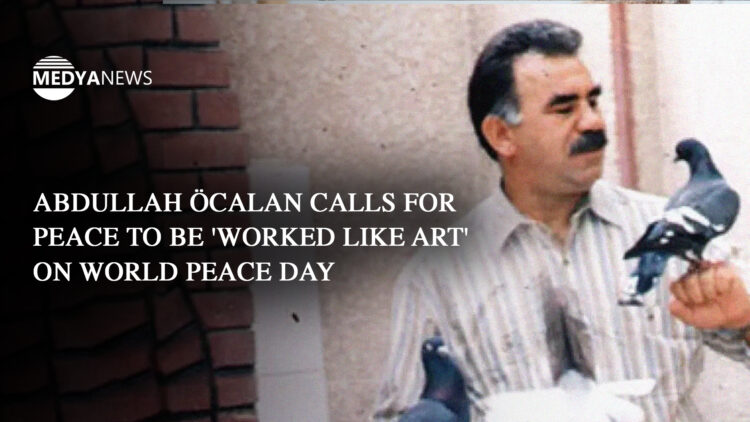
Abdullah Öcalan, a central figure in the struggle for a democratic resolution to the Kurdish issue, continues his relentless fight for what he calls a “war for peace” from within the isolated conditions of his imprisonment on İmralı Island.
The Historical Context of World Peace Day
World Peace Day has dual observances: one on 1 September and the other on 21 September. The former was established by the Soviet Union and members of the Warsaw Pact to commemorate the invasion of Poland by Nazi Germany on 1 September 1939, an event that triggered World War II and resulted in the deaths of over 70 million people. The United Nations later declared 21 September as the International Day of Peace in 1981, highlighting the global desire for peace. Despite the passage of 85 years since the end of World War II, conflicts continue to rage across the globe, from the Middle East to Ukraine, and more recently, Israel’s attacks on Palestine and Lebanon.
Imprisonment and Isolation on İmralı Island
Abdullah Öcalan, the leader of the Kurdistan Workers’ Party (PKK), has been a prominent advocate for a democratic solution to the Kurdish issue, a demand echoed at numerous 1 September peace events across Turkey, Kurdistan, and Europe. He refers to the start of the international conspiracy against him on 9 October 1998 as the “beginning of the Third World War”. Öcalan has been held in isolation in İmralı F-Type High-Security Prison for over 25 years, with no news received from him in the past 42 months. Since 2015, the intensification of Turkey’s war policies has plunged the country into crisis, particularly affecting the economy and the rule of law. Despite the persistent obstacles, Öcalan’s calls for a democratic resolution and enduring peace have largely been ignored, and his efforts to reach millions have been blocked by the government, which continues to deepen the crisis with its war policies.
A Call for a ‘War for Peace’
During a meeting with his lawyers on 7 June 1999, Abdullah Öcalan said, “Every war has its peace. Those who do not know peace stumble in war. The best peace is harder than war. Understand the concepts of war and peace correctly. I may face execution tomorrow, but I will continue my efforts for peace. War is the destruction of ugliness; peace is the creation of beauty. It has no zero point. Peace must be worked like art. This is my advice.”
Later, in a meeting on 19 June 1999, Öcalan described his efforts as “the utopia of a war for peace”, stressing that his mission was to achieve peace, not as a tactical manoeuvre but as a sincere endeavour.
‘Peace Means Freedom’
Emphasising that life should focus on peace, Öcalan stated on 29 June 1999, “I am engaged in an incredible struggle for peace. With intense and bloody conflict, will a two-century-long fight turn into peace and end? A great effort for peace is beginning; it is historic. We endure the heaviest burdens of both war and peace. Every second here is sacred and must be respected. No one has experienced more brutal war than we have. Will I live for peace, is that understood? The meaning of both war and peace is freedom; it is the achievement of freedom for all. I hope everyone embraces this understanding.”
The Philosophy of Peace and War
Öcalan has consistently argued for a new understanding of peace, pointing out in his writings that achieving peace is often more challenging than war. In a meeting on 2 December 1999, he declared, “I am in a war 24 hours a day. I am waging a war for peace. A peace war is harder than a war fought outside. Peace is not just about embracing; there are terrible adversaries. My position was always to contribute to the peace process.” He further explained on 6 December 1999 that “there should either be further conflict or a comprehensive peace process. Uncertainty is dangerous. If efforts for peace do not deepen, conflict will develop.”
The Link Between Peace and Society
Abdullah Öcalan has also reflected on the relationship between peace and societal structure, especially concerning the Kurdish issue. He notes the complexity and multifaceted nature of the Kurdish problem, which he says involves deep-rooted issues between the Kurdish people and state structures in all four parts of Kurdistan (Turkey, Iraq, Iran and Syria). “Even the most basic civil rights are denied to them, and their political and economic rights are not even on the agenda,” he said. He argues that peace is continuously thwarted by ideologies based on falsehoods, which have historically justified conflict and created opposing ideologies and structures that keep societies in a state of tension and conflict.
The Declaration for a New Understanding of Peace
On 2 December 1999, Öcalan spoke of the necessity of a new understanding of peace. “We are at a crossroads: either there will be renewed conflict or a comprehensive peace process. Uncertainty is dangerous. If peace efforts do not deepen, conflict will escalate,” he warned. “The most effective way to solve social problems, particularly those related to peace, is democracy. It derives its strength not from war, except in necessary self-defence, but from the ability to persuade. It can always develop solutions that align with the essential interests of the people by comparing what could be lost in war with what can be gained through persuasion. Courageous and realistic discussions illuminate problems. Illuminated problems can be resolved through broad participation and profound compromises.”
Öcalan’s Peace Proposals
In a peace declaration on 13 August 2003, Öcalan presented a 10-point plan for reconciliation and resolution, urging for 1 September, World Peace Day, to be a day of peace, reconciliation, and resolution. His plan included lifting obstacles to freedom of thought and organisation, creating conditions for free and independent elections, recognising Kurdish cultural rights, and removing illegal security forces. He called for courageous political and social reforms to foster a climate of peace and democracy.
Imprisonment and Continuing Advocacy
Since his imprisonment in 1999, Öcalan has continued to advocate for peace, often articulating his ideas through his lawyers. Despite the prolonged isolation on İmralı Island and the government’s refusal to engage in meaningful negotiations, Öcalan remains committed to his vision of democratic solutions and peaceful resolution. As a testament to his ongoing fight, he has repeatedly called for dialogue, democratic reform, and the recognition of Kurdish rights.
On this International Day of Peace, Öcalan’s past statements and continuing calls for dialogue remain pertinent. He advocates for a redefined approach to peace, one that values open dialogue, cultural rights, and a democratic framework as the only viable path to resolving long-standing conflicts, especially in the Middle East. Despite the isolation and continued resistance, his call for peace persists, a reminder of the enduring relevance of his vision for a more democratic and just world.


