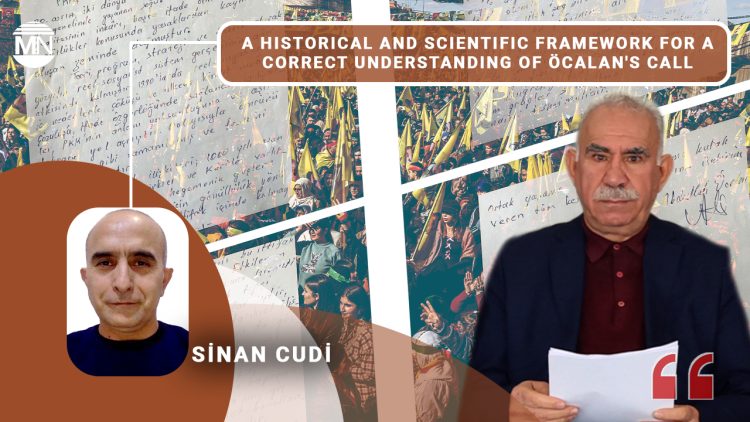
Sinan Cudi
On 27 February, we all listened to the historic call of Leader Apo [Abdullah Öcalan]. Hundreds of thousands of people from all over Kurdistan flocked to the squares to see and listen to the Leader. Even though the traces of years of resistance and pain could be seen on the face of the Leader, his strength and determination could be seen in his eyes. Of course, seeing the Leader was a source of joy and pride for our people and PKK [Kurdistan Workers’ Party] members.
Everyone’s eyes have been on İmralı for a while. Everyone was wondering what the Leader would say, what message he would give us. The leadership’s [Abdullah Öcalan] handwritten letter was read live by the Imrali delegation.
In fact, this was not just a message. It was an evaluation of history and a perspective for the future. Many rigid and stereotypical ideas may have interpreted the content of this message differently, or there may be many people trying to interpret the messages in it according to their own ideas and interests.
Of course, everyone’s mind and goals are different and can make judgements accordingly. But let us not be like them and try to evaluate that historical message sentence by sentence. We will see whether this message is the end of the struggle or the beginning of a new era in which all rigid beliefs and ideas are destroyed.
I will start from the end. I would like to draw attention to the date of the writing. It is clear from the handwriting of the leadership that this statement was not written today during the visit of the delegation, but it was written two days ago, on 25 February, and delivered to the delegation on 27 February. In other words, as some people say, it is not the case that the leadership thinks and takes decisions according to the speeches and opinions of the delegation. Moreover, the leadership did not insist on whether or not this message should be published in audio or video format. It is clear from the photograph that this statement was made in İmralı and it was probably recorded in order to be transmitted to the relevant authorities and to avoid any doubt about this statement. But it seems that the Turkish state does not allow this video to be shared, but do not worry, the important thing is that we have seen Leader Apo and we know what he is doing.
Let me share an observation; not many people know, but there are three other prisoners in İmralı prison, Hamili Yıldırım, Ömer Hayri Konar and Veysi Aktaş. They are also in the photograph shared. These three PKK cadres have been staying with Leader Apo in İmralı for some time. As assistants of him, they take part in the work and projects of the Leader.
DEM Party Co-Chairs Tuncer Bakırhan and Tülay Hatimoğulları, Istanbul MPs Sırrı Süreyya Önder and Cengiz Çiçek, Van MP Pervin Buldan and Asrın Law Office lawyer Faik Özgür Erol are also in the photograph. The people in this photo play a role in the upcoming process and in the realisation of the messages of the Leadership.
Now let’s move on to the content of the call.
‘The Call for Peace and Democratic Society’ begins by discussing the reasons for the emergence and development of the PKK. It recalls the two world wars, real socialism and the Cold War period, which inflicted great suffering on humanity, and explains and expands on how the rise of nation-states and state policies towards a race, class and other oppressed peoples deny them: ‘In this context, there was the denial of the truth about the Kurds and the prohibition of freedoms, especially freedom of thought.’ Our readers who are interested in the PKK and Leader Apo’s ideology have read about this process in the Defences of the Leader (the manuscripts he wrote for ECtHR, between 2004-2010) and know it well.
What is important and needs to be well understood are the circumstances and conditions surrounding the formation of the PKK and the characteristics that influenced it. The former Soviet Union, which was a party to the Cold War and played a role in the expansion of nation-states, played an influential role in determining the fate of the peoples of the world in the years following World War II.
The PKK, like many other leftist and socialist parties of the period, established itself ideologically in this period. However, with the collapse of the Soviet Union in 1990, the other side of the Cold War and the changes it brought about in states were not well analysed in many respects. Even before the collapse, the leadership was criticising the established order and trying to change its strategy of struggle. The 1993 unilateral ceasefire was essentially a response to these realities. The PKK had to change in parallel with the changes and transformations in the world order and the development of democratic values. However, this could not be realised due to the wing of the state that insisted on denial and annihilation of the Kurds. The war and the existence of the PKK had to continue, even if it repeated itself.
Between 1993 and 1998 there was a very violent war all over Kurdistan. The leadership [Abdullah Öcalan] considered 1998 as a year of preparation for change and transformation. Because the 6th PKK congress was to be held at the end of the year and changes were to be made in many areas. Due to these processes of change, the Leadership announced another ceasefire on 1 September, which was again decided upon with the suggestions of some sections within the state. But again, the forces and circles who wanted to turn the war into a war between peoples responded to the Leadership with the 9 October conspiracy. This stage reached its peak with the capture of the Leadership on 15 February 1999.
However, while in prison, the leadership broke this game, called for the guerrillas to withdraw from North Kurdistan [Southeast Turkey] and declared a unilateral ceasefire. In this way, he wanted to prevent a war between the peoples and create a great opportunity for the democratisation of the republic. It did not want to spoil the thousands of years of Kurdish and Turkish relations. It wanted them to remain in alliance against any intervention.
The PKK changed its strategy at its 7th congress in January 2000. The previous strategy was called ‘Longlasting People’s War’. After this congress, however, it changed its strategy to the ‘Strategy of Democratic Political Struggle’. The aim of this strategy was to change the colonialist-genocidal fascist mentality and policy, and to make the Kurds recognise their existence and national rights. For this reason, it considered democratisation in Turkey through democratic political struggle and the solution of the Kurdish question as an indispensable part of this democratisation.
When the strategy was explained in this way, discussions about the existence of the PKK started and the Leadership said that we should also change our struggle led by the PKK. For this reason, the 8th PKK congress convened on 4 April 2002 decided to dissolve the PKK. Alternatively, KADEK (Kurdistan Freedom and Democracy Congress) was declared.
Let’s take a look; in 1999 the war was stopped, in 2000 the strategy was changed, in 2002 the PKK was disbanded. There was no longer any obstacle for the state to solve the Kurdish problem through democracy. However, the conditions and circumstances of the Middle East and the world at that time, and the plans of the great powers in the world were not favourable to this process. In order to establish a better order in the Middle East and the world, they wanted the Kurds to cause wars and problems in all the countries where they lived.
In the message of the leadership, there is a section in which it is explained how the policy of the Turkish state was shaped in the 19th and 20th centuries and what the international powers were aiming for:
‘The last 200 years of capitalist modernity have made it their main goal to break up this alliance. The affected forces, together with their class bases, have considered it essential to serve this purpose. This process accelerated with the uniformist interpretations of the Republic.’
When this evaluation became fundamental and the Kurds’ rights were wanted to be lost by intervening, the Kurdistan Freedom Movement, which was reorganised under the name Kongra Gel, decided to start the struggle again on 1 June 2004 due to the blockage of politics. And when guerrilla warfare resumed, the existence of the PKK came to the fore once again. For this reason, a congress was held on 4 April 2005 for the reconstruction of the PKK and the second period of the PKK began.
In his message, the leadership draws attention to the following reasons: ‘The PKK is the longest and most widespread movement of rebellion and violence in the history of the Republic. Since the path to democratic politics was blocked, the PKK gained strength and support.’
In other words, from the beginning until today, the PKK has only wanted to fight for Kurdish rights through democratic means. If we add the Apoist group, the PKK did not resort to armed means against the state until the military coup d-etat of 12 September 1980. All it wanted was to freely discuss the reality of Kurdish identity and existence of Kurdistan, and to draw attention to Kurdish rights, of course, via a leftist and revolutionary way.
However, the violence against the Kurdish people and the state’s policy of mass murder and genocide led the PKK to become increasingly radicalised. In the last ten years of the war, it has also become clear that the war has only strengthened the opponent, hence the intensity and level of the battles has gradually increased. There is no one who can win this war. Therefore, the Leadership essentially states that if the Turkish state gives up its war policy, the ground on which the PKK feeds and raises the level of war will disappear.
Therefore, first of all, a democratic political space must be created in order to stop the cycle of war and arms. The Kurdish people want their identity to be recognised, to express their thoughts freely, to organise democratically, and for all their components to have social, economic and political rights. For this reason, they do not want a nation-state, a federation, administrative or cultural autonomy that would be filled with racism. Just as it has lived in peace with the people and societies around it for thousands of years, it must achieve this again in terms of historical sociology. What is happening in practice in Northern and Eastern Syria proves and concretises this point of view and desire.
Yes, the addressee of the call of the leadership is the Turkish state. Because Kurds have faced the politics of genocide for the last hundred years. Now this paradigm needs to be changed and, and turned into the culture of democracy. If you want to maintain unity and solidarity among peoples, there is no other way but democracy. This is why the Leadership says:
‘Democratic reconciliation is the basic method. The language of peace time and democratic society must be developed in accordance with this reality.’
In summary, noting that Bahçeli, Erdoğan and other parties have taken a positive approach to this issue, the leadership said, ‘I am also calling for disarmament in this process and I assume the historical responsibility of this call’.
In other words, he says that if the democratic method is chosen instead of armed conflict, I will be the first person to take away the arguments the state has. For this reason, the note left by the leadership to the İmralı delegation intervenes here;
“Undoubtedly, the laying down of arms and the dissolution of the PKK in practice require the recognition of democratic politics and a legal framework.”
So what are these corrections? All articles in the Turkish Constitution that do not take into account the existence of the Kurdish people and that create obstacles to the rights of the Kurdish people and democratic politics must be removed. The private and illegitimate law imposed on Leader Apo must also be abolished and the Leader must be allowed to enjoy his ‘right to hope’. If the state takes these steps, the Kurds will no longer be a threat to the sovereignty of the state, not only in Turkey, but also in Syria, Iraq and Iran.
Of course, before this statement, PKK and Kurdistan Freedom Movement officials had shown their commitment to the messages and projects of the Leadership. It seems that all parties have been considered and the Leadership has made its decision in this direction. But of course, as emphasised by the Leadership, the PKK needs to convene its congress and make its decision. In today’s conditions, where occupation attempts continue and a relentless war is being waged in the plains and mountains of Kurdistan, it will of course be difficult to convene the congress. Therefore, the state must do its best to offer the required conditions for the disarming or disbanding the PKK. Neither the PKK nor anyone else can forget that thousands of guerrillas were martyred during the 1999 withdrawal. This is not possible without a bilateral ceasefire.
We have been following the Turkish state closely during this period of struggle and we know that neither by force nor by our struggle will they move one step forward. Therefore, in essence, a new struggle begins. If we want to achieve a lasting and secure peace, each of us must take responsibility and be more pro-active than in the past.
Leader Apo has been striving for freedom moment for more than 50 years. For all of us. The PKK has protected us until today. Despite very difficult conditions, everything was done to protect our people and the values of our people. Now it is our turn. Now is the time to defend these values. It is time to protect the hopes, dreams and aspirations of our martyrs and sacrifices.