

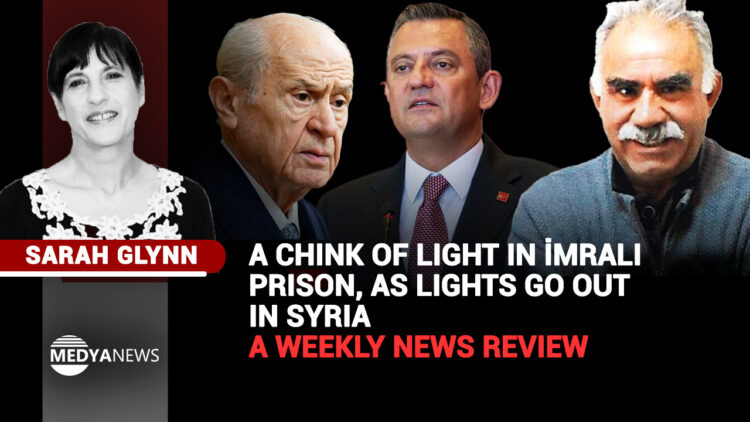
Sarah Glynn
This has been a rollercoaster week in Kurdish politics, which has left political pundits reeling. As Lenin wrote, “There are decades where nothing happens; and there are weeks where decades happen.” For the Kurds, eventless decades are sadly absent, but this week has contributed decades worth of history. It is still too early to fully comprehend all that has taken place, but I will give an account of the key events and the reactions of some of the lead players, and I will add some basic observations about Turkey’s President Erdoğan and wider political developments, which may help to make sense of it all.
To recap. On the first of this month, at the opening of the Turkish Parliament, Devlet Bahçeli set the ball rolling by offering his hand to the co-chair of the pro-Kurdish DEM Party. Bahçeli is the bullish leader of the far-right National Movement Party, which is part of the government coalition, and has, up to now, been at the forefront of government oppression of the Kurds and of Kurdish politicians. That his handshake was part of a government plan was soon confirmed by statements from President Erdoğan and from Bahçeli himself. While these moves were given a cautious welcome, they were not accompanied by any lessening of anti-Kurdish oppression. Rumours of government discussions with imprisoned Kurdish leader, Abdullah Öcalan remained unconfirmed.
Monday
The response from the main opposition Republican People’s Party (CHP) has been encouraging. On Monday, the party leader, Özgür Özel, held a three-hour meeting with Selahattin Demirtaş, former co-chair of the HDP (the DEM Party’s predecessor), who has been a political prisoner since 2016. Afterwards, in a press conference outside the prison – a situation of which Özel said he was ashamed – Özel predicted a “magnificent” end to the “peace process”, and stressed their shared emphasis on the importance of involving the Turkish parliament: an emphasis reinforced by Demirtaş’s subsequent Tweet.
Tuesday
On Tuesday, Bahçeli sprung another surprise. He told his party meeting, “If the isolation of the terrorist leader [i.e. Öcalan] is lifted, let him come and speak at the DEM Group Meeting in the Turkish Grand National Assembly. Let him declare that terrorism is completely over and the organisation is disbanded. If he shows this determination, the way for the legal regulation on the exercise of the Right to Hope should be wide open.” This was not only startling in its suggestion of Öcalan at the parliament. It also acknowledged Öcalan’s previously denied incommunicado isolation, and the possibility of allowing him parole.
As his lawyer reminded us, Öcalan’s isolation is anyway illegal, and his right to hope for parole has already been demanded for ten long years by a ruling of the European Court of Human Rights.
DEM Party co-chair, Tülay Hatimoğulları, speaking at her party meeting, pointed out that they have been struggling for years to lift Öcalan’s isolation and that he should come and speak. She described him as “the interlocutor of peace in the Middle East and Turkey”, but stressed that peace must involve all political parties and democratic forces, and be adopted by society.
Özel’s speech to his CHP group reiterated the importance of parliamentary involvement (as he had discussed with Demirtaş) and of wider social consensus. Noting that every actor speaking of peace is valuable, he stated that it was not enough to invite one actor to parliament. “If this issue is to be solved, it must be discussed at a table where all parties are present.” Rising to the challenge laid down by the governing alliance, he announced, “I offer the Kurds a state. I offer all Kurds who don’t fully feel they belong, to be the owners of the state of the Republic of Turkey. Let’s make a country where all democratic political channels are kept open, where the rights of students in universities are not violated, where democratic rights are at world standards. Let’s make Kurds the owners of the Republic of Turkey.”
Erdoğan, on Twitter, referred to a “historic window of opportunity”. But there was still no concrete action to support the rhetoric, and many people were wary that this was all nothing more than a trap.
That evening a tweet from a pro-government journalist claimed that permission for DEM Party MP Ömer Öcalan to visit his uncle in prison was expected soon.
Wednesday
On Wednesday Özel visited the Kurdish city of Diyarbakır (Amed) where he stressed the importance of language rights and of the recognition that there is a Kurdish problem; this cannot be simply declared not to exist, as Erdoğan attempted to do. Rather, “Kurds decide whether Kurds have a problem or not”.
That afternoon, history was given another shake with the news of an explosion and gunfire at Turkish Aerospace Industries in Ankara. The attack, by a man and a woman who were both killed, led to the death of five further people and the injury of 22 others. It was condemned by politicians of all parties. The Turkish government was quick to blame the PKK, who, two days later, announced their responsibility for the action.
In a rerun of events last October, following another PKK attack in Ankara, Turkey responded with massive military force, which has been especially targeted at the Autonomous Administration of North and East Syria. Erdoğan has told journalists “We have learned specifically that [the Ankara attack] was an infiltration movement from Syria,” but there is no reason to believe this convenient claim, just as there wasn’t for the similar claim last time.
The Autonomous Administration is under constant low-level attack from Turkey, and has defended North and East Syria against their Turkish attackers, but their Syrian Democratic Forces (SDF) don’t attack or threaten Turkey. However, Turkey refuses to distinguish between the SDF and the PKK.
When Turkey’s air and artillery bombardment began on Wednesday night, Mazloum Abdi, the leader of the SDF stated via Twitter, “Turkey indiscriminately and unjustifiably bombards our areas, targeting civilian, service, and health centres. This is a war crime. We have repeatedly shown our readiness for dialogue. Meanwhile, we affirm that our forces are ready to defend our people and land.”
Thursday
Then, on Thursday morning, we woke up to the news that Kurds have long been waiting for: Öcalan’s near 43 months of total isolation had finally been broken. His nephew, Ömer Öcalan, had visited him the day before. Ömer posted on Twitter, “This visit was held as part of a family meeting. Mr. Öcalan commented on general political developments during the meeting and asked for the following message to be conveyed to the public: ‘Isolation continues. If conditions are right, I have the theoretical and practical power to move this process from a ground of conflict and violence to a legal and political ground.’ He was in good health and sent greetings to everyone.”
DEM Party Spokesperson, Ayşegül Doğan, addressed a press conference with a question, “Democratic politics is ready, Mr Öcalan is ready, is the state ready to create these conditions, to eliminate the isolation, to create the legal and political ground for a democratic solution to the Kurdish issue?”
Friday
By Friday evening, Turkey’s attacks on North and East Syria had killed seventeen people, and wounded 48. Fourteen of the dead and 39 of the wounded were civilians. Eight of those killed were workers (mostly Arabs) at the now destroyed Suwaydiyah power plant. Targets of the attacks included oil wells – depriving the population of fuel and a vital economic resource, and destroying the environment – water and power stations, grain silos, bakeries, dispensaries, checkpoints of the internal security forces, and people’s homes. Rojava Information Centre has commented, “This repeated targeting of vital and service facilities precipitates a humanitarian disaster in an area that is home to millions of people, who are already suffering from severe fuel and gas shortages as a result of Turkey’s repeated targeting of infrastructure facilities in previous years.”
The SDF have responded with attacks on Turkish forces and their mercenaries in Turkish-occupied Syria.
In Iraq, Turkish airstrikes on the Yazidi region of Sinjar (Şengal) have killed six fighters from the Sinjar Resistance Units (YBŞ). There have also been intense attacks on the mountains of the Kurdistan Region of Iraq, where the PKK have their bases.
Within Turkey, the oppression of Kurdish culture and Kurdish activism has never stopped, and there seems to be no end to the human rights abuses reported in Turkish prisons. On Friday the Minister of Interior announced that 176 people had been detained on terrorism charges across 31 provinces.
View from the PKK
And what of the views of the PKK themselves – a vital component of any peace talks? These are clearly set out in the statement published on Thursday by the Kurdistan Democratic Communities Union (KCK), the umbrella body of which the PKK is a part.
They begin with their happiness at the meeting with Öcalan, but emphasise that “It is not possible to talk about and expect progress until the isolation of Rêber Apo [i.e. Öcalan] is completely lifted and his health, safety, and working conditions are ensured.”
They stress their belief that the solution to the Kurdish Question and the democratisation of Turkey are mutually dependent, and that Öcalan is the interlocutor and negotiator. They remind us that they seek a democratic solution achieved through negotiations and dialogue. And they confirm that “Our movement, with all its parts, structures, and organisations, will act according to the process that Rêber Apo will develop.”
While first responses to the Ankara attack generally shared the view that it was an attempt by then unknown militants to torpedo peace negotiations and prevent their associated compromises, the PKK insists that the action “was planned a long time ago and… has nothing to do with the political agenda discussed in Turkey in the last month”. It was conceived as a “sacrificial action” to send a message and warning “against the genocidal practices, massacres and isolation practices of the Turkish state power”. When the attack was carried out, the meeting with Öcalan was not public knowledge, though speculation about a possible new peace process was everywhere. However, there was no cease fire and certainly no suggestion that the Turkish military was stopping their attacks against the PKK.
For the PKK, Turkish Aerospace Industries was a military target, which they contrast with the Turkish revenge attacks against civilians in North and East Syria. Blame for Turkey’s brutal and indiscriminate response lies solely with Turkey, but that is of little comfort to the people of North and East Syria. KCK Executive Board Member Zübeyir Aydar has now called for a “mutual and sincere ceasefire”, like was agreed in 2013.
It has also been argued, counter-intuitively, that this attack could strengthen the support for peace negotiations by demonstrating that the PKK is still a force to be reckoned with and that the military “solution” hasn’t worked. The PKK action has certainly not shaken Bahçeli’s determination to carry on with his plans. He announced that “No bloody and treacherous project will be able to stand against our national unity and brotherhood”. After condemning the attack, the DEM Party commented “We must protect peace more than ever so that these painful events do not happen again.”
Putting the potential peace process in context
I want to try and give all this a bit more context. Erdoğan dominates the Turkish government, and the driving force behind all Erdoğan’s actions is the boosting of his own power and prestige. To achieve this, he has proved ready to make numerous U-turns, to turn foes into allies and allies into foes, and to play different allies off against each other. This is evident in the way he repudiated the initial agreement reached in the peace talks with Öcalan that took place between 2013 and 2015, which he had earlier encouraged; and also, in his foreign policy. Turkey’s strategic geography has allowed Erdoğan to court Russia while simultaneously exploiting Turkish membership of NATO; and to hold Europe over a barrel with threats of opening the borders to migrants. Even when he portrays himself as taking a moral stance, as in his rhetorical stand against Israel and their genocidal attack on Gaza, his actions belie his words. (40% of Israel’s oil is imported via Turkey, and Turkish exports to Israel have not stopped, as claimed, but merely been relabelled.)
This power-driven inconsistency is hardly a good basis from which to enter any sort of negotiations, but Erdoğan likes to do diplomacy with one hand on the trigger, as we saw recently in his agreement with the government of Iraq. Turkish planes were bombing the mountains of Iraqi Kurdistan even as he met with Iraq’s prime minister in Baghdad. If current moves are to develop into real peace negotiations, trust will have to be built through the involvement of a wide range of actors, as well as by genuine moves towards greater democracy and legality.
Everyone is asking if Erdoğan and his government are sincere in wanting to achieve a settlement, and what could have prompted this particular U-turn. Answers to the second half of this question include fear that the upheavals resulting from US-backed Israeli attacks on Iran’s proxies, and potentially on Iran itself, could provide opportunities for Kurds to make political gains in Syria and Iran; need to win support from the large Kurdish constituency for proposed constitutional changes; and Turkey’s failure to achieve the desired military “solution”. Erdoğan’s promise to eliminate the PKK from Iraq last summer has been quietly dropped, and his attempts to make a deal with Syria’s President Assad to combine forces against the Autonomous Administration of North and East Syria have been rebuffed. Yusuf Karadaş observes for Evrensel, “when the state is under a serious regional risk/threat or when it sees new opportunities for the regional interests of the Turkish monopoly bourgeoisie, it remembers the Kurdish question”. There is also a possibility, as always, of behind-the-scenes intervention from America.
And, vitally, the Kurds have continued to prove that their determination to seek Kurdish rights and recognition, and their support for Öcalan as their leader, are not going away. Together with friends around the world, and despite disregard and criminalisation by international governments, and the indifference of mainstream media, they have ensured that Öcalan’s rights, and Kurdish human rights in general, reach international attention. In doing so, they stress that Öcalan is key to a peaceful resolution of Turkey’s “Kurdish Question”.
If Erdoğan’s government is sincere, they can benefit from a more supportive political climate than negotiators faced ten years ago. Today, the CHP opposition is no longer defining itself through resistance to Kurdish reconciliation, and, as we have seen, it’s trying to demonstrate a more serious commitment to peace than that shown by the government. There is also no powerful Gülenist movement, which was accused of attempting to sabotage Kurdish peace plans. Coincidentally, Fetullah Gülen himself died, aged 83, in a Pennsylvania hospital last Sunday.
The period of the 2013-15 talks demonstrated the existence of a widespread desire for peace among the Turkish population, but there is a substantial ultra-nationalist element that has been nurtured by the government on anti-Kurdish rhetoric. The decision to make Bahçeli, who was the instigator of some of the most vicious rhetoric, the spokesperson for the new turn can be seen as a device for neutralising resistance from this group, including from nationalists within the political establishment.
Currently, anti-Kurdish nationalism is still being appeased by continued oppression of Kurdish activists and by the attacks on North and East Syria, but this two-faced approach cannot continue if the government is serious about making peace and establishing the trust needed to make this possible.
Maintaining the pressure
For all of us who hope to see a genuine peace process, the need to keep up pressure on Turkey is paramount. The chink of light opened up in the last four weeks needs to be given a chance to expand by the continued exposure and condemnation of Turkish oppression and aggression. Turkey’s violence and illegality cannot to be allowed to be eclipsed from sight by the horrors of Gaza and Lebanon, and should be responded to with real consequences in international relations. Both within Turkey and outside, if politicians are to respond with progressive change, they will need to feel pressure from below.
As the KCK’s statement points out, “Everything that has been achieved so far has been through struggle” and the struggle for Öcalan’s freedom needs to be increased.
Postscript in the Kurdistan Region of Iraq
So much has happened that the rest of the news must be passed over or relegated to a footnote.
I had expected to concentrate this week on the results of last Sunday’s elections in the Kurdistan Region of Iraq. Despite the fears of the Kurdistan Democratic Party (KDP), they are still the biggest party, with 39 of the 100 seats, plus three KDP supporting quota seats. The Patriotic Union of Kurdistan (PUK) secured 23 seats and two supporting quota seats, and New Generation roughly doubled their seat share with 15 MPs. Support for the two biggest parties is still divided along regional lines. No-one has an absolute majority, and after all the anger of the election, the parties must now try and put together a coalition.
Also, German Chancellor Olaf Scholz met with Erdoğan in İstanbul last Saturday, when they agreed to pursue greater defence industry cooperation.
And Turkey’s bid for BRICS membership was vetoed by India, with the group agreeing that no new members will be admitted in the near future.
Sarah Glynn is a writer and activist – check her website and follow her on Twitter


