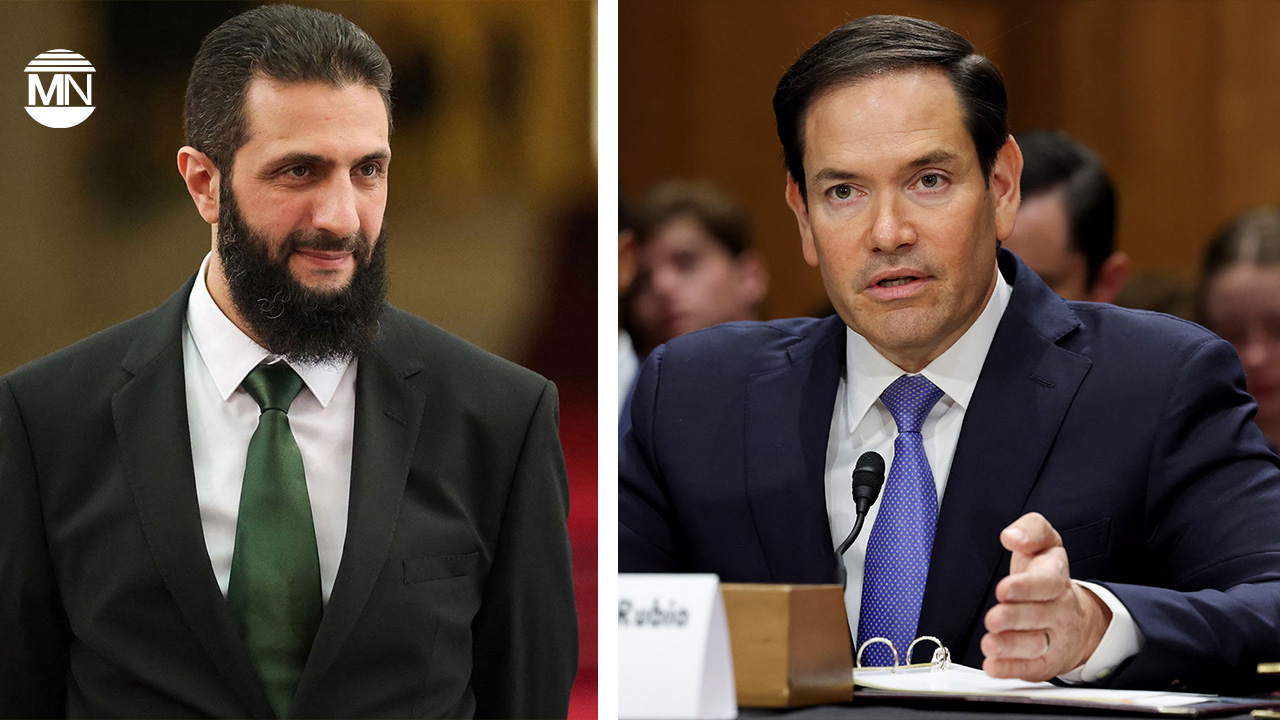
US Secretary of State Marco Rubio warned that Syria’s transitional government could collapse “within weeks”, potentially plunging the country into another full-scale civil war unless urgent international support is provided, during a Senate Foreign Relations Committee hearing in Washington on Tuesday.
Rubio said the Syrian transitional authority — formed after the December 2024 ousting of long-time president Bashar al-Assad — was facing mounting internal and external threats that could tear the war-ravaged country apart.
“If we did not engage them, it was guaranteed to not work out,” Rubio said. “In fact, it is our assessment that, frankly, the transitional authority… [is] maybe weeks, not many months, away from potential collapse and a full-scale civil war of epic proportions — basically the country splitting up.”
Rubio’s stark warning follows US President Donald Trump’s controversial decision last week to lift long-standing US sanctions on Syria. The move came ahead of Trump’s meeting with Syria’s new president Ahmed al-Sharaa, also known as Julani, — a former al-Qaeda commander and current leader of Hay’at Tahrir al-Sham (HTS), a Sunni Islamist group still designated as a terrorist organisation by the US, EU, UN and UK.
Despite Sharaa’s background, Trump defended the move, stating it would open the door for international aid and regional cooperation. “He’s got a real shot at pulling it [Syria] together,” Trump said after meeting Sharaa at a summit in Saudi Arabia. “It’s a torn-up country.”
Rubio acknowledged concerns about Sharaa’s past, noting that many figures in the transitional authority failed FBI background checks. “They’ve got a tough history — one that we understand,” he said, before arguing that engagement was the only path to stability.
The comments come amid rising sectarian violence in Syria. Nearly 900 civilians, mostly from Assad’s Alawite community, were reportedly killed in March by pro-government factions in the western coastal region. In May, over 100 people died in clashes involving Druze gunmen, Sunni Islamist fighters, and the new security forces in Damascus and Suweida province.
Sharaa’s administration has pledged to protect Syria’s religious and ethnic minorities — including Alawites, Christians, Druze and Kurds — but internal distrust remains high. Critics accuse the transitional authorities of favouring Sunni Islamist dominance.
At the same time as Rubio’s stark warning in Washington, Turkey intensified its own diplomacy. The head of Turkey’s National Intelligence Organisation, İbrahim Kalın, visited Damascus for talks with al-Sharaa and other key figures. Turkey’s Defence Ministry also confirmed that a delegation led by General Directorate of Defence and Security Chief Major General İlkay Altındağ held meetings in the Syrian capital. Military coordination and cooperation were reportedly discussed.
Beyond, European foreign ministers, meeting concurrently in Brussels, also announced they would lift economic sanctions on Syria. EU foreign policy chief Kaja Kallas said the bloc aimed “to help the Syrian people rebuild a new, inclusive and peaceful Syria”.
The Syrian foreign ministry welcomed the decision, calling it “the beginning of a new chapter in Syrian-European relations built on shared prosperity and mutual respect”.
Yet human rights groups and minority representatives remain sceptical, citing past abuses by HTS and the fragile ethnic balance in post-Assad Syria.
Inside the Senate hearing, tensions flared as protesters were ejected by Capitol police after shouting “Stop the genocide!” — reflecting the deep divisions and unresolved grievances still haunting the Syrian conflict.
With the transitional authority on the brink and international actors reassessing their roles, Syria’s future remains deeply uncertain more than 14 years after the war first began.
Related article
EU agrees to lift Syria sanctions amid political shift