

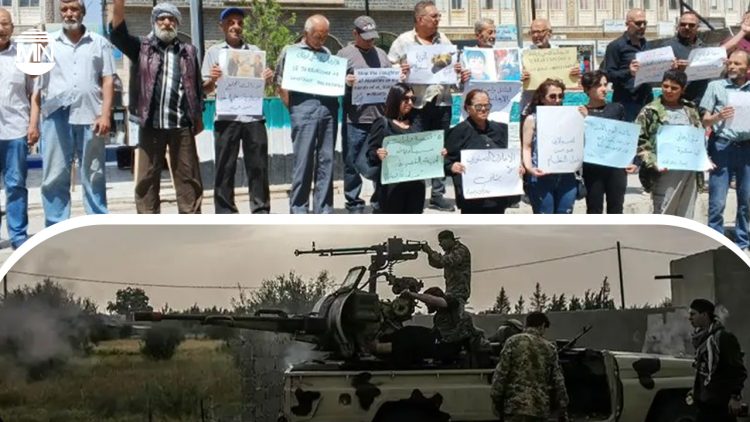
Protesters gathered in central Suwayda on Saturday, condemning recent assaults on Druze-majority areas in Damascus and Suwayda provinces, which have left over 100 people dead. The demonstrators, including women’s organisations and civil society leaders, described the current administration in Damascus as an “illegitimate authority” dominated by the hardline Islamist coalition Hay’at Tahrir al-Sham (HTS), and warned of a broader plan to erase Syria’s religious and cultural pluralism.
The rally follows reports from the Syrian Observatory for Human Rights (SOHR) that at least 109 people, including 42 Druze civilians, were killed between 1 and 3 May in the Damascus suburbs of Ashrafiet Sahnaya and Jaramana. The attacks were reportedly carried out by general security forces affiliated with the newly formed Syrian caretaker government (SCG), which has been accused of imposing a Salafi-inspired rule.
“We reject any compromise that serves the interests of sectarian or extremist regimes,” said activist Lina Abu Hamdan during the protest. “The demand for international protection is growing by the day. The targeting of Syria’s religious mosaic must be exposed.”
Assala Aslan, spokesperson for Suwayda’s Women’s Studies Office, said the latest attacks amounted to “a sectarian and terrorist plan” aimed at transforming Syria into a state governed by Salafi ideology (a fundamentalist Sunni Islamic revival movement which aims to return to the traditions of the first generations of Muslims). She called for global solidarity with minorities under threat, and warned of efforts to “destroy the country’s cultural and religious diversity”.
The violence was reportedly triggered by a fabricated audio message falsely attributed to a Druze cleric, who was alleged to be insulting the Prophet Muhammad—a rumour which spread rapidly online and was followed by a wave of armed reprisals. It is also reported that Israeli warplanes struck targets in Ashrafiet Sahnaya on 1 May in response to the attacks, though Druze leaders have publicly rejected any Israeli involvement in their community’s defence.
Sheikh Hikmat Salman al-Hijri, the spiritual leader of Syria’s Druze community, has appealed for urgent international action to protect civilians. He is reported to have held meetings with Suwayda’s governor, Dr Mustafa al-Bakour.
The Suwayda Military Council has refused demands to disarm, citing what it calls “an existential crisis”. Inspired by the self-defence structures of the Kurdish-led Autonomous Administration of North and East Syria (AANES), the Council describes itself as a grassroots force for protection of the people. Minority groups across the country, including Kurdish women in Aleppo, have expressed solidarity with the Druze community.
Meanwhile, in the Kurdish-majority city of Qamishli (Qamişlo), civil society organisations including the Cizir Lawyers’ Union and the women’s movement Kongra Star held protests condemning the attacks on Druze and Alawite communities. Speaking outside the People’s Court, legal representatives called for international intervention and reaffirmed their support for al-Hijri’s appeals for unity. Protesters demanded an end to sectarian and ethnic discrimination, urging the Syrian caretaker government to fulfil its responsibility to protect all citizens and safeguard Syria’s pluralistic fabric. Kongra Star members also held a separate demonstration at the 12 March Stadium, ending their statement with the slogan, “Jin, jiyan, azadî” (Woman, life, freedom).
Human rights observers warn that failure to act could deepen Syria’s sectarian fragmentation and leave minority communities increasingly vulnerable to extremist violence.


