

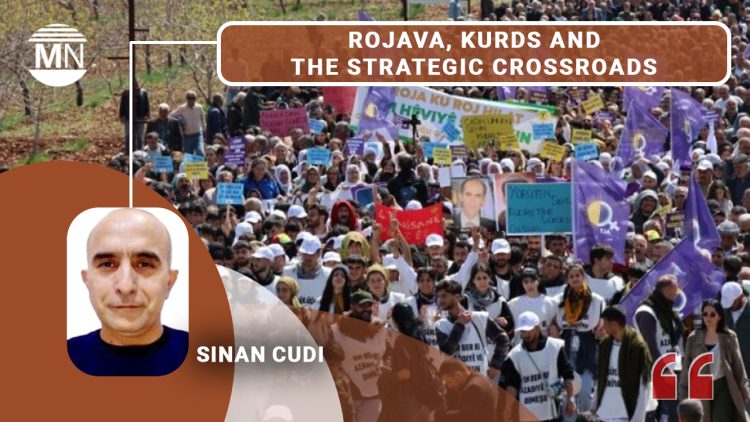
Sinan Cudi
By 2025, the Middle East is undergoing a profound transformation. Not only are borders being redefined, but centres of power, non-state actors and diplomatic balances are being significantly reshaped.
This transformation is particularly evident in Syria. The dissolution of the Ba’ath regime on 8 December 2024 and the subsequent rise of Hay’at Tahrir al-Sham (HTS) to a de-facto central government position is a development that could have regional and global consequences.
Turkey has taken an aggressive stance both militarily and diplomatically. A recent statement by the foreign minister revealed that a diplomatic campaign would be launched in the coming months to eliminate the US’s ‘ambiguous’ position on the YPG. This statement shows that Turkey is not only targeting Rojava, but also aiming to reduce any international pressure on the HTS-led de-facto central government model. In this way, Turkey seeks to both ‘terrorise’ the YPG and create a legitimacy base against secular governance models in Syria.
Meanwhile, US policy in Syria remains far from clear. Washington is trying to balance relations between Rojava and Turkey, accommodating Turkey’s security demands while trying to revise its military presence in Rojava in the context of Israel’s regional strategy. This contradictory stance deepens the power vacuum on the ground and seeks to push the Kurds into an uncertain situation. At this point, Israel’s anti-Turkish position in Syria becomes an important factor. Particularly in its efforts to counter Iran, Israel has taken steps to limit Turkey’s expansionist position in Syria. In this context, Turkey’s indirect support for the rise of HTS is seen as a potentially dangerous development for Tel Aviv in the long run.
In this complex, multi-actor environment, the crucial question for the Kurds is not simply one of military defence or seeking external support. The crucial question is how to devise a political and social strategy to counter this entrapment.
First and foremost, it is essential to rebuild Kurdish national unity in an updated and realistic way. Attempts at unity between ENKS and PYNK, which failed in the past, are being pursued again despite internal and external pressures. Coming together on the basis of common defence, external diplomacy and political vision is a strategic necessity, not only for Rojava but for all Kurds in the four parts.
There is also an urgent need for serious restructuring in the social sphere. In particular, the youth and women’s movements, which have been fragmented in recent years by war, migration and economic crises, are under threat. Youth efforts to actively participate in decision-making processes, from local government to diplomatic delegations, are being hampered by the negative approach of the ENKS mentality. Similarly, the women’s movement, which brought the Rojava revolution to the world’s attention, is being strengthened not only as a social but also as a political subject. With the philosophy of “Jin Jiyan Azadî”, it continues to spread, not only as a form of resistance, but also as a platform for diplomatic legitimacy.
In all these processes, the possibilities offered by international law should not be overlooked. Turkey’s attacks on Rojava can clearly be seen as violations of international law based on the Geneva Conventions, CEDAW and UNESCO resolutions. Initiatives under these legal frameworks to protect Rojava’s pluralist, women-led and ecological system will create not only political but also moral legitimacy. The Kurdish diaspora in Europe can be a pioneer in this process; diplomatic pressure can be applied in many arenas, from UN commissions to local parliaments.
Furthermore, the Kurdish movement needs to diversify its alliances, not only through traditional state relations, but also through people-to-people diplomacy. Left governments in Latin America, secular groups in Lebanon, ecological and feminist networks in Europe, indigenous peoples and anti-imperialist platforms are valuable interlocutors in this regard. These relationships are important not only as geopolitical, but also as ideological and ethical forms of solidarity.
In conclusion, Rojava and the Kurdish movement are at a historical crossroads. This social experience, which is besieged, isolated and criminalised from all sides, can be rebuilt not only through resistance, but also through renewal, inclusivity and strategic alliances.
Alternativism is the biggest trap. However, the Kurdish people have repeatedly proved throughout history that they can follow the path of resistance and construction at the same time under the most difficult circumstances. Now is the time to reorganise this will.


