

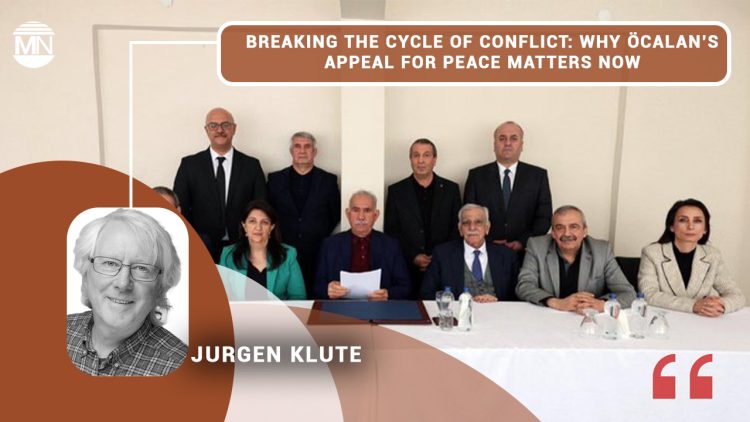
Jurgen Klute is an ex-Die Linke representative to the European Parliament, and a columnist for Medya News. In this article, Klute analyses the current historical moment of oppurtunity, following yesterday’s momentous call from imprisoned Kurdistan Workers’ Party (PKK) leader Abdullah Öcalan.
By Jürgen Klute
On 25 February 2025, during a press conference in Istanbul, representatives of the Kurdish party DEM [the Peoples’ Equality and Democracy Party] published a statement by the co-founder of the PKK, Abdullah Öcalan, which received an unusual amount of media attention: In his statement, Öcalan called for the dissolution of the PKK in order to end the 40-year armed conflict between the PKK and Turkish security forces and to initiate a peace process.
At the 2013 Newroz festival, Öcalan had already called for a political solution to the conflict and proposed a peace process. In 2013, however, he had not yet called for the dissolution of the PKK, but suggested that the PKK withdraw from Turkish territory to northern Iraq as a first step. The PKK’s disarmament should not take place until the peace process had been secured.
Today’s call by Öcalan therefore goes significantly further than the 2013 peace initiative. The peace process of 2013 was ended by the Turkish side in 2014, leading to a return to armed conflict with a large number of deaths.
In autumn 2024, Öcalan’s years of solitary confinement were eased and several DEM delegations were able to meet with him. The current call has therefore been coordinated with Kurdish politicians and, most likely, with the leadership of the PKK.
The relaxation of Öcalan’s solitary confinement was preceded by an approach between Devlet Bahçeli, the leader of the ultra-nationalist [Nationalist Movement Party, or] MHP, Öcalan and the DEM. For decades, Bahçeli was considered an implacable opponent of the Kurds and their political concerns.
Ending the armed conflict, which has cost the lives of more than 40,000 people on both sides, is the right decision. The conflict cannot be won militarily by the Kurdish side. This has been clear to the Kurdish side for a long time. That is why Kurdish politicians began intensive diplomatic contacts at EU level, in parallel with Turkey’s accession negotiations with the European Union. Since 2004, a conference has been held annually in the European Parliament to press for a political solution to the conflict. From this perspective, today’s step by Abdullah Öcalan is to be welcomed. His call could be the decisive breakthrough to a political and diplomatic solution.
At the same time, it is notable that the Turkish side has so far made no concrete offers to the Kurdish side in return for Öcalan’s call.#
RELATED ARTICLES
PKK urged to dissolve as Öcalan takes responsibility for new era of peaceDie Linke’s co-chair calls for Öcalan’s release, urges German government to lift PKK banÖcalan’s historic call will be watched on giant screens all over KurdistanSDF Commander Mazloum Abdi and AANES’s Salih Muslim back Öcalan’s call for PKK disarmament
This should make the international community, especially the UN and the EU, sit up and take notice. If a peaceful political solution should actually come about this time, then there must be a fair balance of interests between the Turkish and Kurdish sides.
In the Middle East, fundamental changes have taken place since 7 October 2023, the date of Hamas’ terrorist attack on Israel. The political balance of power in the Middle East is currently being re-balanced. This is associated with a window of opportunity for a political solution to the decades-old conflicts. This may have contributed to the Turkish side moving towards Öcalan and easing his solitary confinement after several years, and to Öcalan making his current appeal despite the bloodily failed peace process of 2013.
It would therefore be desirable for the European Union to use its links with Turkey, which still officially exist as part of the accession process, to support this process in a smart, diplomatic way. The EU should not focus solely on the Kurdish-Turkish conflict, but broaden its view to include the entire Middle East. That is why I would like to refer again to my proposal of 27 December 2024 (A proposal for a Marshall Plan for Syria and the Middle East). This would be an effective way of supporting the current process of change in the region. It would be in the EU’s interest and would be an appropriate response to the shared responsibility of the former European colonial powers for the conflicts in this region.
*Jürgen Klute is a former Die Linke (The Left) MEP and spokesman for the Kurdish Friendship Group in the European Parliament from 2009 to 2014. He is editor of Europa.blog and a columnist for Medya News.


