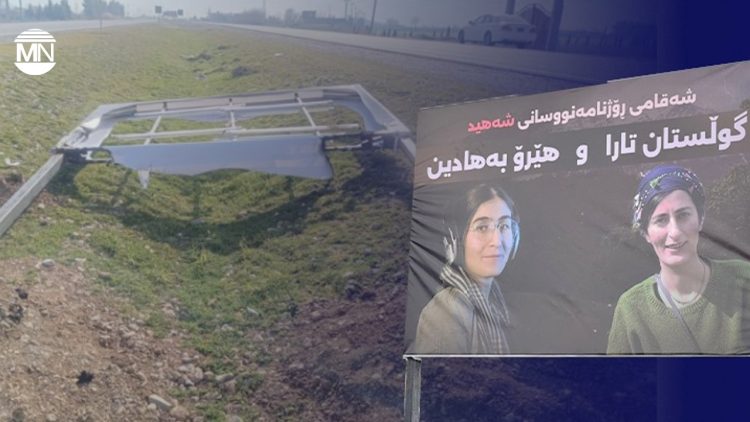
On the night of 11 February 2025, the portraits of two Kurdish women journalists, Gulîstan Tara and Hêro Bahadîn, were vandalised in Sayd Sadegh, Sulaymaniyah (Silêmanî), in the Kurdistan Region of Iraq (KRI). The destruction of their images, which had been erected in their memory, was attributed to agents allegedly connected with Turkish intelligence (MIT), according to Roj News Agency.
Tara and Bahadîn were tragically killed on 23 August 2024, when a Turkish drone strike targeted the area, resulting in their deaths. Their killing, along with others injured in the attack, shocked the Kurdish community and the wider journalistic world.
In the aftermath, local journalists and civil activists petitioned the regional governor to honour the two women by renaming the highway where they were killed and installing a memorial image at the site. The governor approved the request, and the highway was renamed in their memory. A ceremony, attended by journalists, civil activists, and members of the Chatr Press Company—where both Tara and Bahadîn had worked—commemorated their lives and work.
However, just months after the memorial was established, the portraits of Tara and Bahadîn were destroyed by suspected Turkish intelligence agents. This act of vandalism has sparked outrage, yet the mayor of Sayd Sadegh, Reza Ismail, has yet to respond publicly.
The Women Free Journalists of the KRI condemned the destruction, calling it a “fascist attempt to undermine the struggle of women in free press and communication.” They demanded that the perpetrators be held accountable and called on journalists—especially women—to unite in the face of such attacks, strengthening the fight for free media and the truth.
Zana Ali, a civil activist who had been involved in advocating for the memorial, also condemned the act. She urged security officials from the Kurdistan Regional Government to identify and bring the culprits to justice.
The destruction of the memorial serves as a stark reminder of the risks faced by journalists in the region. The Turkish government’s oppressive policies, compounded by the lack of sovereignty in Iraqi Kurdistan, continue to endanger both journalists and civilians, silencing voices of resistance and freedom of press.