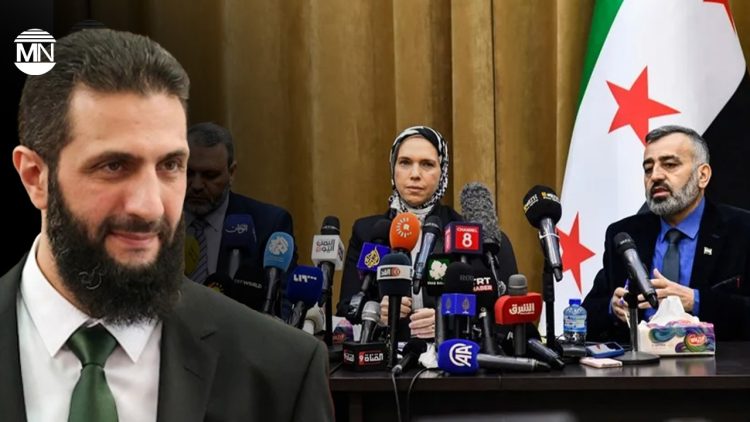
On 13 February 2025, the Syrian National Dialogue Preparatory Committee—comprising five men and two women under the leadership of Ahmed al-Sharaa (al-Julani), the former head of Hay’at Tahrir al-Sham (HTS)—announced its formation, vowing to shape Syria’s political future and draft a new constitution in the wake of Bashar al-Assad’s downfall.
In a statement published by SANA, the committee stressed its commitment to representing all segments of Syrian society across the country’s provinces, affirming its recognition of Syria’s socio-political diversity.
However, Hassan al-Daghim, spokesperson for the Preparatory Committee for National Dialogue, stated in a press conference in Damascus on 13 February that groups refusing to disarm and integrate into the Syrian Ministry of Defense—referring to the Democratic Autonomous Administration of North and East Syria (AANES) and the Syrian Democratic Forces (SDF)—could have no role in shaping the country’s political future.
“The principles of our revolution reject sectarian quotas. Diversity must be upheld so that Syrians of all ethnic, religious, and regional backgrounds see this conference as a true reflection of their society,” al-Daghim declared.
In response to the exclude of Kurdish and other northeastern Syrian representatives, Salih Muslim, a senior leader of the Democratic Union Party (PYD), asserted that the preparatory committee merely reflected a specific political agenda and had taken such a stance to gain the approval of certain foreign states. He stressed that this committee could not claim to represent the Syrian people as a whole.
Decentralised system best for new Syria, says AANES’s Ilham Ahmed
Kurdish front warns against Turkey’s interference in Syria amid ongoing dialogues with Damascus
In a separate statement, Salih Muslim reaffirmed that the Syrian Democratic Forces, the Syrian Democratic Council, and other institutions affiliated with the AANES were the legitimate representatives of the region’s residents. He underscored that if the preparatory committee failed to include northeastern Syria, its decisions would not be binding on its people.
Farhad Shami, spokesperson for the Syrian Democratic Forces, echoed this sentiment, stating:
“Any conference in Syria that excludes the Syrian Democratic Forces cannot be considered national or inclusive. Instead, it will merely reinforce the exclusionary and divisive policies of past governments, leading to further fragmentation and destruction.”
Muslim’s remarks appeared to allude to Turkey’s longstanding ties with Hay’at Tahrir al-Sham and its direct backing of Ahmed al-Sharaa. A Western diplomat specialising in Syrian affairs noted that the committee fell far short of inclusivity, pointing out that six of its seven members were Sunni Muslims, most of whom had close links to either al-Sharaa or HTS.