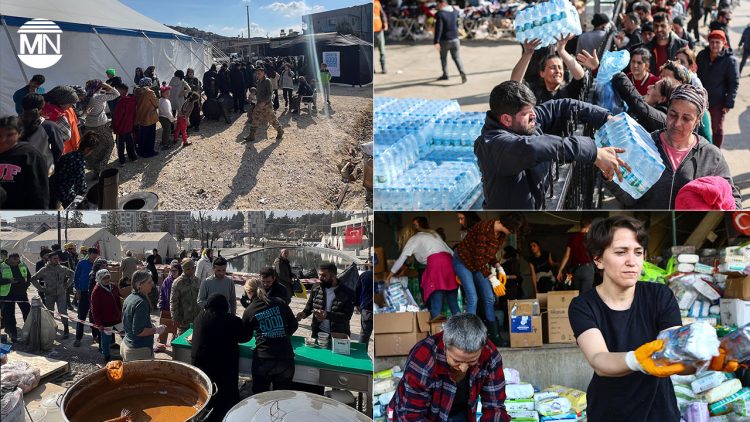
Nearly half of the survivors of the February 2023 earthquakes in Turkey still do not have regular access to food, and promised housing projects remain largely incomplete, according to a new report from the Turkish Medical Association (TTB) and the Union of Health and Social Service Workers (SES).
The report reveals that out of the 452,983 housing units promised by the Ministry of Environment, Urbanisation and Climate Change, only 201,580 have been delivered to rightful owners. This leaves thousands of families in precarious living conditions, with many lacking even basic kitchen facilities. “Only 44.3% of families have regular access to food,” the report states, while just 5.6% have a functioning kitchen.
Related Articles :
Broken lives and broken promises: between earthquakes and elections – a weekly news review
Two years after 6 February earthquakes: Survivors left in cold as government inaction persists
“The percentage of children consuming adequate vegetables and grains is critically low, with just 8% eating enough vegetables and 6.7% meeting grain intake standards.”
The nutritional situation for children is particularly alarming. In Adıyaman (Semsûr), 14.4% of children under five suffer from stunting, and only 13.7% of children aged 12-59 months consume enough milk. The report highlights, that only 8% of these children have adequate vegetable intake, and 6.7% consume sufficient grains.
“The mental health crisis remains a growing concern, with PTSD rates continuing to rise, and suicide attempts climbing sharply.”
Healthcare access has also deteriorated. In Hatay, 56 family health centres were destroyed, but only three have been rebuilt. As a result, over 105,000 people in Hatay and nearly 44,000 in Adıyaman lack family doctors. Mental health issues have surged, with Adıyaman reporting a 44.8% rate of post-traumatic stress disorder two months after the earthquake and 187 suicide attempts between November 2023 and 2024.
The education sector faces similar challenges. Student numbers have dropped sharply, with Hatay seeing a decrease of over 65,000 students across all levels. In Kahramanmaras (Mereş), construction worker deaths have quadrupled since 2020, reflecting unsafe working conditions in rebuilding efforts.
Air quality remains a concern. In Antakya, a district of Hatay, fine particulate matter levels were 2.8 times above World Health Organization guidelines throughout January 2025. “The WHO recommends exceeding these limits no more than 3-4 times a year, yet we’ve seen them surpassed for 19 consecutive days,” the report stated.