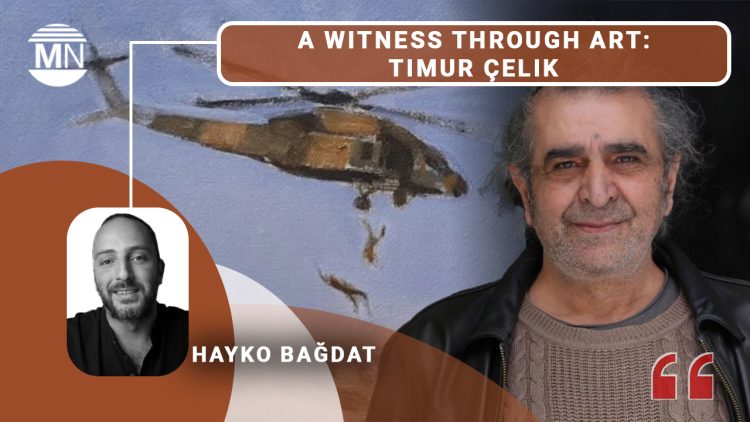
The artist Timur Çelik, who passed away on 16 January 2025, left a legacy of paintings “grounded in responsibility and realism“, in which he looked at the ongoing sociopolitical climate in Turkey.
As the Medya News community, we commemorate Çelik, his loved ones, and his family, honouring his courage and artistic resistance. We also owe him a debt of gratitude, as his powerful painting became a vital testimony in our reporting on this crime against humanity.
In this deeply moving tribute, his friend Hayko Bağdat remembers a fearless artist—one who saw, painted, and refused to look away. His legacy will endure, etched into history with every stroke that bore witness to the truth.
The translated article follows:
Hayko Bağdat
This was an artist outpacing journalists and photo reporters with his work. This was an artist bearing witness. This was Timur’s intervention against the murder of two Kurdish villagers. This was about tearing down the dark curtain of the state. Timur took this news more personally than any of us.
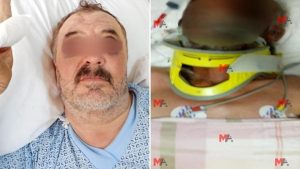
We were stunned when the news arrived from the Kurdish media. On 11 September 2020, Turkish soldiers conducting an operation in Çatak (Şax), Van (Wan), detained two agricultural workers—Servet Turgut (55), a father of seven, and Osman Şiban (50), a father of eight. The two men were subjected to severe torture in the village square in front of numerous soldiers before being loaded into a Skorsky military helicopter. Their families found them two days later in the intensive care unit of Van Regional Training and Research Hospital. It was then revealed that the soldiers had thrown them from the helicopter.
It was a relatively warm September day in Berlin when we received the news. Timur took it harder than any of us. The horrors of the 1990s—the state’s bloody policies against the Kurdish people, the intellectuals and journalists assassinated in broad daylight, the Saturday Mothers still searching for their children’s remains—had never faded from memory.
Once again, the state had revealed its darkest, most brazen, most merciless face. Just like in the 1990s, those who exposed the crime faced immediate repercussions. Threats, arrests, detentions, raids on newspaper offices, bullets aimed at newspaper distributors.
The then-Minister of the Interior, Süleyman Soylu, mobilised all his power to cover up the murder. Witnesses and prosecutors were pressured, and only a handful of journalists kept the story alive, while even opposition media remained silent.
But no one had accounted for another witness, one thousands of kilometres away. Timur took this news more personally than any of us.
It was one of our usual conversations, where we summarised the day’s events for each other. He was speaking hurriedly on the phone, cutting the conversation short with a simple:
“Let’s end it here.”
I don’t remember how much time passed, but then he called me again.
“Check my Instagram account—I’ve painted something new.”
Timur had seen through the state’s efforts to cover up the murder. He had bypassed the darkness cast over the crime scene, the police, the prosecutors, the soldiers, the barricades.
He had seen what happened.
He had painted the crime—the way the villagers were thrown, the helicopter, the villagers, the sky, the earth, the murderer.
Despite all the state’s efforts, the news reached the public. Both the Turkish and international press made it headline news. Global news agencies used Timur’s painting—”Villagers Thrown from the Helicopter”—as the sole visual representation of the event.
After being discharged from the hospital, Osman Şiban was detained again. Later, he too lost his life.
The journalists who broke the story—Adnan Bilen and Cemil Uğur of Mezopotamya Agency (MA), JinNews journalist Şehriban Abi, and journalist Nazan Sala—were arrested. MA reporter Zeynep Durgut was prosecuted but released. They were all eventually acquitted.
This was an artist outpacing journalists and photo reporters with his work.
This was an artist bearing witness.
This was Timur’s intervention against the murder of two Kurdish villagers.
This was about tearing down the dark curtain of the state.
Timur took this news more personally than any of us.
With every brushstroke, he narrated another grief, another struggle, another resistance.
He saw, he told, he bore witness to the truth.
He left his mark on history so that the future could see today.
Timur was the bravest, funniest, most brilliant, most wonderful person I have ever known.
Now, both he and his works belong to eternity.
We are grateful to you, Timur Çelik, for all that you saw, witnessed, and painted.
We are glad that you lived.
Timur’s funeral will take place on Thursday, 13 February, at 10:00 AM in Berlin.