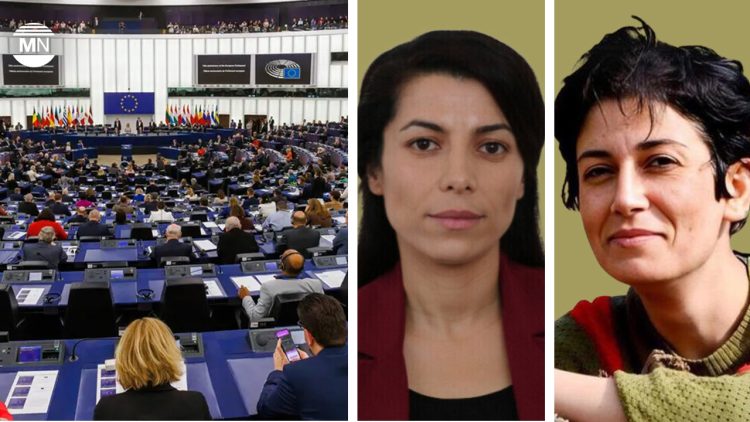
The European Parliament has passed a pivotal resolution demanding the immediate annulment of the death sentences for Pakhshan Azizi and Warisheh Moradi, while unequivocally condemning the systematic human rights violations in Iran. The resolution, passed on Thursday, also called for targeted sanctions against Iran’s Supreme Leader Ali Khamenei, President Masoud Pezeshkian and senior judicial officials, and urged the designation of the Islamic Revolutionary Guard Corps (IRGC) as a terrorist entity. With an overwhelming majority of 556 votes in favour, six against, and 42 abstentions, the resolution highlights the urgent need to end Iran’s use of hostage diplomacy and halt the execution of these unjust death sentences.
The resolution further emphasises that, given Iran’s longstanding history of human rights abuses and previous European Parliament resolutions, the execution of political prisoners – particularly those involved in uprisings – has significantly worsened since the Jin, Jiyan, Azadi (Woman, Life, Freedom) movement.
The second paragraph notes that both Azizi and Moradi fought ISIS in Kurdistan, but have been sentenced to death for “armed rebellion against the government”. It also notes that their trials were marked by the denial of a fair hearing, torture and prolonged solitary confinement.
With Azizi’s death sentence, confirmed in January 2025, and in light of Iran’s use of hostage diplomacy and continued human rights violations – especially targeting women – the European Parliament has demanded the immediate and unconditional release of all political prisoners, including Azizi, Moradi and 56 others.
The resolution further expresses solidarity with human rights defenders and the Jin, Jiyan, Azadi movement, urging Iran to end its systemic repression of minorities, including Kurds, Baluchis, Christians and Baha’is. It also calls for the safe return of EU nationals such as Olivier Grondeau, Cécile Kohler, Jacques Paris and Ahmadreza Djalali, and for all charges against them to be dropped.
It “strongly condemns the murder of [Iranian-German citizen] Jamshid Sharmahd”, demanding that Iran return his body to his family and disclose the full details surrounding his death.
One of the key elements of the resolution calls for the designation of Iran’s Islamic Revolutionary Guard Corps (IRGC) as a terrorist organisation. It also supports the imposition of sanctions on high-ranking Iranian officials, including Ali Khamenei and Pezeshkian. Additionally, the resolution targets key judicial figures responsible for the death sentence of Pakhshan Azizi, including Gholamhossein Mohseni Ezheyie, head of Iran’s judiciary, Mohammad Movahedi, the country’s attorney general, and Judge Iman Afshari, the judge who issued the death sentence.
Finally, the resolution calls for increased financial support for Iranian civil society, highlighting the EU’s commitment to countering the regime’s repression and advancing human rights.
Iran experts believe that the leak of a statement by Narges Mohammadi, just before the European Union’s meeting condemning Iran, played a key role in shaping the resolution. Mohammadi, a Nobel laureate, joined the French Senate’s Women’s Rights Commission via video conference and condemned the Islamic Republic’s retaliation against women following the killing of Jina Mahsa Amini.
She voiced deep concern over the rising numbers of executions in Iran, particularly the death sentences of Azizi and Moradi, and revealed that gallows have been set up in Iranian prisons. Mohammadi urged the French Senate to take decisive action and recognise gender apartheid as a criminal offence.